Student Loan Payoff Time Calculator
Estimate student loan payoff months, total interest, extra payment savings, and target payment gap with JSCalc-Blog.com.
Used to calculate the payment gap for your desired finish date.
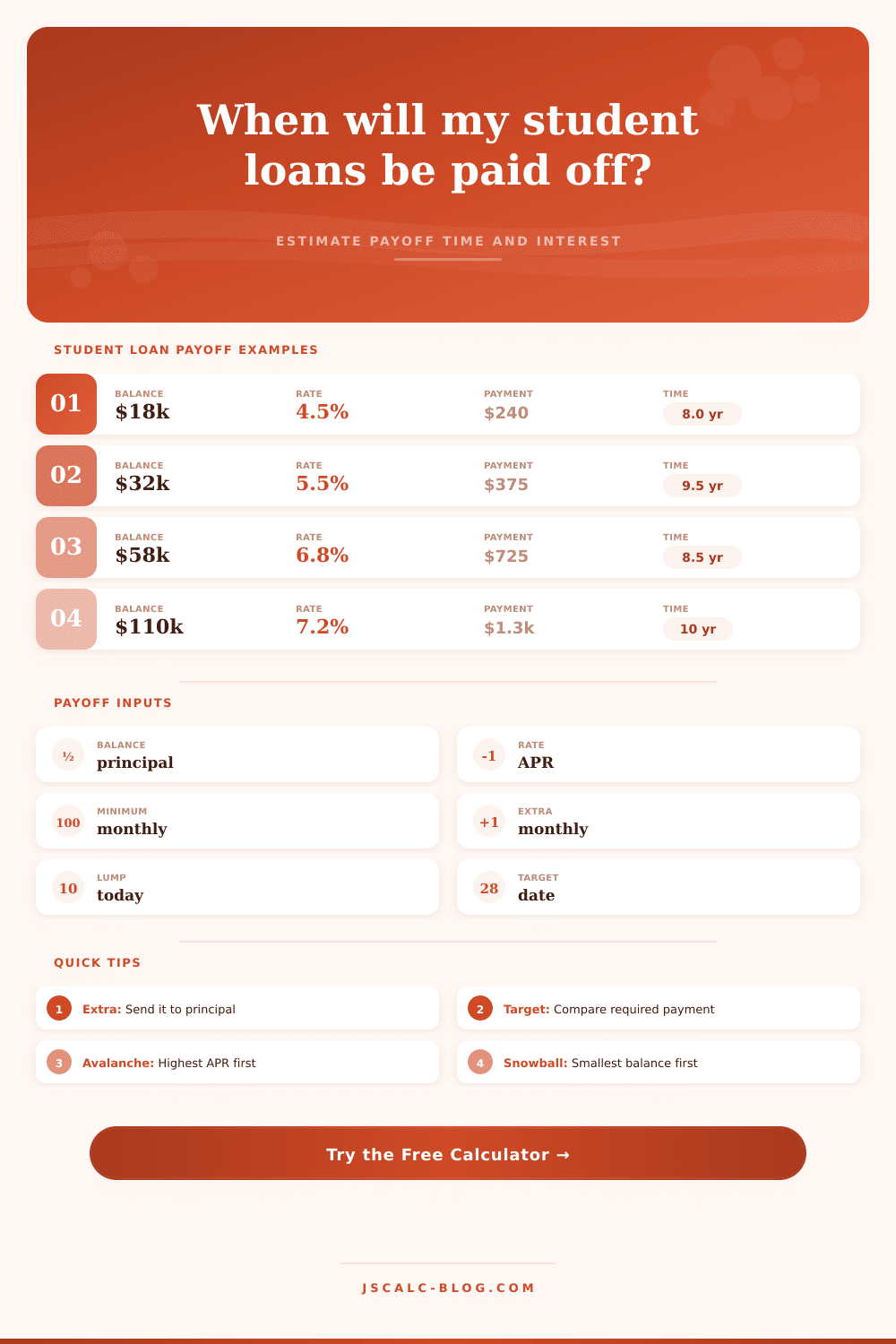
Enter up to three loan groups. The calculator compares highest-rate avalanche, smallest-balance snowball, and blended balance payoff timing.
| Loan Group | Balance ($) | APR (%) | Minimum ($/mo) | Type |
|---|---|---|---|---|
| Federal Subsidized | Undergraduate | |||
| Federal Unsubsidized | Undergraduate | |||
| Grad PLUS or Private | Graduate/private |
| Scenario | Balance | APR | Monthly Pay | Payoff Time | Total Interest |
|---|---|---|---|---|---|
| Small undergraduate balance | $12,000 | 4.50% | $150 | 7.8 years | $2,050 |
| Typical bachelor degree debt | $30,000 | 5.50% | $326 | 10.0 years | $9,100 |
| Extra $100 monthly | $30,000 | 5.50% | $426 | 6.9 years | $6,000 |
| Parent PLUS higher rate | $45,000 | 8.05% | $550 | 10.6 years | $24,700 |
| Graduate Stafford mix | $65,000 | 6.80% | $750 | 9.7 years | $22,000 |
| MBA refinance schedule | $88,000 | 5.95% | $1,250 | 7.5 years | $24,300 |
| Law school high balance | $140,000 | 7.20% | $1,650 | 10.7 years | $70,300 |
| Aggressive two-year push | $28,000 | 5.25% | $1,230 | 2.0 years | $1,600 |
| Loan Type | Typical APR Pattern | Interest Subsidy | Payoff Note |
|---|---|---|---|
| Federal subsidized undergraduate | Lower fixed federal rate | Possible while in school | Often a lower avalanche priority |
| Federal unsubsidized undergraduate | Fixed federal rate | No subsidy after disbursement | Interest accrues during deferment |
| Federal graduate unsubsidized | Higher fixed federal rate | No subsidy | Review interest before capitalizing |
| Grad PLUS | Often highest federal rate | No subsidy | Common avalanche target |
| Parent PLUS | Higher fixed federal rate | No subsidy | Minimums can run long |
| Private refinance | Fixed or variable | No federal protections | Compare payoff speed and flexibility |
| Starting Balance | APR | Base Payment | Extra Payment | Approx Months Saved |
|---|---|---|---|---|
| $20,000 | 5.00% | $212 | $50 | 25 months |
| $30,000 | 5.50% | $326 | $100 | 37 months |
| $45,000 | 6.25% | $505 | $150 | 36 months |
| $65,000 | 6.80% | $748 | $250 | 39 months |
| $90,000 | 7.00% | $1,045 | $400 | 43 months |
| $125,000 | 7.50% | $1,484 | $600 | 44 months |
| Calculation | Formula | When It Applies | Result Meaning |
|---|---|---|---|
| Fixed payment payoff months | -ln(1 - rP/M) / ln(1 + r) | Payment exceeds monthly interest | Months until balance reaches zero |
| Zero interest payoff months | P / M | APR is 0% | Principal divided by payment |
| Monthly interest | P x APR / 12 | First month estimate | Amount before principal reduction |
| Required target payment | rP / (1 - (1 + r)^-n) | Known target month count | Monthly payment needed by date |
| Avalanche simulation | Extra to highest APR | Multiple loan groups | Interest-minimizing payoff order |
| Snowball simulation | Extra to smallest balance | Multiple loan groups | Balance-clearing payoff order |
There’s something about numbers that makes student loans seem abstract. How long will this take? Does this extra hundred dollars per month make a difference? How much are you realy saving? Who knows? Most grads just know they’re supposed to pay it back eventually; and that the number they owe look big.
Before you can start chipping away at it, interest has already been silently eating away at principal. It compounds with unforgiving math. Your payments don’t go toward the principal until after the interest have been paid.
Student Loan Calculator Guide
This calculator compares the “avalanche” and “snowball” methods. It also shows your estimated payoff month, interest, extra payments, and how much you are missing your target date by. It removes the guessing from what is naturaly a confusing problem.
First, plug in total amount of all your existing balances. Also, plug in your weighted average annual interest rate. This average is important because most people has various loans with different rates based off their year of schooling. If your lowest rate is all that matters to you, chances are you’re underestimating your overall expense.
You can split this out into custom buckets if you wish to run a simulation of the “snowball” vs. “avalanche” strategy: Attack the smaller balances for quick psychological wins (the snowball), OR attack the highest-APR debts first (the avalanche). Both strategies makes sense. Mathematically speaking, the avalanche approach save you the most money. The snowball approach helps you stay motivated, especially when the finish line seem miles away. It’s not a matter of being right; it’s a matter of staying consistent.
After plugging in your minimum needed payment, the calculator presents baseline scenario, aka the gloomy picture of what happens when you don’t change anything at all. What’s the projected payoff date? How much interest will you be forced to shell out? That number there is typically part that shocks people: it’s the price tag of financing something for a decade (or longer) instead of using cash. It’s the interest rate premium you’ll pay.
Then you toss in an extra principal payment each month. This is where the calculator really shines. Even a modest sum, say, one hundred or even fifty bucks, can knock years off the clock. You save not just time but thousands of dollars in interest that stays in your pocket instead of flowing to the bank. The table on the same page make this clear, explaining how minor hikes in monthly payments drastically reduce overall cost.
It has a target date function, as well. Plug in the date you want to achieve a financial goal (e.g., buy a house in three years), and the tool spits out the difference between your current payment and payment needed to reach your goal. That’s powerful when you’re reverse-engineering your budget. Rather than guessing whether or not you’re doing enough, you now know exactly how much more you must pay per month to achieve your goal. Adjust the payment up or down until it fits your comfort level. You go from vague desire to concrete plan.
By the way: most people don’t realize that they’re paying interest on the unpaid portion. Interest charges decreases as the unpaid balance decreases. Most of your payment in the initial years of a loan is interest; later, the reverse happen and you pay off principal. When you accelerate payments, it moves to an earlier date, which means more of your payment is reducing debt instead of enriching the lender.
The sooner you apply a lump sum, the better, because it’s worth more then if it were applied five years from now. You should of accelerated sooner. The calculator assumes this (adjusts the outstanding balance accordingly) and recalculate the new schedule.
In conclusion, getting rid of your student debt requires more of a marathon than a sprint, but it also require you to adjust the pace. And yes, the tools to see the finish line are there. You simply need to determine your desired pace (how quickly do you want this paid down?) and what you’re willing to forego in order to achieve that goal. The math speaks for itself, but it needs your input to speak the truth.