Student Loan Payment Calculator
Estimate monthly student loan payments, grace or deferment interest, fees, payoff timing, and total interest with the standard amortization formula.
Enter total principal across the loans you want to model.
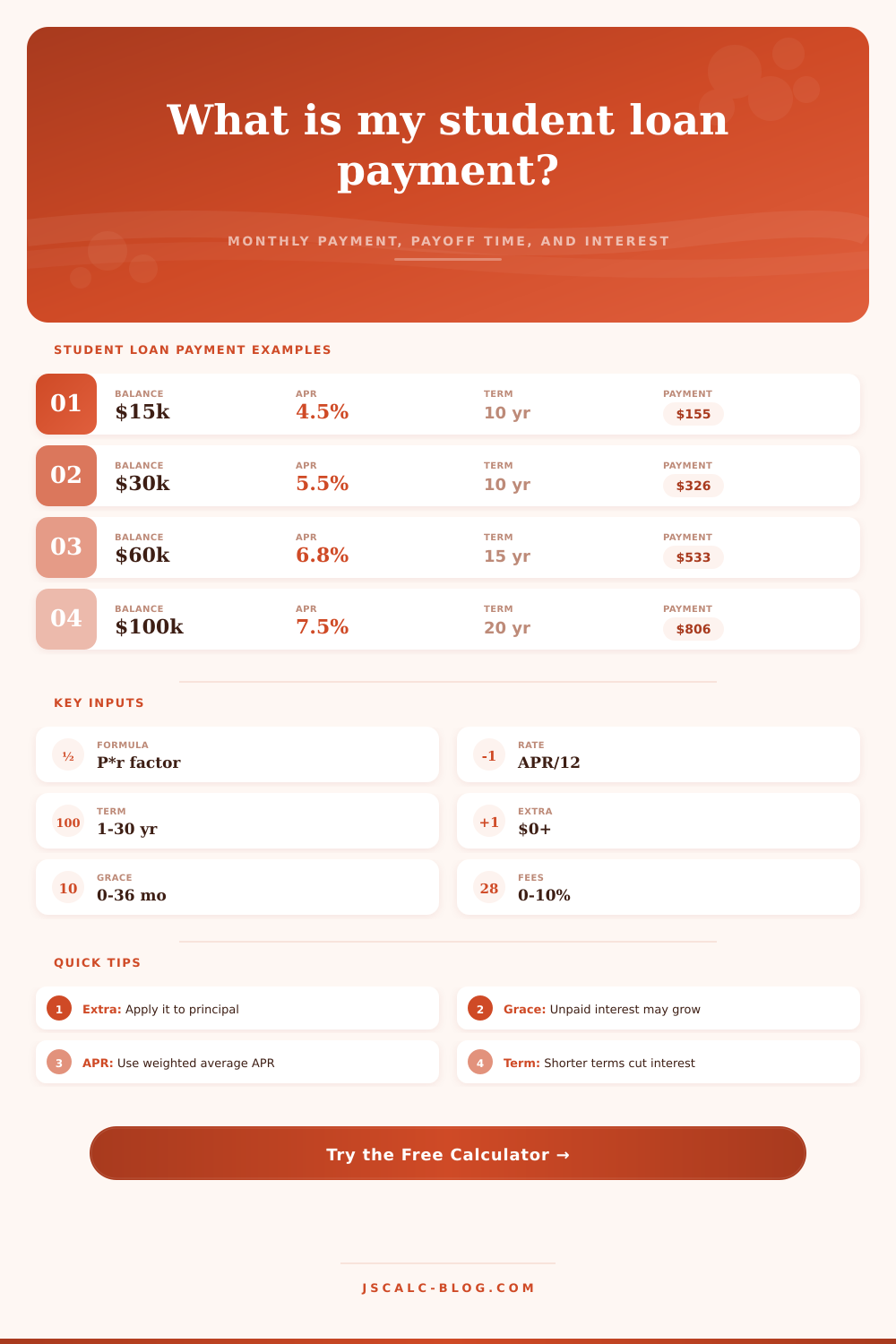
Monthly rate is APR divided by 12.
Student Loan Payment Results
| Plan Type | Typical Term | Payment Shape | Interest Pattern | Best Used For | Calculator Treatment |
|---|---|---|---|---|---|
| Level selected term | 1 to 30 years | Same every month | Falls as principal falls | Predictable payoff | Exact amortized payment |
| Extended level | 25 years | Lower than 10-year | Higher lifetime interest | Large balances needing room | Exact 300-month amortization |
| Graduated estimate | Selected term | Starts lower, rises | More interest early | Expected income growth | Simulated stepped payments |
| Accelerated payoff | Shorter than selected | 15% above level | Lower lifetime interest | Borrowers with surplus cash flow | Level payment times 1.15 |
| Income-linked 10% | Up to 20 years | Income-based estimate | Can grow if payment is low | Cash-flow stress testing | 10% of discretionary monthly income |
| Income-linked 15% | Up to 25 years | Income-based estimate | Often more than 10% option | Higher income share comparison | 15% of discretionary monthly income |
| Interest-first grace | Selected term | Pays accruing interest first | Less capitalized interest | Deferment planning | Adds estimated interest paid in grace |
| Zero-interest loan | Selected term | Principal divided by months | No interest charge | Family or employer loan modeling | Uses P divided by n |
| APR | 5-Year Payment | 10-Year Payment | 15-Year Payment | 20-Year Payment | 10-Year Interest |
|---|---|---|---|---|---|
| 0.00% | $500 | $250 | $167 | $125 | $0 |
| 3.50% | $546 | $297 | $214 | $174 | $5,596 |
| 4.50% | $559 | $311 | $230 | $190 | $7,321 |
| 5.50% | $573 | $326 | $245 | $206 | $9,069 |
| 6.50% | $587 | $341 | $261 | $224 | $10,871 |
| 7.50% | $601 | $356 | $278 | $242 | $12,733 |
| 8.50% | $615 | $372 | $295 | $260 | $14,666 |
| 9.50% | $630 | $388 | $313 | $280 | $16,680 |
| Balance | APR | 3 Months | 6 Months | 12 Months | Monthly Interest |
|---|---|---|---|---|---|
| $10,000 | 4.50% | $113 | $226 | $460 | $38 |
| $20,000 | 5.50% | $276 | $555 | $1,129 | $92 |
| $30,000 | 6.50% | $489 | $985 | $2,001 | $163 |
| $50,000 | 7.00% | $879 | $1,773 | $3,609 | $292 |
| $75,000 | 7.50% | $1,414 | $2,854 | $5,816 | $469 |
| $100,000 | 8.00% | $2,013 | $4,067 | $8,300 | $667 |
| Extra Monthly | Total Monthly | Payoff Time | Total Interest | Interest Saved | Months Saved |
|---|---|---|---|---|---|
| $0 | $444 | 120 months | $13,290 | $0 | 0 |
| $25 | $469 | 112 months | $12,239 | $1,051 | 8 |
| $50 | $494 | 105 months | $11,356 | $1,934 | 15 |
| $100 | $544 | 93 months | $9,934 | $3,356 | 27 |
| $200 | $644 | 75 months | $7,746 | $5,544 | 45 |
| $400 | $844 | 55 months | $5,283 | $8,007 | 65 |
| Symbol | Meaning | Calculator Source | Formula Role | Zero-Interest Handling |
|---|---|---|---|---|
| P | Repayment principal | Balance plus fees and capitalized interest | Starting amount amortized | Still divided across term |
| r | Monthly rate | APR divided by 100 then 12 | Interest portion of payment | Set to 0 when APR is 0 |
| n | Number of payments | Repayment term in months | Exponent in payment factor | Principal divided by n |
| M | Monthly payment | Calculated result card | P*r*(1+r)^n / ((1+r)^n - 1) | P / n |
| Extra | Added principal | Extra monthly payment input | Used in payoff simulation | Reduces months owed |
| Grace interest | Interest before repayment | Grace/deferment months input | May increase repayment balance | 0 when APR is 0 |
This calculator uses amortized payment math for planning estimates. Income-linked entries are scenario estimates, not a determination of eligibility or official repayment-program terms.
Student loan payment calculator by JSCalc-Blog.com
When students graduate, most carry away a fuzzy impression of their debt; few possess any idea about what kind of cash-flow is needed each month to eliminate that debt. They recieve the university’s bill, which shows the principal amount, but it rarely include details on how interest builds up while you’re delaying payments. They also don’t realize that an extra $50 could shorten your repayment schedule by as much as two years.
Once the math goes beyond numbers, it transforms into a tool for strategy: It turns “paying down debt” from a passive action to one that controls time, interest, and human psychology. What matter are the inputs, especially the grace period treatment.
How to Control Your Student Loan Debt
For many borrowers, not making payments = nothing bad happens. Here is the truth. You’re accruing interest (on both federal unsubsidized loans, and all private loan) when you’re in school/residency. And if you don’t pay that interest while in school/residency, it capitalizes. Meaning it adds it to your principle balance, which means now you’ll be paying interest on the interest.
Toggle this setting on the calculator above, and it’ll do the math for you. It’ll show you just how much your starting balance increases before you’ve even made your first real payment. It is a little thing, but it is important for long-term cost.
The other variable here is the term length… And the term length determines the total amount of interest you’ll pay once you enter the repayment phase. For example, when you think of a fixed 10 year standard plan, it sounds more secure (you know exactly how much you’re paying each month). But if you take 15 or even 20 years, you reduce your current monthly payment by thousands. However, you also end up paying thousands of dollars more in interest.
This is spelled out in the reference table on the page. It shows that if interest rates go up, a longer-term commitment can result in nearly twice as much money owed throughout the lifetime of your loan. So do you prefer a reduced payment today? Or do you prefer early financial freedom? There’s no correct choice here. It is just a trade-off.
The secret weapon is extra payments on student loans. The majority of folks think about paying only enough to keep their loans at status quo, enough to keep the balance stable. That won’t get them out of debt any faster. It won’t help them.
If they add an additional, regular amount toward principal each month, it completely alters the payoff schedule. They’ll pay down their balance faster, resulting in less interest paid the next month…which means they can allocate even more of the upcoming payment toward principal. It’s a compounding effect in reverse.
You don’t have to throw thousands into your debt payoff! A steady $50 or $100 goes a long way and can cut years off a ten-year loan. The catch is that you want to be sure to specifically designate your extra payment as “principal” rather than letting the servicer put it toward fees or future interest. Some companies will do this if you simply over-pay without specifying.
Here is where income-driven repayment plans alter the game. They peg your payment as a percentage of discretionary income, and that can be a life-saver in a lean month. But they tend to stretch out the time-frame (often to 20 or 25 years). And the calculator estimates what those payments will look like if you pay ten or fifteen percent of your discretionary income.
This is good for stress testing. Does your income drop? Can you still afford the minimum? Does your income rise? Does the payment spike high enough to make you stop and think?
Income-driven repayment plans aren’t about saving you money. Unless you’re eligible for forgiveness, they are an insurance policy against default.
Now for the trade-offs with private loans. Lower rates up-front? Sure. More lenient repayment terms different than with federal aid? Probably not. If you refinance at a better rate, you lose federal protections, which means you’ll need to consider whether or not those savings outweigh being locked out of that flexibility. To do so, the calculator will let you model out a scenario with a hypothetical refinanced rate vs. This is the weighted average APR of your existing mix, including both federal and private loans. Then you can see how each compares.
It’s about making things clearer. Debt is frighteningly abstract. It becomes concrete when put into numbers. You can see that paying an extra fifty bucks each month saves you many months. You might also realize that your loan builds up so much interest over a year of deferment. That’s when it stops being about fear, and turns back into math.
The loan isn’t something meant to punish; it’s just another financial product, with explicit terms. That change in mindset is typically what leads people to payoff. They go from feeling like they’re at the mercy of the bill to feeling like they have the bill under control.