Student Loan Amount Needed Calculator
Estimate your remaining school funding gap, origination fee gross-up, federal cap room, and expected unsubsidized interest with JSCalc-Blog.com.
Student loan planning result
| Borrower profile | Typical annual direct loan cap | Aggregate direct loan cap | PLUS availability | Calculator use |
|---|---|---|---|---|
| Dependent undergraduate first year | $5,500, with subsidized portion limited by need | $31,000 total direct loans | Parent PLUS may cover eligible remaining COA | Use freshman cap unless school confirms more room |
| Dependent undergraduate second year | $6,500, with subsidized portion limited by need | $31,000 total direct loans | Parent PLUS may cover eligible remaining COA | Use sophomore cap for a one-year plan |
| Dependent undergraduate third year or later | $7,500, with subsidized portion limited by need | $31,000 total direct loans | Parent PLUS may cover eligible remaining COA | Use this for junior and senior years |
| Independent undergraduate first year | $9,500, with subsidized portion limited by need | $57,500 total direct loans | Private or other aid may cover extra gaps | Edit annual cap when year level differs |
| Independent undergraduate third year or later | $12,500, with subsidized portion limited by need | $57,500 total direct loans | Private or other aid may cover extra gaps | Use for dependency override or independent status |
| Graduate Direct Unsubsidized | $20,500 for many programs | $138,500 combined undergraduate and graduate direct loans | Grad PLUS may cover eligible remaining COA | Use before considering Grad PLUS |
| Graduate PLUS | Up to certified COA minus other aid | No direct aggregate cap, credit rules apply | Primary PLUS option for graduate borrowers | Set cap to remaining certified attendance gap |
| Parent PLUS | Up to certified COA minus other aid | No direct aggregate cap, credit rules apply | Parent borrower is responsible for repayment | Use after student direct loan eligibility |
| Planning case | Annual COA | Annual grants and scholarships | Family, savings, and earnings | Terms remaining | Common loan planning issue |
|---|---|---|---|---|---|
| Community college transfer | $16,000 to $23,000 | Pell, state grant, transfer scholarship | Part-time earnings often reduce the gap | 4 to 6 semesters | Credit transfer timing changes semesters remaining |
| In-state freshman dorm year | $27,000 to $36,000 | Need grant, merit award, housing grant | Family monthly payment plus summer savings | 2 semesters for first-year award | Freshman direct loan cap is often below the bill gap |
| Commuter sophomore | $18,000 to $28,000 | Renewed merit scholarship and state aid | Work earnings can replace some borrowing | 2 semesters | Transport and parking are easy to understate |
| Junior apartment year | $31,000 to $43,000 | Department award, need grant | Lease deposit may require one-time savings | 4 semesters | Off-campus housing bills do not always align with aid |
| Senior capstone year | $29,000 to $44,000 | Smaller remaining scholarship pool | Internship earnings may arrive after tuition due date | 2 semesters | Graduation, licensure, and project fees add late costs |
| Independent undergraduate finish | $24,000 to $38,000 | Federal and state need aid | Higher work earnings but less family support | 2 to 4 semesters | Aggregate loan room can be tighter than annual room |
| Two-year master's program | $38,000 to $72,000 | Assistantship, fellowship, employer benefit | Cash flow may vary by summer term | 4 to 6 semesters | Direct Unsubsidized limit may require Grad PLUS |
| Parent PLUS one-year plan | $30,000 to $58,000 | Student grants and scholarships first | Family payment plan reduces parent borrowing | 2 semesters | Parent fee and interest rate can materially raise balance |
| Funding source | Reduces loan amount? | Typical timing | Risk to check | Calculator entry |
|---|---|---|---|---|
| Federal Pell Grant | Yes, dollar for dollar | Posted by semester after enrollment confirmation | Enrollment intensity can reduce the award | Annual grants from FAFSA or school aid |
| Institutional merit scholarship | Yes, if renewable and accepted | Usually split evenly across terms | GPA or credit completion requirement | Annual outside and institutional scholarships |
| Outside scholarship | Yes, after school applies it | May arrive after the first bill date | Could reduce need-based aid package | Annual scholarships or one-time savings if not renewable |
| 529 plan withdrawal | Yes, when used for qualified education expenses | Parent or student requests distribution | Timing must match tax year and bill date | Total 529, savings, prepaid tuition, or one-time payment |
| Work-study award | Only when wages are earned and applied | Paycheck over the term, not bill credit upfront | Hours may be lower than the award amount | Annual work-study or term earnings applied to school |
| Family payment plan | Yes, if paid during the academic year | Monthly installments before or during term | Missed installments can become a registration hold | Annual family contribution paid directly |
| Loan category | Origination fee treatment | Interest during school | Cap check | Best input practice |
|---|---|---|---|---|
| Direct Subsidized | Same fee gross-up method as direct loans | Government generally covers in-school interest | Within annual and aggregate direct caps | Set unpaid interest rate to 0 for subsidized portion |
| Direct Unsubsidized undergraduate | Borrowed amount is reduced by fee before disbursement | Interest accrues from disbursement | Annual and aggregate caps both matter | Use award letter rate and remaining cap room |
| Direct Unsubsidized graduate | Borrowed amount is reduced by fee before disbursement | Interest accrues from disbursement | $20,500 annual cap for many borrowers | Run this before estimating Grad PLUS |
| Graduate PLUS | Higher federal origination fee usually applies | Interest accrues from disbursement | Certified COA minus other aid | Use only the gap after Direct Unsubsidized |
| Parent PLUS | Higher federal origination fee usually applies | Interest accrues from disbursement | Certified COA minus student aid | Confirm parent borrower and repayment start choice |
| Private student loan | Fee may be zero or lender-specific | Interest rules vary by lender and deferment option | School certification and credit approval apply | Enter actual lender APR, fee, and approved amount |
Loan amount needed = total cost of attendance - grants - scholarships - family contribution - savings - work-study or earnings
Amount to borrow = net amount needed / (1 - origination fee rate)
Remaining borrowing room = min(annual cap x semesters remaining / 2, aggregate remaining cap)
Expected in-school interest = gross borrowed amount x annual interest rate x average years outstanding x unpaid interest share
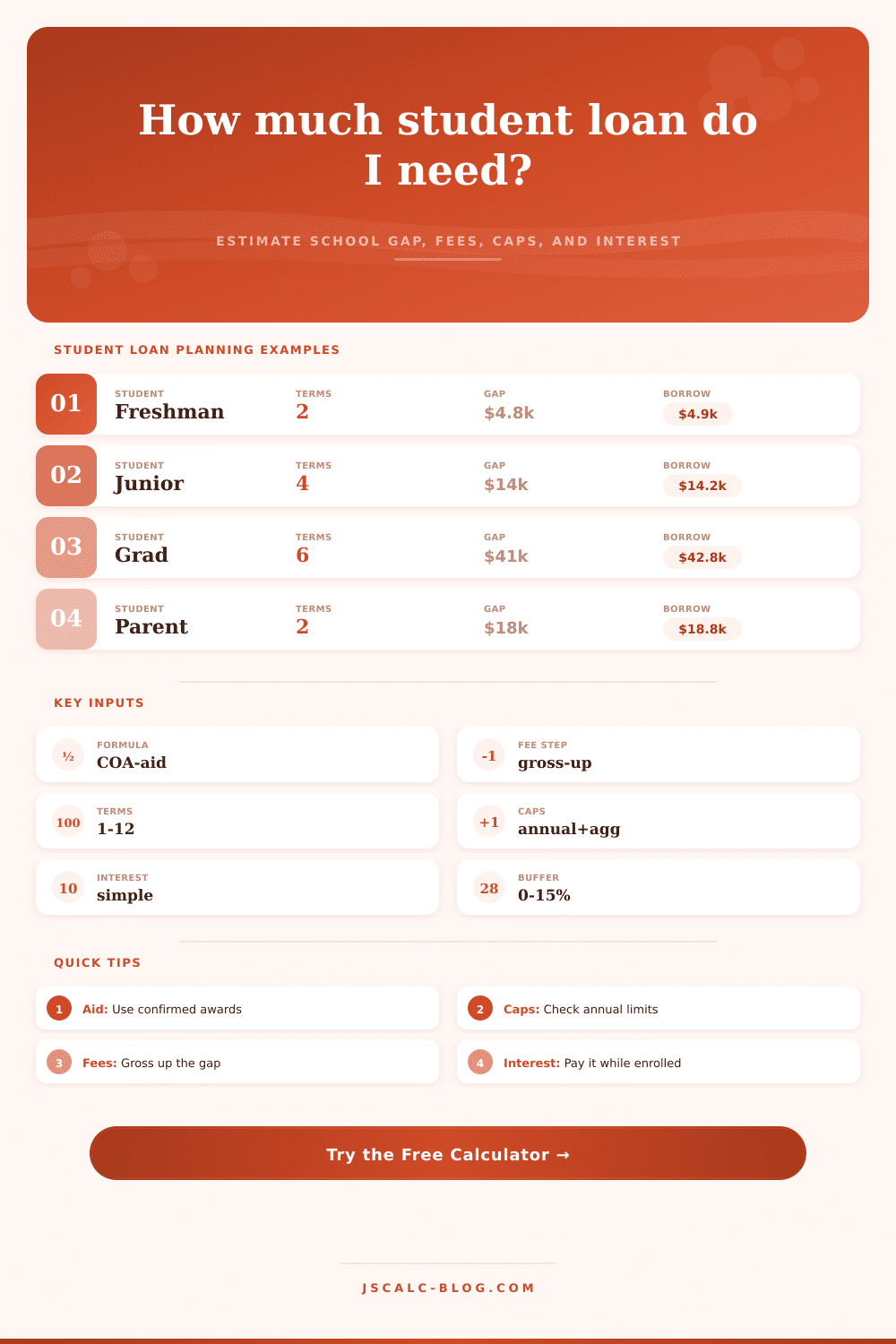
The calculator applies cost growth by academic year, spreads annual items across semesters, subtracts one-time savings once, adds the emergency buffer to attendance costs, then compares the gross loan request with both annual and aggregate borrowing limits.
Then comes the financial aid letter. The math gets fuzzy. There’s a total cost of attendance which appears reasonable enough. There are scholarships and grants which appear large enough. So you see the difference, which looks smaller, and want to cover it with a loan. This is where things get dicey.
It is rare, very rare, that the figure on the initial page is what you’ll end up borrowing. That figure need to be adjusted down to reflect fees, which shrink your disbursement. You also need to account for interest, which builds up during your education and limits on how much you can borrow from federal lenders. Make a mistake here and you could find yourself out-of-cash in February. Or worse, you could graduate with more debt then necessary.
How to Calculate Your Student Loan Needs Correctly
First, get an accurate read on cost of attendance. This includes tuition, room and board, books and miscellaneous living expenses. That last one, personal expenses… Is where people mess up. They think that they will cover it all with the allowance: things like going home on weekends or buying a new laptop. Get real about how much money you’ll have to drop out of your part time job or pocket. Enter your exact numbers for food and housing and let the calculator do the math for you. No more guesswork on conversions and coefficients here!
Subtract the confirmed amount of family contribution, scholarships and grants. Voila: This is your net number. This is your baseline. This is how much actual cash you must pony up to send the check to the school.
And this is where the origination fee comes into play. When you apply for federal student loans, they don’t pay out every penny of what you ask for. A portion gets withheld upfront in order to cover administrative costs. Let’s say you want to use $4,000 to fill your gap. That means borrowing exactly $4,000 will leave you short. But once the fee is taken out, you won’t end up with quite that much. The school will be paid something less than the full amount. So you should of ask for more. Ask for enough that when the money gets paid out there is no surprise shortage in your student account. If you ignore this math, the payment could leave you with less money than you expected.
But there are also caps. And unlike tuition costs, federal law have strict caps on how much a dependent undergraduate can take out per year. Maybe you have an eight-thousand-dollar gap as a first-year student. But the annual cap is just five thousand. That’s where the tool comes in: It checks your borrowing profile for compliance with those caps. Did you hit your max? It says so. Have you got a shortfall once it takes into account the caps? The calculator will tell you.
Know what this means? You’ll need to explore other options, such as a private lender, a Parent Plus loan, or even a call to your financial aid office to ask for a review of your situation. That’s a warning sign. Don’t blow it off. It will be the difference between a registration hold and a payment plan you can manage.
Another big item is interest. For undergrads, subsidized loans help, the government covers the interest during school. Graduate loans (and unsubsidized loans) aren’t protected from this fate. As soon as they disburse, the interest begin to accrue. If you don’t pay the interest while in school, it will be added to your principal. That’s a fancy word for “get added onto your principal.” When you graduate, you’ll be paying interest on your old interest. This is a compounding penalty for doing nothing. Adjust the interest payment percentage in the tool to see how it models out. When you see the estimated in-school interest tacked onto your balance, its a sobering experience. It makes you think about the trade-off between short-term cash flow vs. Long-term debt load.
Your education timeline will also affect the math. If you’re a freshman just beginning school, your borrowing constraints will be different than those of a transfer student with only two years left. But if you’re a transfer student who has only two years left before finishing, you face different borrowing constraint. As you near graduation, it’s the total that matters. Sure, maybe you still have lots of room within your annual limit, but what about your total borrowing allowance for the rest of your life? To provide a realistic view of your potential debt, the calculator takes into account how many semesters you’ve got left. That means it projects tuition based on expected inflation and spreads your expenses across those remaining term. That way, you don’t underestimate the price of your last year.
Lastly, put up a buffer. Real life does happen. Unexpected expenses like medical issues, car problems, surprise vacations; you name it, will eat through your savings. Protect yourself by adding an extra few percent on top of your cost of attendance. Don’t leave yourself scrambling for survival by running up debt at high interest rates. Scrape a little more today and borrow cheaply at the federal level instead. You’re not only paying to earn your degree; you’re paying so that you don’t break your financial future in the process. View your loan as less “free” money and more like a bridge you need to cross, one you want to be certain will support your weight.