Spaced Repetition Interval Calculator
Plan the next review interval with SM-2 style ease scheduling, recall quality, repetition count, retention target, lapses, exam compression, deck growth, and daily review load.
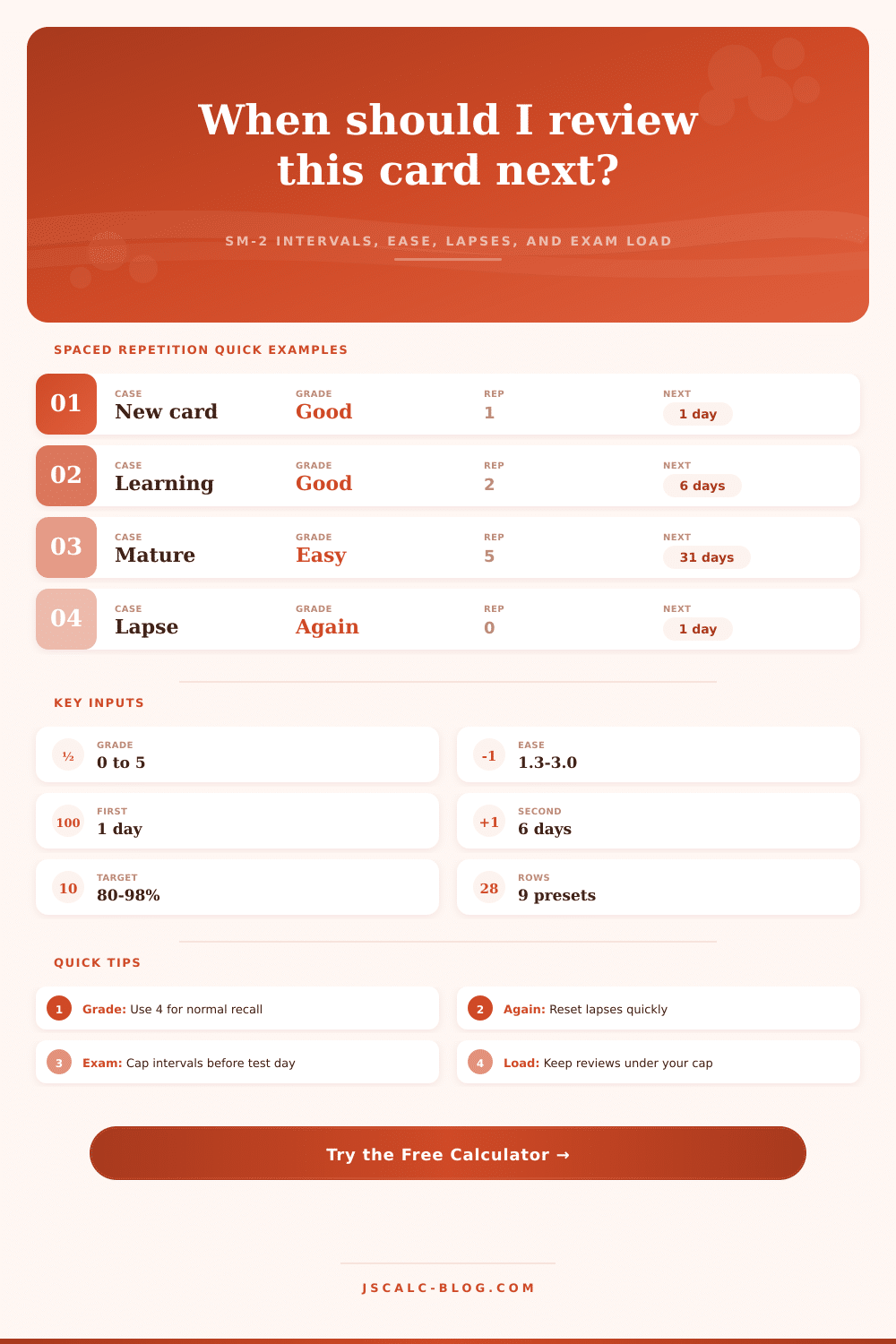
SM-2 commonly schedules repetition 1 at 1 day and repetition 2 at 6 days.
| Quality | Recall Meaning | Ease Change | Interval Effect | Repetition Handling | Use Case |
|---|---|---|---|---|---|
| 5 Easy | Immediate correct answer | Raises ease | Longer than normal | Count as success | Stable facts |
| 4 Good | Correct with normal effort | Slightly raises ease | Baseline interval | Count as success | Default grade |
| 3 Hard | Correct but strained | Lowers ease | Shorter interval | Count as success | Fragile memory |
| 2 Incorrect | Wrong after delay | Lowers ease | Reset interval | Relearning | Missed detail |
| 1 Hint | Needed a strong cue | Lowers ease more | Reset interval | Relearning | Weak association |
| 0 Again | No usable recall | Lowers ease most | Shortest interval | Relearning | Full lapse |
| Exam cap | Any grade near deadline | No direct change | Caps long dates | Keep stage | Test prep |
| Lapse count | Repeated failures | Penalty applied | Compresses future | Relearning risk | Leeches |
| Step | Formula | Meaning | Typical Range |
|---|---|---|---|
| Ease update | EF + 0.1 - diff x (0.08 + diff x 0.02) | diff is 5 minus quality | Min 1.30 |
| Rep 1 | Interval = 1 day | First successful review | 1 day |
| Rep 2 | Interval = 6 days | Second successful review | 3-7 days |
| Rep 3+ | Previous interval x ease x grade factor | Mature card scheduling | 7-365+ days |
| Retention | Interval x (0.90 / target) | Higher target shortens gaps | 0.92-1.13x |
| Lapses | Interval / (1 + 0.12 x lapses) | Repeated misses compress future reviews | 0.45-1.00x |
| Stage | Repetition | Good Grade | Easy Grade | Hard Grade |
|---|---|---|---|---|
| Learning | 0 to 1 | 1 day | 1 day | 1 day |
| Early review | 1 to 2 | 6 days | 6-7 days | 3-4 days |
| Young | 2 to 3 | 12-16 days | 15-20 days | 7-10 days |
| Mature | 4 to 5 | 25-45 days | 32-60 days | 15-28 days |
| Very mature | 8+ | 2-6 months | 3-9 months | 1-3 months |
| Relearning | After lapse | 1-3 days | 2-4 days | 1 day |
| Deck Size | Avg Interval | New Cards | Est. Daily Reviews | Load Signal |
|---|---|---|---|---|
| 300 cards | 30 days | 10/day | 36/day | Light |
| 800 cards | 35 days | 20/day | 75/day | Moderate |
| 1500 cards | 32 days | 30/day | 125/day | Busy |
| 3000 cards | 40 days | 40/day | 179/day | Heavy |
| 6000 cards | 45 days | 50/day | 263/day | Very heavy |
| 12000 cards | 55 days | 75/day | 413/day | Intense |
If you’ve ever read something yesterday and recognized it when you saw it again in a book, yet can’t remember it today, then you know how it feels: You read stuff, feel productive, and assume you’re remembering it, only to find out later that it was an illusion. Your brain tosses out what it thinks isn’t important (i.e., “noise”).
Spaced repetition combats this by forcing you to review material right before you are about to forget it. It transforms a disorganized study effort into a well-engineered problem. All you need are two inputs; your current ease factor and recall quality… Which you plug into the calculator above and let it figure out the rest for you. No guessing required.
Why Spaced Repetition Works
And then there’s the heart of it: the SM-2 algorithm, which views your memory as a decaying curve. This means that every time you respond to a card, it increase or decreases your ease factor, a number representing how quickly you’ll forget what you’re learning. When you answer with ease, the interval jumps; when you struggle, the interval shrinks. And the reference table on the page makes this clear. A grade of four doesn’t extend your next review nearly as much than a grade of five does. And that difference is more important to most students than they know, since most people see correct/incorrect as a binary switch.
They don’t. It’s not a simple switch. An easy correct are different from a difficult one. And the algorithm rewards honesty. Marking a difficult card as easy will get you in trouble eventually. You’ll lie. Then the system will adjust, and the gap widen too fast.
At two point five or so, that’s when the ease factor kicks in; that’s the number after which most cards are fairly easy. It means your next review come about twice as far away as the last one. But it’s dynamic: A long streak of easy answers pulls it up closer to three, stretching intervals into months. A couple misses pull it down toward one point three, when the card is in your face almost every day.
That’s where the retention target slider on the calculator can be helpful. You can set it at ninety percent, at which point the intervals really stretch out, or you can crank it up to ninety-eight, and get reviews coming back sooner. And there’s a cost to the additional two percent, a cost in leisure time, for marginal security. On an important test like a medical board exam, it’s worth the tradeoff. On something less serious, like everyday words, it’s likely too much.
It lowers your ease factor. If you completely forget a card, the system doesn’t reset the interval; it will still disrupt your momentum, but it won’t let those difficult cards grow too large too quickly. You’ll notice that the calculator accounts for past lapses, and will force-compress the upcoming interval so that the material realy sticks. That’s a protective measure, if it didn’t, you’d be staring at the same hard-to-digest concepts at impractical lengths.
The daily load estimate isn’t any less critical either, it lets you know whether or not your deck is expanding beyond your comfortabley ability for digestion. If estimated reviews are higher than your comfort cap, you should of throttle back on new card intake (or else you’re creating a backlog that’ll kill your motivation).
The problem with most people’s failure with spaced repetition isn’t the algorithm, it’s that they don’t respect the daily cap, and they get ambitious and add 50 new cards per day. Their review queue then explode, but the system isn’t broken. You’re just feeding it too much. No, you’re just feeding it too much. Respect the daily cap, let the reviews catch up, keep the new cards steady. When you respect the limits, the math make it work.
The beauty of the system is that it takes away your anxiety of having to plan. You don’t decide when to review; the algorithm decides. It turns studying into a rhythm instead of a chore, and you simply show up. You no longer worry about forgetting, and you trust the schedule. Those cards that matter come back around, and those you truly know dissapears into the background until you need them again.
A quiet confidence built on repeated success.