Severance Pay Calculator
Estimate severance from weekly pay, years of service, weeks per service year, cap and floor rules, partial-year policy, optional unused PTO, and optional notice pay.
Each preset fills the calculator with a different policy pattern. Edit any field to match a written plan or worksheet.
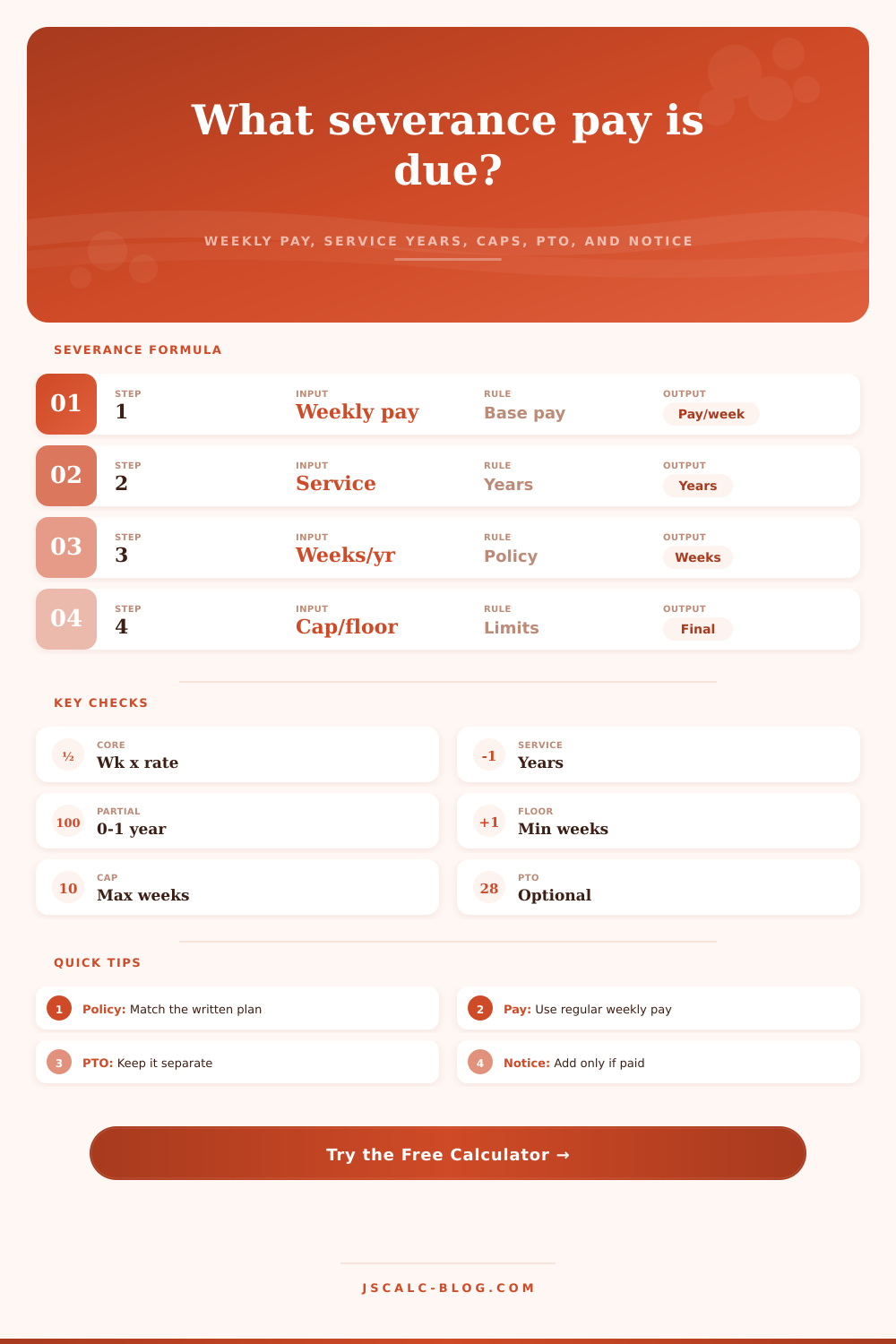
Core severance = weekly pay x weeks per year of service x years of service
Applied weeks = formula weeks after the selected floor, cap, and partial-year policy
Total gross package = severance pay + unused PTO + notice pay + other fixed separation pay
| Formula Step | Input | Calculator Treatment | Result Used | Review Point |
|---|---|---|---|---|
| Weekly pay | Annual, hourly, or weekly pay | Annual divided by 52, hourly multiplied by weekly hours, or direct weekly amount. | Regular weekly pay | Use the same base pay definition as the policy. |
| Service years | Completed years plus extra months | Partial-year setting controls whether extra months count, round, or drop. | Counted years | Do not count a partial year twice. |
| Formula weeks | Weeks per year x counted service | Multiplies service by the selected weeks-per-year policy rate. | Raw severance weeks | Some plans use bands instead of a single rate. |
| Cap and floor | Minimum and maximum weeks | Raises raw weeks to the floor or lowers raw weeks to the cap when limits apply. | Applied weeks | Enter 0 for maximum weeks if there is no cap. |
| Additions | PTO, notice, fixed pay | Adds optional amounts separately after the severance formula. | Total gross package | Keep these separate from severance weeks. |
| Policy | How Extra Months Count | Example: 6 Years 4 Months | Use Case | Risk to Check |
|---|---|---|---|---|
| Ignore partial year | Only completed full years count. | 6.00 years | Simple service anniversary rules. | May understate if policy prorates months. |
| Prorate by months | Extra months divided by 12. | 6.33 years | Most worksheet-style estimates. | Use completed months, not rounded days. |
| Nearest half year | Partial year rounds to 0, 0.5, or 1.0. | 6.50 years | Policies using half-year service bands. | Boundary months should be confirmed. |
| Round up | Any partial year becomes one full year. | 7.00 years | More generous service credit rule. | Can change cap timing quickly. |
| Round down | Partial year is excluded. | 6.00 years | Strict completed-year rule. | Same result as ignore in this calculator. |
| Limit Type | Where It Applies | Example Setting | Raw Weeks | Applied Weeks | Effect |
|---|---|---|---|---|---|
| No limit | After formula | Floor 0, cap 0 | 14 weeks | 14 weeks | No adjustment |
| Floor only | After formula | Minimum 4 weeks | 1.5 weeks | 4 weeks | Raises payout |
| Cap only | After formula | Maximum 26 weeks | 34 weeks | 26 weeks | Lowers payout |
| Floor and cap | Floor first, then cap | 4 to 26 weeks | 12 weeks | 12 weeks | Within range |
| Conflicting limits | Calculator warning | Floor above cap | Any weeks | Uses floor | Fix inputs |
| Display Option | Calculator Shows | Severance Timing | PTO Treatment Here | Best Use |
|---|---|---|---|---|
| Lump sum | One gross package amount. | All severance shown together. | Added to the same gross total. | Quick worksheet estimate. |
| Weekly continuation | Estimated weekly checks and duration. | Severance weeks plus paid notice weeks. | Shown as a separate optional payout. | Regular weekly payroll view. |
| Biweekly continuation | Estimated number of two-week checks. | Uses weekly pay x two weeks per check. | Separate from the check schedule. | Common payroll cadence. |
| Semi-monthly continuation | Estimated semi-monthly checks. | Uses about 2.167 weeks per check. | Separate optional line. | Salary payroll view. |
| Monthly continuation | Estimated monthly checks and months. | Uses about 4.333 weeks per check. | Separate optional line. | Longer continuation display. |
| Input | Typical Entry | Low Example | High Example | Calculator Role |
|---|---|---|---|---|
| Weeks per year | 1 to 2 weeks | 0.5 weeks | 4 weeks | Multiplies counted service years. |
| Minimum weeks | 2 to 4 weeks | 0 weeks | 8 weeks | Sets the severance floor. |
| Maximum weeks | 13 to 26 weeks | 8 weeks | 52 weeks | Caps formula severance weeks. |
| PTO hours | 0 to 80 hours | 0 hours | 200 hours | Adds optional PTO payout. |
| Notice weeks | 0 to 4 weeks | 0 weeks | 12 weeks | Adds optional notice pay. |
| Other fixed pay | Worksheet amount | $0 | Custom | Adds a separate fixed line. |
JSCalc-Blog.com: This severance pay calculator estimates gross amounts from user-entered assumptions. It does not determine eligibility, rights, taxes, benefits status, or compliance obligations.
When you get fired, the talk turns away from playing music and into numbers. You meet with HR, and it’s all business. Your severance package are meant to be a bridge to your next job. However, there is no road map for building this bridge so it does not feel like a sturdy structure.
Most people take the number on the paper as just math. It’s not always that easy. Before you sign off on anything, key is figuring out exactly what it is they’re measuring.
Understanding Your Severance Package
There isn’t one size fits all severance policy. It’s a set of variables with an interplay that will vary from place to place. It starts with how much you make each week. The next question is how many years of service that multiplier apply to.
This is where it gets nitty-gritty. Do you have 6 years and 4 months? Is that enough service time to bump your severance? Or do they count just whole years? Will those 4 months get rounded up? Will they be rounded down? Will they vanish altogether? Select your partial year policy and let the calculator do the math for you. Depending on your salary and number of weeks per year, that distinction can increase (or reduce) total by thousands of dollars.
The typical format is a simple formula, “weeks per year of service” times “weekly pay.” For example, two weeks of pay for each year of employment is common benchmark. Suppose you earn $1,000/week and have been with the company for five years. Without any adjustments, that means ten weeks of pay.
But no policy stops there. They also adds floors and caps to limit their liability. The floor helps people with shorter tenure receive at least something, whereas the cap prevents someone who’s stuck around forever from getting an unreasonably large lump sum. Knowing where your policy falls between these extremes matter.
This table on the page spells it out in plain English; it shows how a policy could increase your score (e.g., floor) or decrease your score (e.g., cap), depending on what it looks like. It’s a boundary check, which is great for company, but cuts down your maximum upside.
There’s also the add-ons (which many people don’t think about) beyond the basic formula. For instance, severance pay and unused PTO is typically different things in most jurisdictions. Another one is notice pay.
That’s a different thing entirely if your company wants you to work out your notice period… I.e., they give you two weeks’ notice in writing, but then want you to stick around for those two weeks. Those get mixed up with the concept of severance which means you end up with false expectations.
The tool breaks out those extras so you know exactly what kind of value the severance part provide vs. This includes the value of benefits you already earned. Because depending on how it’s categorized, the taxes can be different. And you want to see the breakdown because tax implications can differ depending on how the payment is classified.
You must decide between a lump sum or salary continuation. The lump sum provides you with a lump sum of cash immediately, and that’s comforting. Salary continuation distributes those payments over time, and it may make you more eligible for unemployment benefits (depending on the state).
You can see what the cash flow impact is either way, as shown in the calculator above. It won’t tell you whether one approach is superior from a tax perspective. But it will show you what the check would be like per week in each scenario. And that visualization are going to help you plan your post-transition budget.
When you’re looking back at the offer, don’t trust your memory. Those employment contracts can get pretty thorny, and it’s all too simple to skip over the small print about partial-year rounding and other caps. You should of got the doc out again, locate the relevant clauses, and line them up with your inputs.
If it’s a partial year rounded up, make sure that shows up. If it says twenty-six weeks as a hard cap, recognize it for what it is. It’s one thing to know the numbers; it’s another to check the rules governing those numbers.
That’s where the negotiation stops being an exercise of hoping for the right answer and turns into checking the work. You’ll enter the room armed with exactly how the number came together, which is the strongest possible stance.
When you base a bridge on assumptions, it doesn’t hold up; when you do so based off verified facts, it does.