Holiday Pay Calculator
Estimate holiday premium pay, paid holiday hours, double-time, time-and-a-half, overtime, shift differential, and total gross pay for one pay period.
Presets model common payroll policies. Confirm which hours count toward overtime and whether premiums are additive or replace regular holiday-work pay.
Choose the method from the employer policy or payroll rule.
Hourly rate before holiday premium or shift differential.
Hours worked in the period that are not holiday hours.
Hours actually worked during the holiday window.
Use 0 if no paid day is granted when not worked.
Formula uses holiday hours x base rate x premium multiplier.
Enter known overtime hours not already in holiday worked hours.
Overtime pay = overtime hours x rate x multiplier.
Adds to worked regular, holiday, and overtime hours.
Optional allowances, bonuses, or period adjustments.
Used only for the hours-over-threshold display.
This does not force overtime; it flags possible threshold hours.
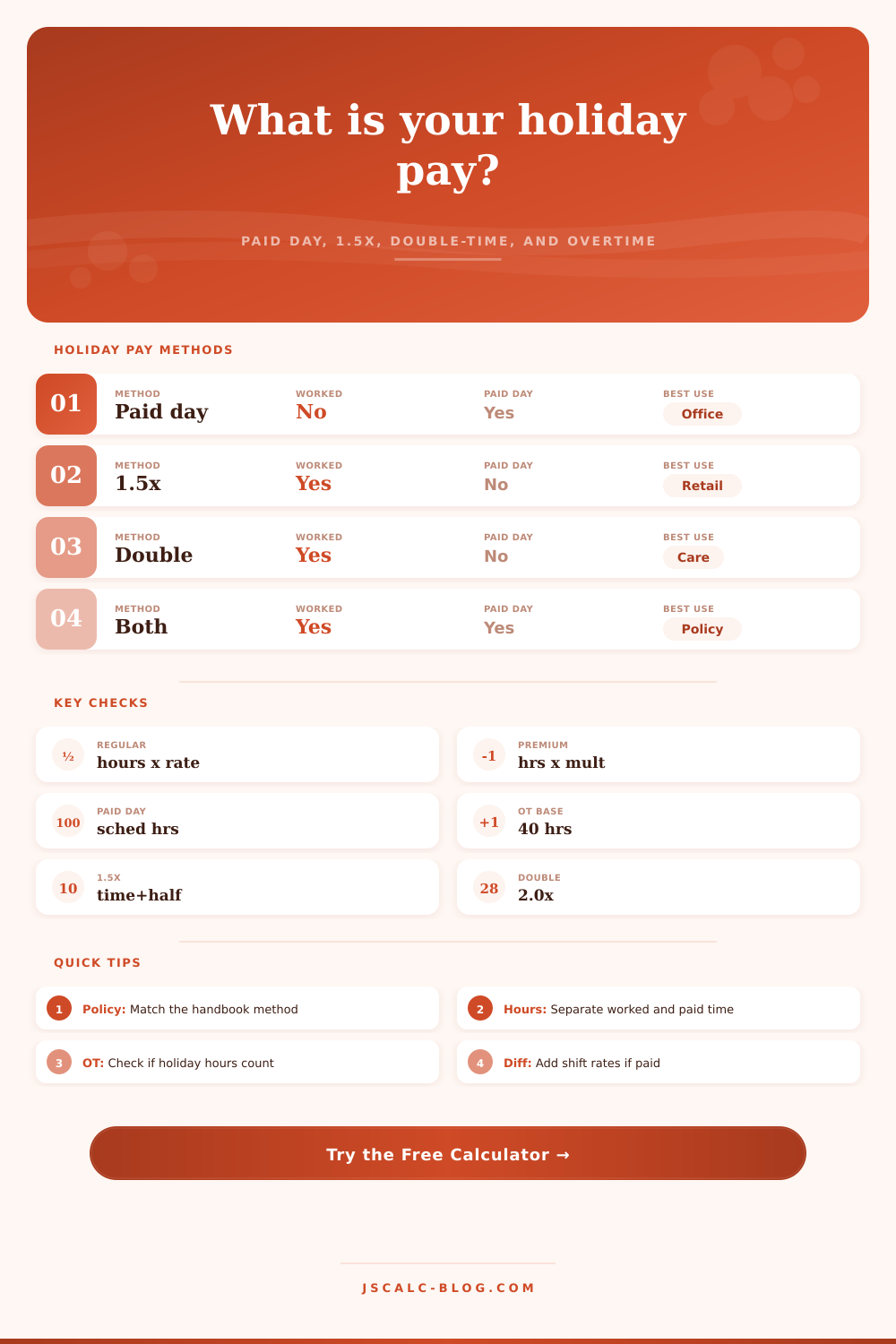
| Method | Core formula | Worked holiday hours | Paid day hours | Use when |
|---|---|---|---|---|
| Paid holiday not worked | scheduled hours x rate | 0 | Included | The employee receives paid time off for the holiday. |
| Premium only | holiday hours x rate x premium | Premium only | Not included | Regular pay is handled elsewhere in payroll. |
| Regular plus premium | holiday hours x rate + premium | Included | Not included | Time-and-a-half or double-time is paid for holiday work. |
| Paid day plus worked | paid day + worked holiday pay | Included | Included | Policy gives holiday pay plus pay for working the day. |
| Overtime stack | regular + holiday + overtime | Included | Optional | Holiday work also creates overtime or known overtime hours. |
| Scenario | Base rate | Reg hrs | Hol worked | Paid day | Method note |
|---|---|---|---|---|---|
| Retail holiday shift | $18 | 32 | 8 | 0 | 1.5x worked holiday |
| Hospital coverage | $35 | 36 | 12 | 0 | Double-time holiday |
| Office closure | $30 | 32 | 0 | 8 | Paid day not worked |
| Warehouse holiday | $22 | 32 | 8 | 8 | Paid day plus worked |
| Hotel busy week | $20 | 38 | 8 | 0 | Holiday plus overtime |
| Part-time support | $19 | 18 | 4 | 4 | Short paid holiday |
| Compressed schedule | $28 | 30 | 10 | 10 | Ten-hour holiday day |
| Overnight coverage | $24 | 32 | 8 | 0 | Premium plus differential |
| Multiplier style | Premium input | Worked base pay | Total holiday rate | Example at $20/hr |
|---|---|---|---|---|
| Premium add-on 0.5x | 0.5 | Included separately | 1.5x total | $30/hr total |
| Premium add-on 1.0x | 1.0 | Included separately | 2.0x total | $40/hr total |
| Direct premium 1.5x | 1.5 | Not separate | 1.5x total | $30/hr total |
| Direct premium 2.0x | 2.0 | Not separate | 2.0x total | $40/hr total |
| Paid day only | 0 | No holiday work | 1.0x paid time | $160 for 8 hrs |
| Paid day plus work | 0.5 to 1.0 | Included separately | Varies by policy | $400 to $480 |
| Input to verify | Payroll question | Calculator field | Risk if mixed |
|---|---|---|---|
| Holiday window | Which hours are holiday hours? | Holiday hours worked | Premium can be overstated. |
| Paid holiday eligibility | Is the day paid if not worked? | Scheduled paid hours | Paid-day pay may be missing. |
| Multiplier wording | Is 1.5x total or extra? | Method and multiplier | Double-counted regular pay. |
| Overtime basis | Do paid hours count toward OT? | Threshold selector | Incorrect overtime flag. |
| Differential | Is shift diff paid on holiday? | Shift differential | Worked-hour pay understated. |
| Known overtime | Is overtime already calculated? | Separate overtime hours | Same hour counted twice. |
This calculator estimates gross pay from your chosen inputs. It does not decide eligibility, tax withholding, union rules, local law, or employer-specific policy.
Pay is a common problem because of the holidays. When you see your work calendar you worry that overtime will evaporate in smaller than expected paycheck. What’s wrong? The calculation looks straightforward, why does it mess up your bank account?
The trouble isn’t your hourly wage. It’s the way overtime plays with special rates, whether you get a paid day off or work for a premium, and how premium time stack. Most employees assume that holiday pay are a flat bonus. That misconception lead to confusion.
How to Calculate Holiday Pay
Before you calculate, you must separate out the pay categories. That’s regular time, plus any holiday worked time, plus paid time off. Define the policy and the calculator does the rest.
Did your employer give you a paid day off or did you get premium pay (time-and-a-half) for working? This is an either/or deal. You gets eight hours of guaranteed pay or instant cash. If you work at retail, chances are good that your job offer extra pay because they need you there. Office jobs typically offers paid days because the work will wait. Both methods aren’t wrong. They simply represent two ways to value your time.
The disagreements begin with multiplier language. Your contract could stipulate double time for the holidays. How do you know whether that means two times your base rate? Or the base rate plus another amount? One way is a slight bump up, the other is a big windfall. For planning purposes, it makes all the difference.
Look in the handbook and determine whether premium is additive: Add the regular hours worked x base rate + hours worked x bonus = total pay. Or is it a total rate: Pay is hours worked x premium = total pay. That sounds like quibbling. In fact, it is hundreds of dollar per year.
Overtime adding up is what makes it complicated. Holiday hours are used for the 40-hour overtime cap in most locations. So you could be getting both the holiday premium and time-and-a-half rate on your last hour of the shift. That’s a lot of stacking! The calculator accounts for that and will show you the actual gross pay. It also alerts you to any hours over the cap, and calculates at proper rates. There’s no formula to remember, you simply need to understand how hours are counted.
Some companies argue they don’t count paid holidays towards overtime, since nobody worked those hours. Other companies count them since money was earned. Adjust this setting based off your company policy.
Another wrinkle is shift differentials. Some employers will pay you more per hour for working weekend hours or late into the night. Maybe that adds an extra dollar. And maybe that gets multiplied by your holiday premium. Sometimes yes, sometimes no. This variable tests what happens with shift differential. Does that extra dollar gets multiplied by the holiday premium? Or do you earn an extra buck? How much is it worth working late on a holiday? When the premium is already high, how much is it worth getting the overtime hours in?
The other reason why most people makes mistakes is they get their inputs mixed up. They put in the normal hours instead of the holiday hours. Or they forgot to subtract their paid day because they actualy worked the shift. That’s where the reference tables comes into play. All you do is find the row corresponding to your case. Look for the one that says combined if you worked and also got paid for the holiday. Look for the paid day only one if you took the day off. It is a tiny detail, but it can make all the difference in whether a result is trustworthy. If your inputs are good then so will be your outputs.
I’m not here to pick a fight with payroll. I’m here to say: I want to know what’s coming in. When my direct deposit hits, I want to know where it came from. I want to understand why the number on the screen is what it is.
By definition, holiday pay is flexible. It fluctuates based off company culture. It also depends on local law and union contracts. This is a neutral way to run those situations through the mill. Enter your hours, your rate and your policy. Let the math do the work.
At the end of the day, you’ll have a clear view of what you’ve earned, and none of the guesswork that muddies this time of year. Your worries becomes manageable. You know how much will come in. You know why the total is what it is.