PTO Accrual Calculator
Estimate earned PTO hours, usable balance, cap limits, carryover trimming, and probation handling by pay period, hourly, monthly, or annual accrual method.
Choose the formula your policy uses for earning PTO.
Full-year PTO hours used by period and annual methods.
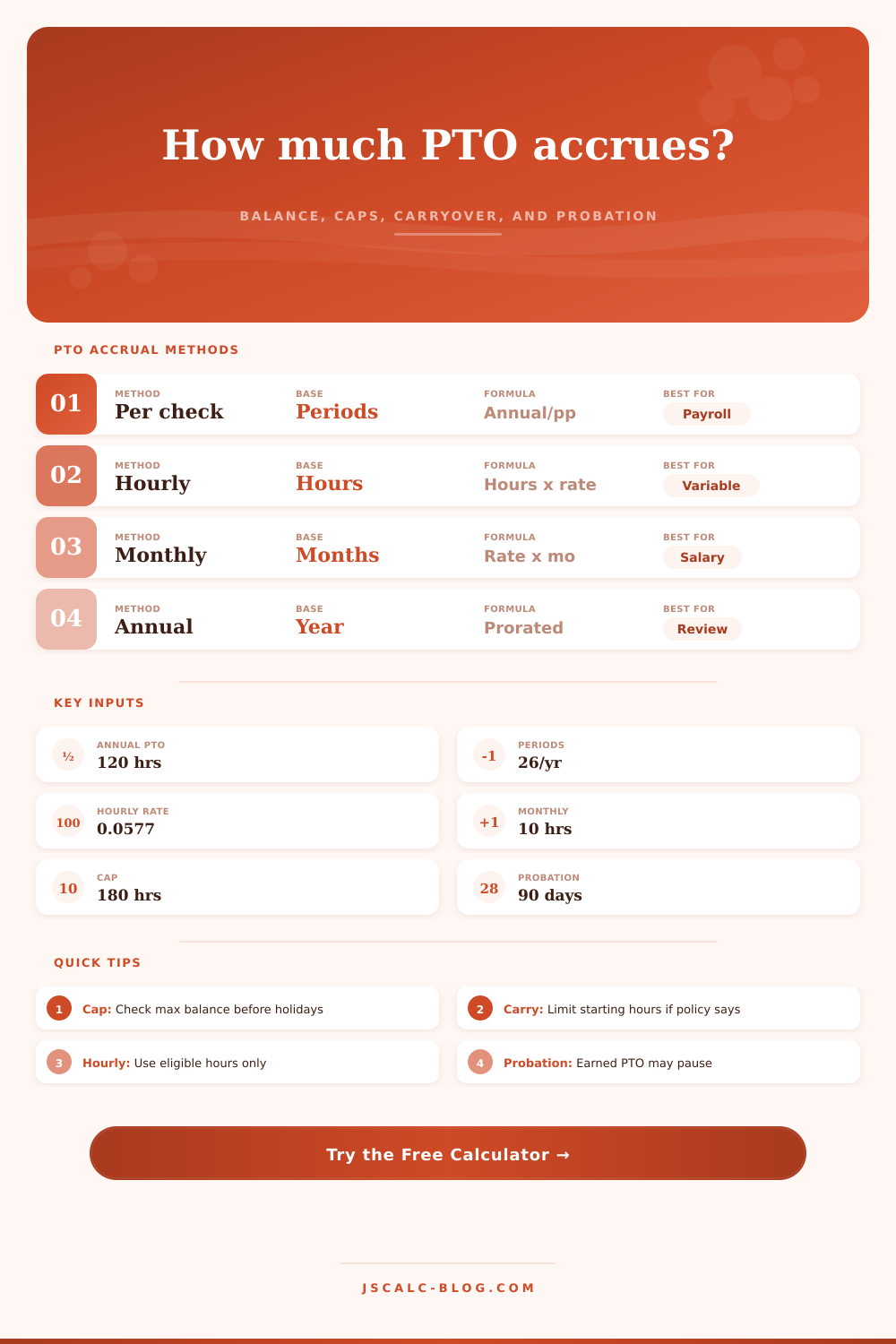
Per-period rate = annual PTO hours / pay periods.
Completed checks or payroll cycles inside the estimate window.
Hourly method: earned PTO = hours worked x hourly accrual rate.
Example: 120 PTO hours / 2080 work hours = 0.0577.
Monthly method: monthly rate x eligible months.
Also used to prorate annual allowance by months / 12.
Hours available before this estimate period, after any prior usage.
Subtract approved vacation, sick, personal, or floating holiday hours.
Enter 0 for no maximum balance cap.
Starting balance is trimmed to this limit when carryover applies.
Enter days before PTO begins earning; use 0 if no waiting period.
If this is below probation length, earned PTO is held at 0.
| Method | Primary formula | Inputs used | Best fit | Watch item |
|---|---|---|---|---|
| Per-pay-period | Annual PTO hours / pay periods | Annual PTO, pay periods, periods completed | Regular payroll cycles | Extra check years may need a 27th biweekly period. |
| Hourly accrual | Hours worked x accrual rate | Eligible hours worked and hourly accrual rate | Part-time or variable schedules | Exclude unpaid, ineligible, or non-accruing hours if policy says so. |
| Monthly accrual | Monthly accrual x months elapsed | Monthly PTO rate and eligible months | Salaried employees | Some policies round partial months up, down, or not at all. |
| Annual proration | Annual PTO hours x months elapsed / 12 | Annual PTO and months elapsed | Midyear starts or annual reviews | Confirm whether the policy uses calendar months or service months. |
| Pay frequency | Periods per year | 120-hour yearly rate | 160-hour yearly rate | Typical use |
|---|---|---|---|---|
| Weekly | 52 | 2.31 hrs/check | 3.08 hrs/check | Weekly payroll with small accrual increments. |
| Biweekly | 26 | 4.62 hrs/check | 6.15 hrs/check | Common U.S. payroll cycle. |
| Semi-monthly | 24 | 5.00 hrs/check | 6.67 hrs/check | Twice monthly salary payroll. |
| Monthly | 12 | 10.00 hrs/month | 13.33 hrs/month | Monthly accrual policies. |
| Four-week cycle | 13 | 9.23 hrs/cycle | 12.31 hrs/cycle | Operational teams using 28-day cycles. |
| Scenario | Method | Earned PTO | Raw balance | Usable balance | Cap room |
|---|---|---|---|---|---|
| Current inputs | Per-pay-period | 0 hrs | 0 hrs | 0 hrs | 0 hrs |
| Policy item | Calculator handling | Example | Result effect |
|---|---|---|---|
| Carryover limit | Starting balance is trimmed before new accrual is added. | 100 starting, 80 carryover | 20 hours are excluded from the new-year balance. |
| Balance cap | Final balance cannot exceed the entered cap when cap is above 0. | 190 raw, 180 cap | 10 hours are shown as cap loss. |
| Probation period | Earned PTO is set to 0 until days employed reach probation length. | 45 days employed, 90-day wait | Balance only reflects allowed starting hours minus used PTO. |
| PTO usage | Used or scheduled PTO subtracts after earned PTO is added. | 24 start + 46 earned - 16 used | Usable balance becomes 54 hours before cap. |
This JSCalc-Blog.com calculator estimates PTO accrual from the entered policy terms. It is a planning aid, not a payroll system or legal interpretation of an employer policy.
It can be frustrating watching the clock tick away without seeing even one hour of paid time off on your request. After all, you took this job so you could make money and now calendar is getting in the way. You watch as people take vacations. Your own balance remains stubbornly at zero. What’s usually wrong here isn’t that you didn’t work hard. It’s that no one told you the rules for earning hours, which are buried deep within lengthy handbooks and confusingly vague. Until you understand how your hours is accounted for, don’t schedule vacation.
There are four ways most companies do this. Most divide your annual allotment by the number of pay periods in a year. If they pays you biweekly, that’s 26 periods in the year. It is easy to count, but you can slip up and forget to account for extra check that sometimes happens in a year. The calculator will do this for you by splitting things evenly so you don’t have a giant pileup at month-end.
How Your Vacation Time Is Calculated
Or let things pile up? (That would of be December.) Hourly accrual is different. This ties your time off to the hours worked. So if you work fewer hours, you’ll earn fewer hour off. That makes sense if your schedule ebbs and flows. Overtime may not add to your accrual if the policy caps it off at some maximum number of hour. And that makes all the difference for part-timers.
For people hired in the middle of year, annual proration will apply. For other salaried employees, it’s the more common route: month-to-month. Both has their rhythms. Annual proration is like receiving a lump-sum that goes away fast. Monthly accrual feels consistent. Scroll down to table of references to see what factors into each formula.
Before you peek at the numbers, first determine your own. Use incorrect formula and you’ll get a number… But it won’t represent anything real.
With the accrual method, once you get this one, you will start hitting caps and carryover limits, which can be a bummer for vacationing. The cap is a maximum amount of balance. Once you hit the cap, you stop earning time or some of it dissapears. Some employers will freeze accrual when you hit the cap, other employers will trim it down. Bye-bye, those hours forever.
The carryover limit is similar, except it’s for what you carry over from last year. If you’re allowed to carry over eighty hours and you brought in ninety, bye-bye to that tenth hour. Gone. Useless. Sellable.
And then there’s probation. A lot of firms don’t count it towards accruals during the initial 90 days. You work and yet your balance remain frozen at zero. The calculator allows for this scenario: simply change number of days employed. New? Don’t look for the needle to move just yet. This is a waiting game. Your goal is to understand the moment the clock begins ticking. Is it when you start? When you recieve your first paycheck? At the conclusion of your review process? Depending on your answer, you’ll know when you can actualy take that first day off.
Secondly, consider the room above the cap. Are you near the cap? Taking a few days off now could free up some headroom that lets you build up more in long run. Sounds counterintuitive. Spend time making more time. But if the cap’s tight, each hour matter. The tool tells you exactly how far under the cap you are. It turns a vague feeling into a concrete number.
So in the end, vacation time is just like money, a finite resource that should be guarded from policy hazards, monitored and spent wisely. The rules are slippery. But the math isn’t. Once you understand how this thing works, once you’re no longer making guesses but instead making plans, then you’ve got the power. Then you can go on vacation with peace of mind.