Root Quadratic Equation Calculator
Solve any quadratic equation ax^2 + bx + c = 0 with the quadratic formula. Enter coefficients a, b, and c to get the discriminant, both roots, a real or complex classification, the vertex, the axis of symmetry, and the sum and product of the roots.
📐Your Equation
🎯Example Equation Presets
📝Coefficients & Options
Leading coefficient. Set a = 0 to solve a linear equation instead.
The middle coefficient multiplying x.
The constant term with no variable.
Controls rounding on every result and root value.
Cosmetic label used in the equation display and roots.
Decimal is easiest to read; radical shows the exact surd.
Two distinct real roots
🔢Formula Snapshot
📊What the Discriminant Sign Tells You
| Discriminant D | Nature of Roots | Graph vs x-axis | Example |
|---|---|---|---|
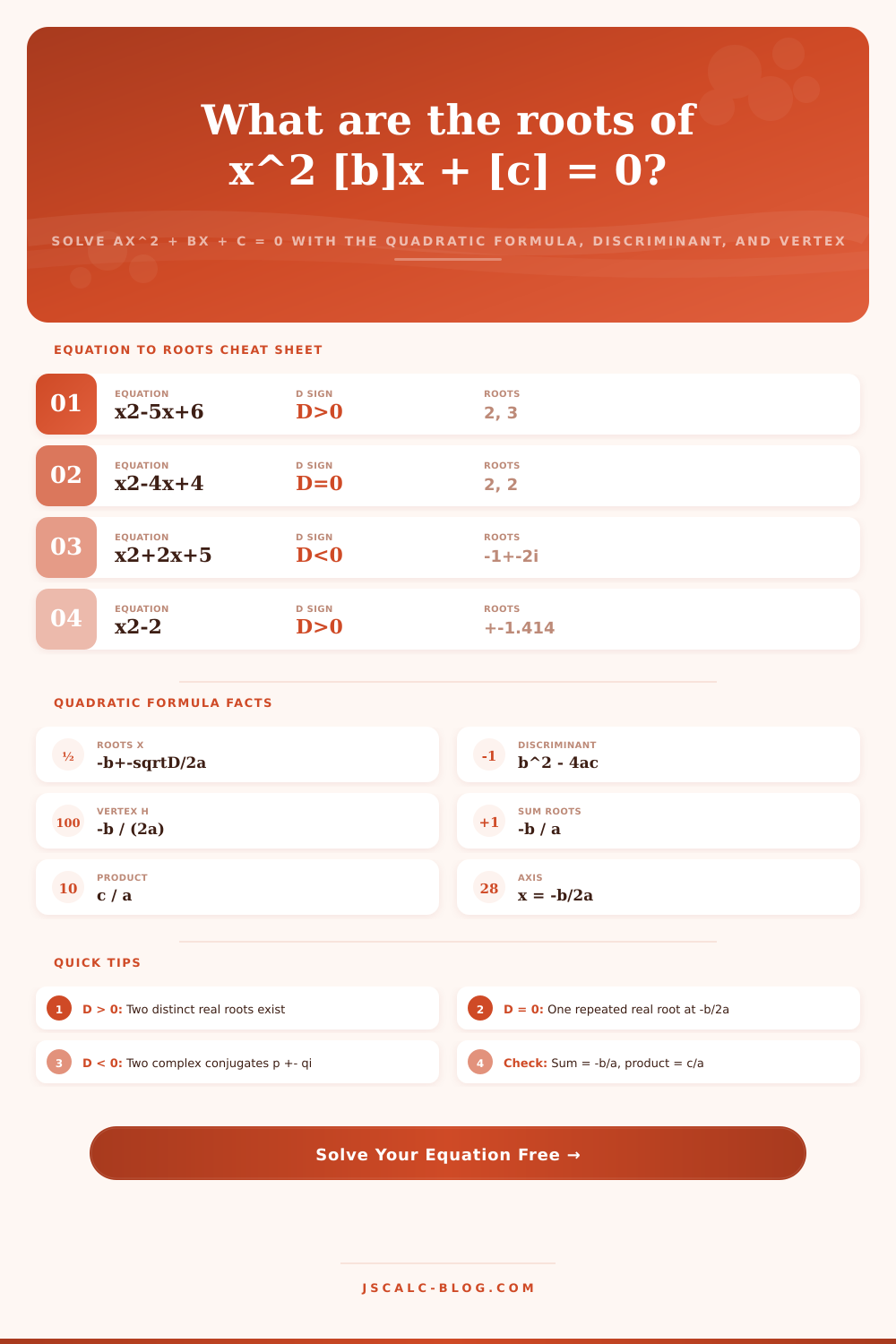
| D > 0 | Two distinct real roots | Crosses at two points | x²-5x+6 |
| D = 0 | One repeated real root | Touches at the vertex | x²-4x+4 |
| D < 0 | Two complex conjugates | Never touches the axis | x²+2x+5 |
| D is a perfect square | Two rational roots | Crosses at neat values | x²-3x-10 |
| D > 0, not perfect square | Two irrational roots | Crosses at surds | x²-2 |
📏Quadratic Formula Components
| Symbol | Name | Formula | Meaning |
|---|---|---|---|
| a | Leading coefficient | coeff of x² | Opens up if a>0, down if a<0 |
| b | Linear coefficient | coeff of x | Shifts the axis of symmetry |
| c | Constant term | value at x = 0 | The y-intercept of the parabola |
| D | Discriminant | b² − 4ac | Decides root type and count |
| h | Vertex x | -b / (2a) | Also the axis of symmetry |
| k | Vertex y | a h² + b h + c | Minimum or maximum value |
📈Sum and Product of Roots (Vieta)
| Equation | Sum = -b/a | Product = c/a | Roots |
|---|---|---|---|
| x²-5x+6 | 5 | 6 | 2 and 3 |
| x²+x-6 | -1 | -6 | 2 and -3 |
| x²-3x-10 | 3 | -10 | 5 and -2 |
| 2x²-4x-6 | 2 | -3 | 3 and -1 |
| x²-x-1 | 1 | -1 | 1.618, -0.618 |
| x²+2x+5 | -2 | 5 | -1±2i |
🗃Worked Example Equations Grid
| Equation | a | b | c | Discriminant | Roots | Vertex (h, k) |
|---|---|---|---|---|---|---|
| x²-5x+6 | 1 | -5 | 6 | 1 | 3, 2 | (2.5, -0.25) |
| x²-4x+4 | 1 | -4 | 4 | 0 | 2 (repeated) | (2, 0) |
| x²+2x+5 | 1 | 2 | 5 | -16 | -1±2i | (-1, 4) |
| x²-2 | 1 | 0 | -2 | 8 | ±1.414 | (0, -2) |
| x²+x-6 | 1 | 1 | -6 | 25 | 2, -3 | (-0.5, -6.25) |
| 2x²-4x-6 | 2 | -4 | -6 | 64 | 3, -1 | (1, -8) |
| x²-6x+9 | 1 | -6 | 9 | 0 | 3 (repeated) | (3, 0) |
| x²+1 | 1 | 0 | 1 | -4 | ±i | (0, 1) |
| x²-x-1 | 1 | -1 | -1 | 5 | 1.618, -0.618 | (0.5, -1.25) |
| -5t²+20t | -5 | 20 | 0 | 400 | 0, 4 | (2, 20) |
⚙Formula Breakdown
💡Practical Solving Tips
You are on a test, looking at a quadratic equation. Panic sets in. There’s a jumble of coefficients. Signs is tricky. You remember the formula but can’t quite remember which side gets negative sign.
Well, that’s why this tool exists. It helps you with that problem: the quadratic equation root calculator. It doesn’t simply spit out a couple numbers for x. No, no. This thing break down the whole story of the parabola. All it takes are three simple inputs. And then you get a complete algebraic picture right back.
How the Quadratic Root Calculator Works
It applies the master formula. It computes the discriminant. It classifies the roots (real or complex) and, yes, it even finds vertex. A moment of confusion becomes a clear map of what’s going on geometrically.
Yes, the quadratic formula is rigid and yes, it’s powerful. For any given equation with a non-zero leading coefficient, we find x. It equals negative b plus or minus the square root of the discriminant, all divided by 2a. One expression covers every possibility. Two signs before the radical give you two roots.
The stuff under the radical governs if those roots are real numbers, something you can plot on a graph, or imaginary numbers which live in some other mathematical plane. With this calculator, you see exactly what gets fed into that structure with your exact numbers and then can follow along with the arithmetic. No more fear of having made a sign error when working out the problem by hand.
But the most critical number in the entire procedure is the discriminant. It’s the first number the tool spits out. Before you complete the rest of the calculation, it informs you whether your result will be one or two distinct answers. A positive discriminant mean there are two unique real roots. The parabola intersects the x-axis in two locations.
A zero discriminant indicates vertex of the parabola simply touches the x-axis. Because the two roots has become one duplicate value, there is only one solution. For those not accustomed to working with complex numbers, a negative discriminant leads to something interesting. There is no real root of this equation. The graph doesn’t ever intersect the x-axis. You end up with a pair of complex conjugates.
Knowing that sign beforehand means you won’t look at an empty graph and wonder where the solutions went. How does this play out in practice? Let’s take an old favorite: x squared minus 5x plus 6 equals zero. The constant is 6, the middle term is negative 5, and the leading coefficient is 1. We plug that into our equation for the discriminant, getting positive 1. It’s not large, but it’s important because it tells us there are real roots.
When we plug it back in quadratic formula, we get x equals 3 and x equals 2. You know right away that it must be correct, based off Vieta’s relations. The sum of the two roots should equal negative b over a. In this case, it is 5. And their product should equal c over a. In this case, it is 6. 2 times 3 is 6. If you don’t believe it, you can let this calculator run the checks for you. You wouldn’t of to rerun the entire formula by hand.
It’s not all problems in the real world however. How about this one: x squared plus 2x plus 5 equals zero? Here we have a negative sixteen for the discriminant. You can’t take the square root of a negative number and recieve a result in the real world. There is no physical meeting of the equation with the axis. The tool uses complex mode to report that roots are negative one plus or minus two i.
For students encountering imaginary numbers for the first time it presents the answer cleanly so they can see structure is still there. It is just expressed differently.
The parabola’s form is not just important in its roots; there is another point, called the vertex, where the parabola turns. The x-coordinate of this vertex is… B/2a. This is also axis of symmetry. Plug it back into the original expression and you have minimum (or maximum) value of y. In the case of our initial parabola, the vertex has an x-value of 2.5 and a y-value of -0.25, meaning it lies just beneath the axis of symmetry. Two actual roots cross the axis, so that makes sense. Placing the vertex next to the roots on a graph connects the dry algebra with shape of parabola.
The ability to automatically show the product and sum of the roots is also pretty handy without being shouted about. These are set according to Vieta’s formulas no matter if the roots are real or not. It provides an immediate self-check against whatever answer you obtain by hand. Add up your own results and if it doesn’t equal minus b over a then you know you’ve made a slip somewhere. Both quantities appear on calculator so the check is always a single look away.
The built-in presets cover everything you could possibly see in a problem. They range from simple, such as a linear case where the leading coefficient is zero, to the complex, such as the golden ratio equation. It even covers a perfect square case with its repeated root as well as that irrational pair from x squared minus 2.
That last one (the linear case), is important because when a equals zero, this isn’t a quadratic equation anymore. Instead of diving into division-by-zero, the tool will solve the resultant linear equation for you. You’ll be able to choose whether the roots are displayed using radicals or as decimals. You can rename the variable (y or t works best, though it doesn’t really matter). Then, you can select how many outputted decimal places you want. That way, you should get your answer written however you want on final exam.
Quadratics appear everywhere. They are used by algebra students, physicists who model projectiles, and engineers checking their characteristic equations. It removes the drudgery while keeping the learning intact. Rather than shoving everything behind a black box, it displays classification, the substitution and the discriminant. With a tap of a button, you can begin with one of the presets. You can replace the coefficients with your own, read the result cards, and scan through the breakdown to see exactly how every single number is computed.
Whether the equation has complex roots or whether it’s as simple as a factorable trinomial, it provides solutions that are trustworthy, fully explained; often in mere seconds. It replaces the initial panic with clarity: here’s exactly why the numbers are what they are.