Rental Property Break-Even Calculator
Estimate the occupancy level, rent per occupied unit, DSCR, and monthly cash flow needed for a rental property to cover debt, operating expenses, reserves, and a target cash flow.
🏘Break-Even Presets
📝Rental Break-Even Inputs
Potential rent for one rentable unit at full lease-up.
Use units that can produce rent, not bedrooms or occupants.
Current expected vacancy and collection loss.
Monthly principal and interest or required debt payment.
Utilities, HOA, admin, lawn care, licenses, and recurring fixed overhead.
Turnover supplies, utilities billed by use, cleaning, and service items.
Set to 0 for self-management.
Roof, HVAC, pavement, appliances, and major replacements.
Enter 0 for pure break-even, or a positive cushion target.
Used for labeling and benchmark comparisons.
📊Current Break-Even Snapshot
⚙Formula Breakdown
🏢Preset Break-Even Table
| Preset | Units | Rent/unit | Vacancy | Debt | Fixed burden | Break-even occ. | Cash flow |
|---|
📋Input Reference Table
| Input line | Monthly basis | Break-even role | Useful range | Check carefully |
|---|---|---|---|---|
| Rent per unit | Potential lease income | Raises contribution margin | Use signed leases or comps | Concessions and seasonality |
| Vacancy | Percent of potential rent | Sets current occupied units | 3% to 10% long-term | Local demand and collections |
| Debt service | Required loan payment | Fixed cost in break-even | Use actual payment | Rate resets and balloons |
| Taxes and insurance | Monthly escrow or bill average | Fixed operating burden | Use current statements | Reassessment after purchase |
| Management fee | Percent of collected rent | Variable with income | 6% to 10% common | Lease-up and renewal fees |
| Capex reserve | Monthly replacement reserve | Fixed reserve target | 5% to 15% of rent | Older roofs and systems |
| Target cash flow | Required monthly cushion | Adds to fixed burden | $0 to $300 per unit | Investor-specific hurdle |
📈Occupancy Interpretation Table
| Break-even occupancy | Screening read | Operating cushion | What to inspect | Next metric |
|---|---|---|---|---|
| Under 65% | Wide lease-up margin | Strong | Expense completeness | Rent sensitivity |
| 65% to 75% | Healthy margin | Good | Vacancy trend | DSCR at current rent |
| 75% to 85% | Moderate cushion | Fair | Repairs and taxes | Stress vacancy |
| 85% to 95% | Thin margin | Tight | Debt, capex, concessions | Rent gap to target |
| Over 95% | Needs near-full occupancy | Very tight | All assumptions | Full underwriting |
🔍Vacancy Sensitivity Table
| Scenario | Vacancy | Occupied units | Effective rent | Total monthly costs | Cash flow | DSCR |
|---|
💡Break-Even Tips
The listing was posted; it looked good in pictures. The price seemed reasonable on paper. It’s in a decent area. Investing occur in monthly math of realism vs. Optimism.
Before you sign the contract, you should clearly understand how many units you’ll have to fill to pay for insurance, property tax, debt service, maintenance reserve and your target level of profitability.
Calculate Your Break-Even Point Before Investing
New investors gets fixated solely on gross income. They find a single family house with $2,000 in rent, and they’re happy. Next thing they do: deduct their mortgage and think this is free money for them to pocket. This is where most new investors makes a dangerous assumption.
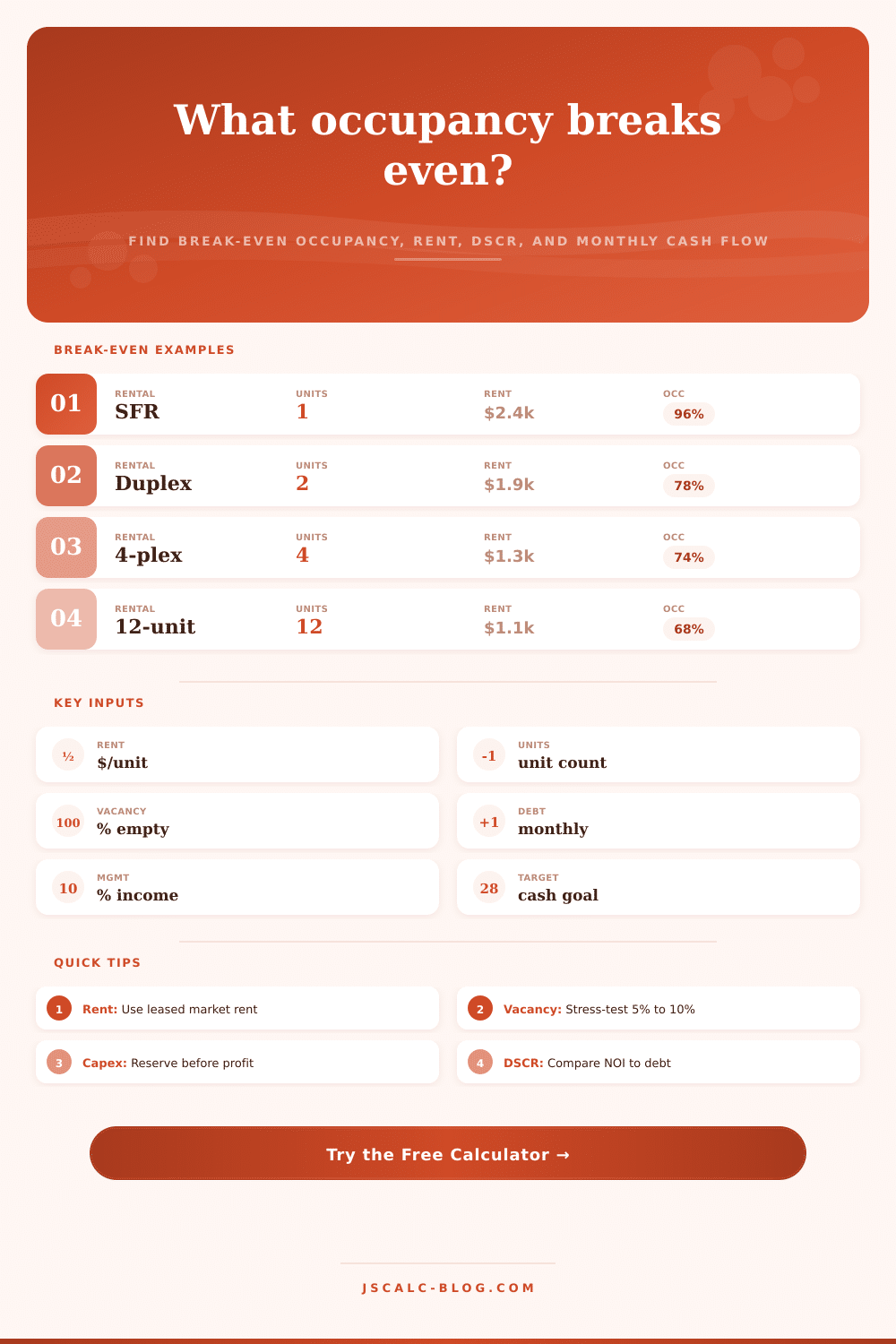
Break-even occupancy is the percentage of units you must rent before you break even and stop losing money each month. Say it’s close to ninety-five percent. In other words, if one unit is vacant, you lose all of your cash flow cushion. It’s the difference between an investment and a liability.
After plugging in your numbers (it does all calculations for you on the calculator up top), you can stop trying to guess how variables impact coefficients. Begin with an honest estimate of your vacancy rate. For example, 5% may seem optimistic for a brand-new home, but you should bump that figure higher if your home is older or you’re renting in a volatile market. This number instantly reflects the rent you’ll recieve, not the rent you’d like to receive.
The whole calculation hinges on debt service, i.e., payments to the bank for loan principal + interest. Property taxes & insurance also counts toward the fixed side of things (many investors overlook this). When tenants move out, these payments don’t magically vanish. Whether you’re occupied or not, these are paid. Consider them as fixed costs within the model which provides a truer representation of your leverage.
If your break-even rent exceeds what’s currently in the market, game over. The deal won’t work. Don’t let yourself fall into trap of wishful thinking that somehow the neighborhood’s rents will magically increase overnight.
Oh, and then there are variable expenses like owner-paid utilities, repairs and replacements (which change based off occupancy), and management fees. If it’s an empty apartment, it doesn’t need turnkey cleaning supplies or tenant-fixing. Removing these from the mix provides a better contribution margin, i.e., how much extra every single rented apartment bring to offset your intractable fixed bills (i.e. This includes your mortgage.
That matters if you own a multi-family property because partial vacancy is the rule, not the exception. Don’t neglect capital expense reserve fund. Replacing a 20-year roof isn’t income-producing; it’s a capital expense that won’t pay for itself until it breaks. Pre-fund a reserve each month so you aren’t surprised by an unexpected $10K HVAC replacement. Add this reserve to the break-even calculation in the calculator. You’ll require slightly higher occupancy as a result, but you’ll save your long-term equity from getting blindsided. Overestimate your reserve, not underestimate it, because nobody likes being surprised with no money in their pockets.
And lastly, consider cash flow with the Debt Service Coverage Ratio. If lenders consider this property safe, then its DSCR should of be greater than one point two, meaning your net operating income comfortabley covers your debt service. A high DSCR doesn’t necessarily mean you’ll earn money personally. To create sufficient capital, you must have enough reserves (or minimal fixed costs) on top of that. Both ratios must sync up.
You don’t want to simply avoid insolvency; you want to generate wealth by maintaining a sustainable surplus every month. Ideally, your break-even occupancy will remain far below eighty percent, which means you’ve created a buffer capable of absorbing market dips and unexpected vacancies without draining your bank account. This is what distinguishes amateur investors from seasoned operators: we prepare for the bad days as thoroughly as we revel in the good ones.