Profit Margin Calculator
Turn revenue and cost into gross profit, gross margin percent, and markup percent, or solve backward from a target margin or markup to the selling price. Add expenses for a net margin view.
🎯Real Pricing Presets
📝Pricing Inputs
Choose what you know; the calculator solves the rest.
Used in the revenue & cost mode.
Used in the target margin mode.
Used in the markup mode.
Fees, shipping, overhead for the net margin card.
🔢Formula Snapshot
🔄Margin ↔ Markup Conversion
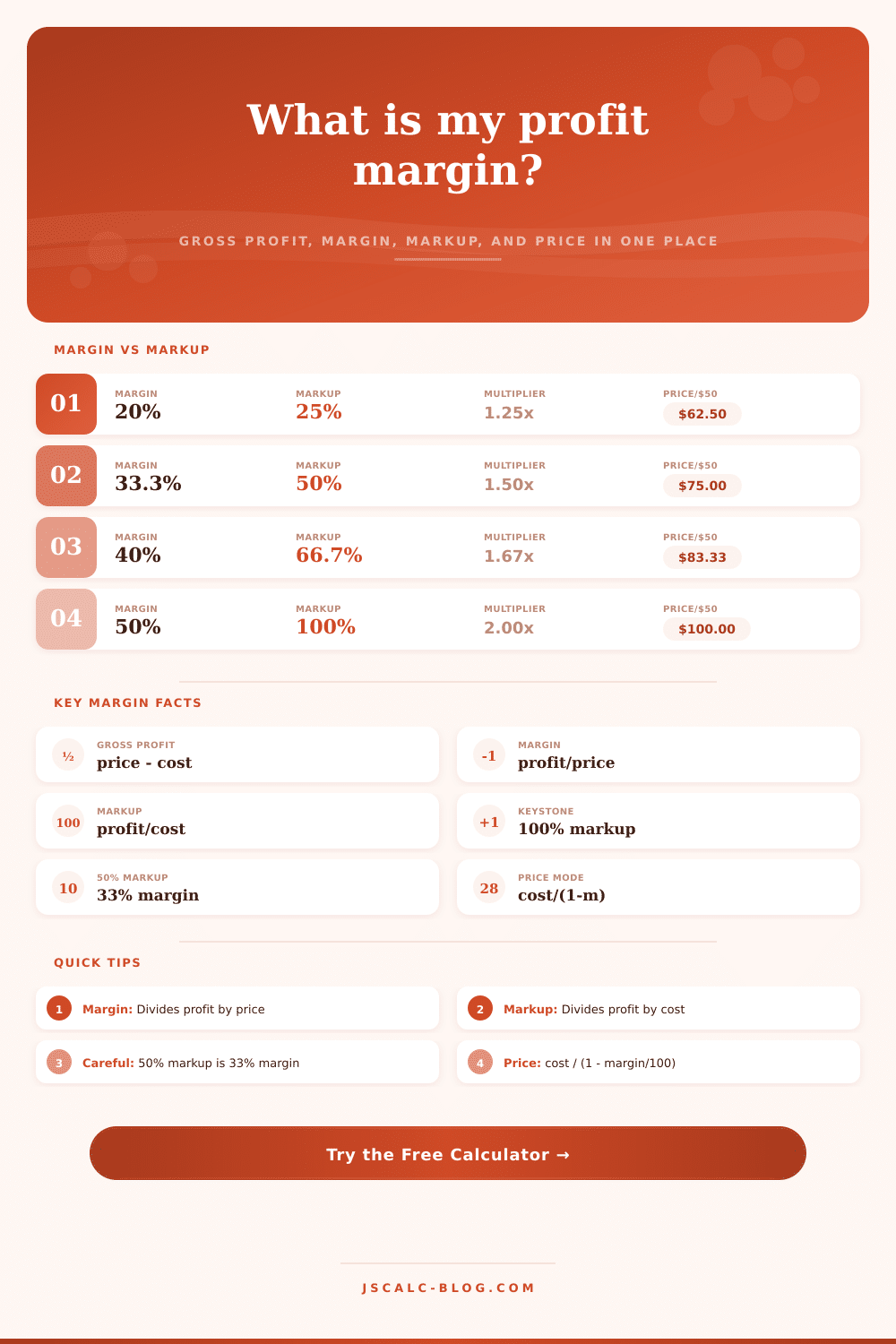
| Gross Margin | Markup on Cost | Price Multiplier | Formula Note |
|---|---|---|---|
| 10% | 11.1% | 1.111× | markup = m / (1 − m) |
| 20% | 25.0% | 1.250× | 0.20 / 0.80 = 0.25 |
| 25% | 33.3% | 1.333× | 0.25 / 0.75 |
| 33.3% | 50.0% | 1.500× | one third margin |
| 40% | 66.7% | 1.667× | 0.40 / 0.60 |
| 50% | 100.0% | 2.000× | keystone pricing |
| 60% | 150.0% | 2.500× | 0.60 / 0.40 |
| 66.7% | 200.0% | 3.000× | triple cost |
| 75% | 300.0% | 4.000× | 0.75 / 0.25 |
| 80% | 400.0% | 5.000× | software-style |
🗂Margin vs Markup Comparison Grid
| Margin % | Markup % | Multiplier | Price on $50 Cost | Profit on $50 | Cost Share |
|---|---|---|---|---|---|
| 15% | 17.6% | 1.176× | $58.82 | $8.82 | 85% |
| 20% | 25.0% | 1.250× | $62.50 | $12.50 | 80% |
| 25% | 33.3% | 1.333× | $66.67 | $16.67 | 75% |
| 30% | 42.9% | 1.429× | $71.43 | $21.43 | 70% |
| 40% | 66.7% | 1.667× | $83.33 | $33.33 | 60% |
| 50% | 100.0% | 2.000× | $100.00 | $50.00 | 50% |
| 60% | 150.0% | 2.500× | $125.00 | $75.00 | 40% |
| 70% | 233.3% | 3.333× | $166.67 | $116.67 | 30% |
| 80% | 400.0% | 5.000× | $250.00 | $200.00 | 20% |
📊Common Industry Margins
| Industry | Typical Gross Margin | Equivalent Markup | Pricing Style |
|---|---|---|---|
| Grocery retail | 25% to 30% | 33% to 43% | High volume, thin margin |
| Apparel & retail | 50% | 100% | Keystone doubling |
| Restaurant food | 60% to 70% | 150% to 233% | Menu costing on plate cost |
| Jewelry & luxury | 50% to 66% | 100% to 200% | Keystone or higher |
| Electronics | 8% to 20% | 9% to 25% | Slim competitive margin |
| SaaS & software | 75% to 85% | 300% to 567% | Low marginal cost |
| Consulting services | 50% to 70% | 100% to 233% | Labor-based markup |
| Wholesale & distribution | 15% to 25% | 18% to 33% | Markup on landed cost |
💲Markup Multiplier Reference
| Markup Name | Markup % | Multiply Cost By | Resulting Margin |
|---|---|---|---|
| Quarter markup | 25% | 1.25× | 20.0% |
| Third markup | 33.3% | 1.333× | 25.0% |
| Half markup | 50% | 1.50× | 33.3% |
| Keystone | 100% | 2.00× | 50.0% |
| Keystone plus | 150% | 2.50× | 60.0% |
| Triple key | 200% | 3.00× | 66.7% |
⚙Full Formula Breakdown
📋Pricing Examples On $60 Cost
| Goal | Selling Price | Gross Profit | Margin / Markup |
|---|---|---|---|
| 20% margin | $75.00 | $15.00 | 20% / 25% |
| 33.3% margin | $90.00 | $30.00 | 33.3% / 50% |
| 40% margin | $100.00 | $40.00 | 40% / 66.7% |
| 50% margin (keystone) | $120.00 | $60.00 | 50% / 100% |
| 25% markup | $75.00 | $15.00 | 20% / 25% |
| 200% markup (triple) | $180.00 | $120.00 | 66.7% / 200% |
💡Margin vs Markup Tips
If you’re selling something, you probably have an idea of how much it costs you to make your product. How many hours of work does it take? What are the costs for raw materials? Shipping? But do you know whether that will allow you to pay yourself and run your business? That’s what matters: the difference between revenue and cost, whether a company is profitable or not. (Confusingly, this is where some folks mix up markup and margin.)
After plugging in your numbers (the base), the calculator do the rest. No more guesswork with conversions. Plug in your direct cost + selling price and voila! You get instant gross profit. How much money do you retain per item sold before spending another dime on marketing or rent? That’s unit economics 101. And if your number isn’t big enough, no matter how many you sell, you’re screwed.
Understanding Markup and Margin
Figuring out what it measures are the hard part. Markup and gross margin both look similar, but they is measured in different denominators. Gross margin measure profit as a percentage of amount you sold it for. Markup measures profit as a percentage of what you paid for it. This is why markup isn’t the same thing than margin. Fifty percent markup is not a 50% margin.
If you buy something for a hundred dollars and apply a 50% markup, you’re going to sell it for one hundred and fifty dollars. You made a fifty dollar profit. But the fifty dollars you made is only one third (33%) of the selling price. That’s where folks gets tripped up.
For example, many retailers practice what is known as keystone pricing, that’s where the markup is one hundred percent. That means if you purchase something at twenty dollars, but then sell it for forty, your markup is one hundred percent of your cost. Your margin are fifty percent. As you can see from the reference table, higher margins demand significantly higher markups. To get a ninety percent margin, you’d have to mark up by nine hundred percent. It adds up fast.
Always price backwards from your target margin. Forty percent margin? Don’t tack on forty percent to the cost. If you tack it on, you gets a twenty-five percent markup and a twenty percent margin. To achieve that forty percent margin, you must divide your cost by (1… 40), or 60%. The tool will do this for you in target mode. It’s insurance against arithmetic mistakes that leads to underpricing.
Once you’ve nailed down your price, it’s easy to tack on costs. Shipping materials, return handling, payment processing fees. What looks like a nice gross margin turns out to be hole in your wallet. With our calculator, you can adjust for other per-unit costs and get a look at your real-world bottom line. Maybe a 40% gross margin translates into a 20% net margin with payment processing fees and packaging? That’s why you need more than top-line revenue; you also has to survive.
Different industries have different norms. Some industry norms include high volume and low margins. Grocery stores is an example of this. Other industry norms: High margin. Software companies falls into this category; their marginal cost is practically $0. Software companies fall into this category; their marginal cost is practically $0. It’s important to establish reasonable expectations by comparing yourself against others in your space. But don’t get so caught up in being competitive that you risk survival. You should of risk racing to the bottom if you chase the market rate.
Command a price that supports lasting growth based off your unique value. Pricing involves some math, but it’s mostly about psychology. The customer doesn’t give a shit how much you mark it up, whether it’s 40% or 60%. He cares whether the solution help him solve his problem. You need to make sure that difference between price and cost is big enough to absorb uncertainty for your business. But small enough that he still finds it appealing. That’s where your intuition comes in.
And this is where the tool will provide some data for you. Try running scenarios through it beforehand. Make adjustments one variable at a time. See what happens when costs shift. Is your margin slim? That’s just one number away from losing weeks worth of profit. If you build a buffer for volatility, you protect yourself from that fluctuation.
Guesswork becomes planning. Reacting to costs gives way to controlling them. Clarity attracts money. When you know the connection between costs, price, and profit margin, you feel confident making choices. Your business lives and dies in the space between revenue and cost. Leave enough room to breathe.