Pressure Drop Calculator
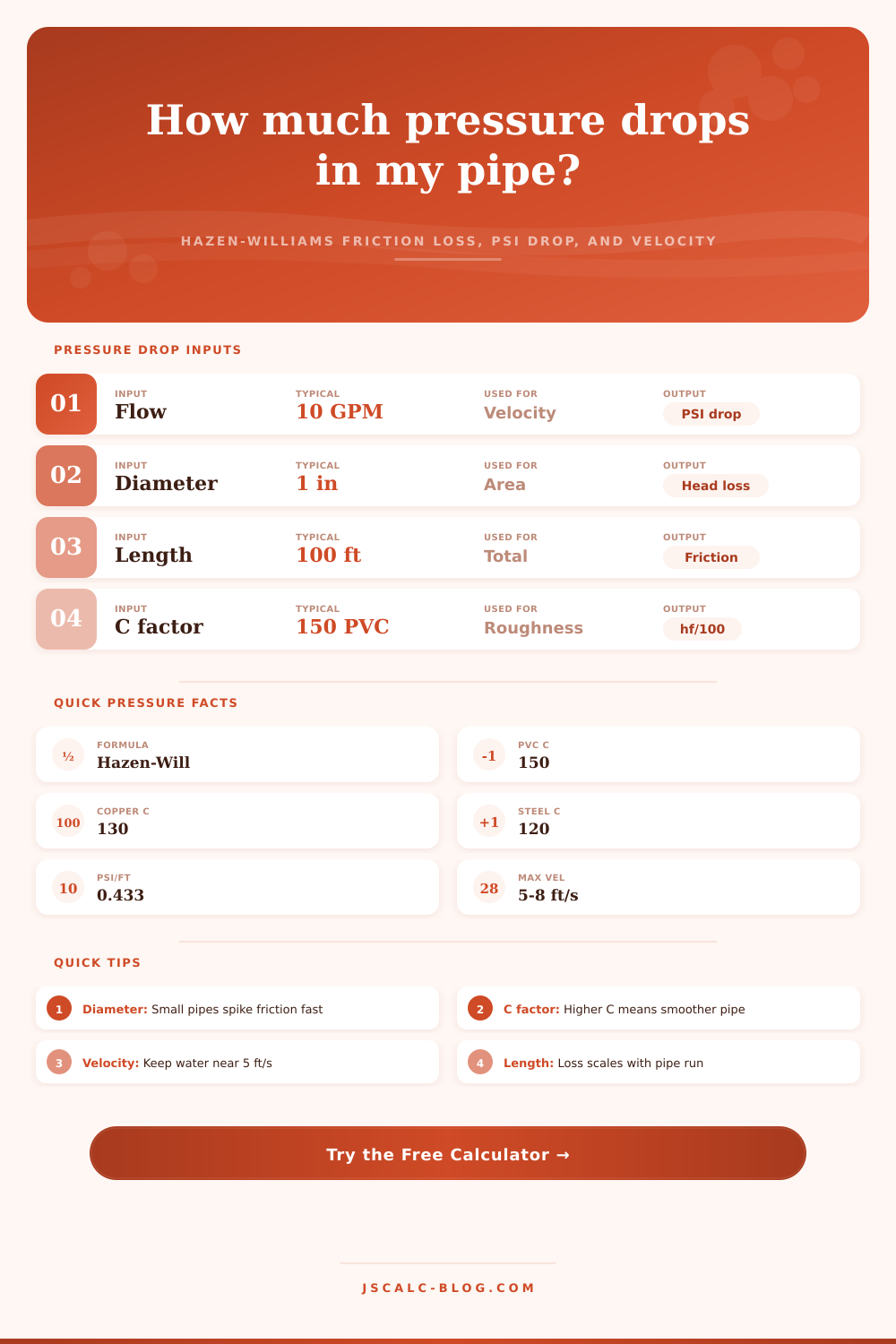
Estimate friction head loss, pressure drop in PSI, loss per 100 feet, and flow velocity for water moving through a pipe using the Hazen-Williams equation in US units.
🔧Real Pipe Presets
📝Pipe & Flow Inputs
Auto-set by material; edit for a custom value.
Auto-filled from nominal size; edit for exact ID.
Elbows and valves as equivalent straight pipe.
Hazen-Williams is calibrated for water.
🔢Formula Snapshot
💧Hazen-Williams C Factor by Material
| Pipe Material | Condition | C Factor | Relative Smoothness |
|---|---|---|---|
| PVC / CPVC / plastic | New | 150 | Very smooth |
| PEX tubing | New | 150 | Very smooth |
| Copper / brass | New | 130 to 140 | Smooth |
| Ductile iron, cement lined | New | 140 | Smooth |
| Steel, new welded | New | 120 | Moderate |
| Galvanized steel | Average | 120 | Moderate |
| Cast iron | Old / tuberculated | 90 to 100 | Rough |
| Concrete | Average | 100 to 130 | Varies |
📊Pressure Drop by Pipe Size at 10 GPM
| Nominal Size | Inner Dia (in) | Velocity (ft/s) | hf per 100 ft | PSI per 100 ft |
|---|---|---|---|---|
| 1/2 in | 0.622 | 10.6 | 70.5 ft | 30.5 psi |
| 3/4 in | 0.824 | 6.02 | 17.9 ft | 7.77 psi |
| 1 in | 1.049 | 3.71 | 5.54 ft | 2.40 psi |
| 1-1/4 in | 1.380 | 2.14 | 1.44 ft | 0.62 psi |
| 1-1/2 in | 1.610 | 1.58 | 0.72 ft | 0.31 psi |
| 2 in | 2.067 | 0.96 | 0.21 ft | 0.09 psi |
Values assume C = 150 (PVC) and 10 GPM. Smaller pipes lose far more pressure because loss rises with roughly the fifth power of diameter.
🚰Velocity Guidelines
| Velocity (ft/s) | Rating | Typical Use | Notes |
|---|---|---|---|
| Under 2 | Low | Gravity, drain | Risk of sediment settling |
| 2 to 5 | Ideal | Supply lines | Efficient, quiet flow |
| 5 to 7 | High | Short branches | Acceptable for short runs |
| 7 to 10 | Very high | Fire service | Noise and wear increase |
| Over 10 | Excessive | Avoid | Erosion and water hammer risk |
🗂Scenario Comparison Grid
| Scenario | Material (C) | Flow | Size / ID | Length | Est. PSI Drop |
|---|---|---|---|---|---|
| Water 100ft PVC | PVC (150) | 10 GPM | 1 in / 1.049 | 100 ft | ~2.3 psi |
| Copper 3/4in | Copper (130) | 6 GPM | 3/4 in / 0.824 | 60 ft | ~2.7 psi |
| Long Run 200ft | PVC (150) | 12 GPM | 1 in / 1.049 | 200 ft | ~13 psi |
| High Flow | PVC (150) | 40 GPM | 2 in / 2.067 | 150 ft | ~2.6 psi |
| Steel Pipe | Steel (120) | 25 GPM | 1-1/2 in / 1.610 | 120 ft | ~7 psi |
| Fire Line | Ductile (140) | 250 GPM | 4 in / 4.026 | 300 ft | ~14 psi |
⚙Full Formula Breakdown
📋Friction Loss Reference
| Input | Common Range | How It Is Used | Effect On Drop |
|---|---|---|---|
| Flow rate Q | 1 to 500 GPM | Raised to 1.852 power | Higher flow raises loss steeply |
| Inner diameter d | 0.5 to 6 in | Raised to 4.8655 power | Bigger pipe cuts loss sharply |
| C factor | 90 to 150 | Roughness in denominator | Smoother pipe lowers loss |
| Length L | 10 to 1000 ft | Linear scale of hf/100 | Loss grows with distance |
| Fittings | 0 to 100 eq. ft | Added to straight length | Elbows and valves add loss |
💡Practical Pressure Tips
When you flush a toilet, why does water pressure go down in your kitchen sink? The water encounters a traffic jam in the wall. This happens every day in many houses. It is easier to understand then blaming an old pump or the citys water supply.
It’s resistance caused by friction… Understanding that will help you diagnose a low-pressure situation, or plan a new irrigation system. Each foot of pipe resist the flow of fluid (that’s the “drag”). And takes energy away from the rest of the system. To remedy the issue, you must quantify that lost energy.
Why Water Pressure Drops in Your Pipes
In the world of civil engineering and plumbing, that’s done with a standard equation called the Hazen-Williams equation. Despite sounding like some kind of academic mumbo-jumbo, it basicly describes pressure loss from friction. All you need to enter are your flow rate, pipe length, pipe material and pipe size. Enter them into the calculator, and voila! The math is done for you. You get a number that you can use to make real-world decisions.
What might surprise you most in this equation is diameter. A lot of folks believe that swapping out their half-inch pipe for a three-quarter inch pipe is hardly an improvement. That’s not true at all. Because of this exponent, the formula raise the inner diameter to nearly the fifth power. This means that small increases in width create huge differences in flow efficiency. Water flows through a slightly bigger pipe with much less resistance.
This non-linear relationship throws a wrench into a lot of DIYers’ plans. You can buy expensive high-pressure pumps until you’re blue in the face, but if your pipes aren’t large enough, youll never get the results you want. Oftentimes, it’s cheaper to size up than to increase your pressure.
And what about material? Maybe more than you’d think. That’s because the interior of the pipe has some sort of roughness (the C factor). The smoother it is, the higher its C value. PVC/PEX tubing has a high C value: very smooth, low resistance. Copper is a bit rougher; old steel pipes can get pretty rough inside if they corrodes over time. But diameter has such a strong impact on friction that going from copper to PVC usually doesn’t save as many pounds per square inch as would moving up from an inch of pipe to an inch-and-a-quarter. When you’re looking to increase flow, put your attention on width, not surface texture.
Finally, there is velocity. Because velocity can affect both wear and noise, it’s something to keep an eye on. Water hammer is what happens if water moves too fast and you shut off a valve quickly, causing the pipes to bang around inside the walls. You’ll notice it if you ever live in a house with really loud plumbing. Generally speaking, keeping velocity under five feet per second is thought of as the sweet spot for home plumbing, since it’s quiet enough but still delivers efficienty.
Real world systems also take into account elevation changes. While the calculator is geared toward friction loss on horizontal runs, it’s working against you if water must travel uphill. For every foot of vertical rise, add approximately zero point four three PSI of required static pressure. To get that much pressure at your source, you’ll need enough initial pressure to not only meet friction drag as determined by this calculator but also overcome the elevation gain. So if you’re designing a system for a property with hillsides, consider those elevation differences before taking the friction numbers alone into consideration.
Resistance within your plumbing system is another hidden problem that older houses are prone to. Galvanized steel plumbing corrodes. Even if it has an effective diameter equal to its nominal rating, the inside will be lined with rust. This rust creates a rough surface that greatly increases friction. You may think you need a higher rated pump because your calculations say there should of been good pressure, but the fact is it’s blocked somewhere. Replacing or cleaning those lines will often return things to working order far more effectively than any pump adjustments ever could.
No piping system is immune to pressure drop. That’s not necessarily bad; that’s physics at work. But knowing where it’s happening and exactly how much helps. Armed with the right information, you don’t guess what’s weak anymore. Does it need fewer fittings? Smoother materials? Bigger pipes? And then, once you know the tradeoffs among resistance, speed, and size, you’re taking control of your plumbing performance. No more surprise sputters when the toilet flushes.