Pregnancy Due Date Calculator
Estimate your estimated due date, current gestational age, trimester, and conception window from your last menstrual period, conception date, IVF embryo transfer, or an early ultrasound gestational age.
🎯Common Pregnancy Presets
📝Pregnancy Inputs
Pick the date you know best. Early ultrasound dating is usually the most accurate.
This is the date the selected method is based on.
Standard is 28. Longer cycles push the due date later.
Used only for the IVF transfer method.
Weeks reported at the scan (ultrasound method).
The 0 to 6 extra days beyond the whole weeks.
Defaults to the current date; change to check any day.
Sets the target date used for the days-remaining count.
🔢Key Pregnancy Numbers
🗓Trimester Timeline
| Trimester | Weeks Range | Start Date | End Date | Approx Length |
|---|---|---|---|---|
| Enter your details above to build the trimester timeline. | ||||
📆Weekly Milestone Dates
| Gestational Week | Milestone | Calendar Date | Days From Now |
|---|---|---|---|
| Milestone dates appear after you calculate. | |||
⚖Method Comparison For Your Dates
| Method | Day Offset | Basis | Estimated Due Date |
|---|---|---|---|
| A side-by-side due date for each method appears here. | |||
🗂Conception To Due Reference
| Scenario | Method | Cycle / Embryo | Offset | Gestation | Accuracy Note |
|---|---|---|---|---|---|
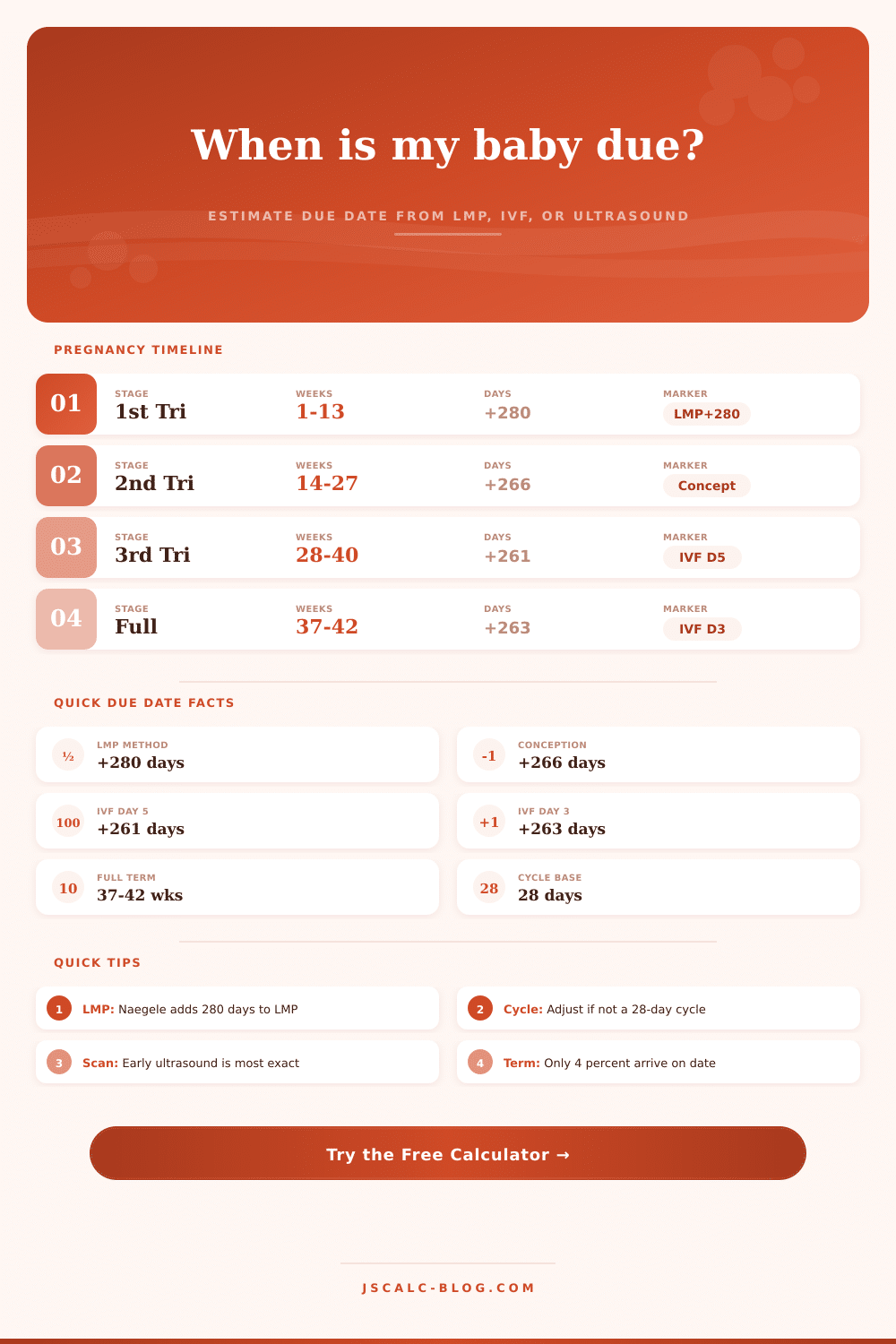
| Regular cycle | LMP | 28-day cycle | +280 d | 40 wk 0 d | Good if cycles are regular |
| Long cycle | LMP | 35-day cycle | +287 d | 41 wk 0 d | Ovulation shifts later |
| Short cycle | LMP | 24-day cycle | +276 d | 39 wk 3 d | Ovulation shifts earlier |
| Known conception | Conception | Fertilization | +266 d | 38 wk 0 d | Best when ovulation is known |
| Blastocyst | IVF | Day 5 embryo | +261 d | 37 wk 2 d | Very precise dating |
| Cleavage stage | IVF | Day 3 embryo | +263 d | 37 wk 4 d | Very precise dating |
| Early scan | Ultrasound | Crown-rump | Varies | Set at scan | Most accurate in weeks 8 to 13 |
⚙Naegele's Rule And Method Formulas
💡Helpful Due Date Tips
Note: This pregnancy due date calculator is an estimation and educational tool only. It is not medical advice, diagnosis, or a substitute for prenatal care. Always confirm your due date and any pregnancy decisions with a qualified healthcare provider.
So if you have some other piece of information with which you’re more comfortabley, you can plug it into this calculator and it’ll give you an estimate for when you were due. It’s never quite as easy as having one date on the calendar because pregnancy dating are dependent upon biological assumptions that might not match your own body. This fills in that gap and lets you pick the data point you are most comfortable with.
The first option for most is beginning of their last menstrual period. That’s a date that most women have in mind. Next they add an additional two-hundred and eighty days from that first day of flow. That means you’re supposed to have ovulated on day fourteen, which is assumption built into this traditional method.
Why Your Due Date Is Only an Estimate
If you typically have a long cycle, more than a twenty-eight day period, chances are high that the standard math will puts you early. So the tool allows you to enter in your true average cycle length and not worry if you think you’re overdue when in fact you’re right on schedule. If you tend to bleed every thirty-five days for example, the math adjust your due date accordingly based off late ovulation. It is not much of a tweak but it avoids needless third-trimester anxiety.
But what happens if you’re not counting on your period, because you’re getting fertility treatments? IVF gives you a clear starting point, removing all the uncertainty of following your cycle: We know exactly when the embryo was placed inside your uterus. Was it a day-five blastocyst or a day-three cleavage stage embryo? That make a difference for the math. The calculator will take that into consideration. It accounts for number of days spent in the lab waiting to become part of you, and then adds the rest of pregnancy on top of that. That’s more precise than fudging a fake last period date that muddies up your prenatal screenings and other medical notes.
If you’ve never had regular periods, or you know yours are irregular, then ultrasound dating add yet another level of accuracy. During early ultrasounds (between eight and thirteen weeks), they can uses the baby’s crown-rump length to establish how far along you are. They physically take a measurement which is more reliable than relying on a theoretical timeline based off when you think your last period was. The tool takes your scan measurements, then goes back to try to find equivalent last period date that would produce this particular size. Then it construct the rest of the months accordingly.
Setting the due date manages expectations, so understanding what all of the jargon means can help as well. From that imaginary starting line, the gestational age will be counted forward or at least that’s how it works for doctors. So, technically you’ll be pregnant (and two weeks pregnant!) before you’re even fertile enough to get pregnant. Doctors use same weird medical convention everywhere… And knowing about it allows you to read your own updates with accuracy.
The tool lays out the timeline by milestones and trimesters, indicating exactly when you cross over each phase. Babies is born anywhere from 37-42 weeks. Most full-term births happen anywhere between thirty-seven and forty-two weeks. Your due date isn’t an actual due date; only about four percent of babies arrive on their exact estimated due date. It’s also a midpoint in a range. While it can provide you with an idea of when you’ll give birth, it doesn’t know when labor will strike (otherwise it would of been called “labor”). Treat it as a road map during your pregnancy to help you plot out what happens in those months, but leave room for flexibility.
This is your due date, a guide for your care, not a guarantee of when you will deliver.