High School GPA Calculator
Find your weighted and unweighted GPA on the 4.0 scale. Add each course, pick a letter grade and level (Regular, Honors, or AP/IB), set credits, and blend in a prior cumulative GPA for the full semester or year picture.
🎓Real High School Presets
📚Your Courses This Term
Most high school courses are worth 1.0 credit for a full year, or 0.5 for a single semester. Choose the level that matches how the course appears on your transcript.
📈Cumulative & Goal Settings
Leave prior credits at 0 if this is your first term.
We estimate the 4.0 credits needed to reach this.
🔢How The GPA Is Built
🅰Unweighted Grade Point Table
| Letter Grade | Percent Range | Grade Points | Meaning |
|---|---|---|---|
| A / A+ | 93 to 100 | 4.0 | Excellent mastery |
| A- | 90 to 92 | 3.7 | Strong work |
| B+ | 87 to 89 | 3.3 | Above average |
| B | 83 to 86 | 3.0 | Good, solid grasp |
| B- | 80 to 82 | 2.7 | Above passing |
| C+ | 77 to 79 | 2.3 | Fair understanding |
| C | 73 to 76 | 2.0 | Average, passing |
| C- | 70 to 72 | 1.7 | Below average |
| D | 60 to 69 | 1.0 | Minimum credit |
| F | 0 to 59 | 0.0 | No credit earned |
These base points are identical for every course level. Weighting only adds a bonus on top for Honors and AP/IB classes.
⚖Weighted Bonus By Level
| Course Level | Bonus | A Weighted | B Weighted |
|---|---|---|---|
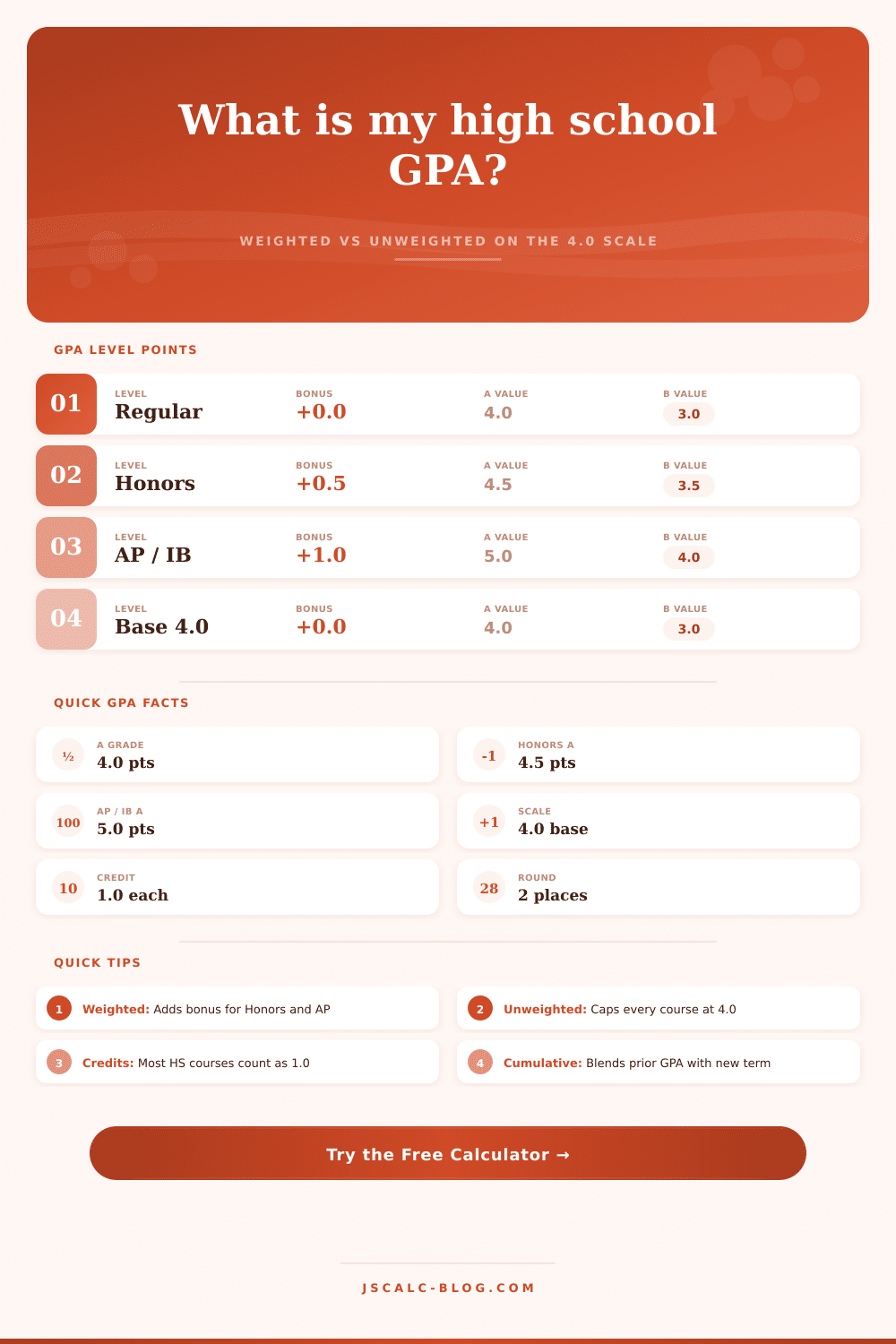
| Regular / College Prep | +0.0 | 4.0 | 3.0 |
| Honors | +0.5 | 4.5 | 3.5 |
| AP / IB | +1.0 | 5.0 | 4.0 |
The unweighted GPA ignores these bonuses entirely, which is why an all-A student always lands at exactly 4.00 unweighted.
🏆GPA To Class Rank Band
| Weighted GPA | Rough Percentile | Typical Standing | Notes |
|---|---|---|---|
| 4.50 and up | Top 5% | Highest honors | Heavy AP or IB load |
| 4.00 to 4.49 | Top 15% | High honors | Strong honors mix |
| 3.50 to 3.99 | Top 30% | Honor roll | Mostly A and B work |
| 3.00 to 3.49 | Top 50% | Above average | Solid B student |
| 2.50 to 2.99 | Middle | Average | Mix of B and C |
| Below 2.50 | Lower half | Needs a push | Focus on recovery |
Percentiles vary widely by school. Use this as a rough feel, not an official rank.
🗓Semester Planning Reference
| Term | Typical Courses | Credits | Counts Toward |
|---|---|---|---|
| Fall semester | 6 to 7 | 3.0 to 3.5 | Half-year grade |
| Spring semester | 6 to 7 | 3.0 to 3.5 | Half-year grade |
| Full year course | 1 subject | 1.0 | Yearly average |
| Semester course | 1 subject | 0.5 | One term only |
| Freshman year | 6 to 8 | 6.0 to 7.0 | Cumulative GPA |
| Four-year total | 28 to 32 | 24 to 28 | Final transcript |
🗂Level Comparison Grid
| Level | Base A | Weighted A | Weighted B | Typical Use | Example Course |
|---|---|---|---|---|---|
| Regular | 4.0 | 4.0 | 3.0 | Standard grade-level class | English 9 |
| College Prep | 4.0 | 4.0 | 3.0 | Prep for college rigor | Algebra 2 CP |
| Honors | 4.0 | 4.5 | 3.5 | Faster, deeper coverage | Honors Biology |
| AP | 4.0 | 5.0 | 4.0 | College credit via exam | AP U.S. History |
| IB | 4.0 | 5.0 | 4.0 | Diploma programme course | IB Physics HL |
| Dual Enrollment | 4.0 | 5.0 | 4.0 | Real college class | ENG 101 |
This calculator treats AP, IB, and dual enrollment as the same +1.0 bonus. Confirm your school's exact policy on your transcript.
⚙Full Formula Breakdown
💡Practical GPA Tips
A mix of letters, numbers, and course levels, high school transcripts can be difficult to understand without context. That is, until you’re required to put them into words. You got an A in regular English, good job! What about the A you earned in AP Calculus?
That’s going to vary depending on whether you’re calculating your weighted vs. Unweighted GPA, making it far more important to know the difference then to strive for straight As. Plug in what classes you took and the calculator will do the math, stripping away the guesswork behind how those bonus points realy add up during your entire four-year run.
How GPA Works
Because the unweighted GPA simply limits each course to a maximum of 4.0 points no matter how difficult the subject, it will give you a straight-up view of your grades. If you recieve an A in chemistry and an A in gym class, those is each worth precisely 4.0 toward your overall score. It reveals nothing but your pure academic achievement on a level playing field, which many colleges uses when judging applicants from high schools that has different grading systems.
But the simplicity hides one of today’s most important truths about high school academics: The rigor of the class can be equally (if not more) meaningful than the letter grade itself. But when you adds the bonus points of weighted GPAs (for AP/IB/Honors courses), it alters the equation. 0. Taking on college level work while still in high school gets rewarded in this system. It’s risky business, there’s no denying the tradeoff.
Bonuses boost your weighted average. That is where folks mess up. They are so scared of losing an A that they skips hard classes altogether. This not only impacts their class rank but also their college chances, this can sometimes be worse than if they would of just gotten a B in a tough course.
Cumulative GPAs can be another headache: Students don’t understand that they’re being combined over semesters. You might get an “A” this term; but then what? You has to combine all those new points with all the ones you’ve already earned. The site on the page lets you plug in past GPA and credits, and tells you what your GPA will look like if this semester is added to your mix.
Why do early grades stick? Because this mixing explains it: Say you take B’s throughout freshman year. That’ll drag down your average for years, because those B credit get mixed into your denominator permanently. They’ll never go away. It’s far more difficult (math-wise) to pull up a big denominator once it exists than it is to start from scratch with a clean slate.
The key here is that we’re planning around these points, not responding to our report card. Have a goal of a 4.0+ GPA? Work backwards and determine exactly how many credits at each grade level you must now get in order to achieve this. It shifts your worry from “I should do better” to “I can still make up for my previous C’s with X number of A-weighted class.” And the table on the page provides the point values in clear terms, you don’t have to do your own multiplication every time you wonder how an Honors B stacks up against a Regular A.
At its core, GPA isn’t only about being smart: it’s also about making choices and staying consistent with them. Do colleges want students who scored 100% on easy classes or students who work hard in challenging classes while still achieving a respectable grade? By using the proper tools to view both the weighted and unweighted numbers, you can see the full picture. This allows you to make educated decisions about which courses to take every semester without guesswork.
Will all this work realy be worth it? You’ll know exactly how each class will contribute to your overall standing, allowing you to strategically balance out your load. This transparency makes a stressful number more like a real plan for your academic future.