On-Target Earnings Calculator
Calculate OTE as base salary plus target variable pay at 100% quota, then model attainment, accelerators, ramp guarantees, draw recovery, and pay mix.
Fixed salary before variable compensation.
OTE equals base salary plus this target variable amount at 100% quota.
Used to compare target variable with quota-based commission economics.
Use 0 for uncapped variable payout.
OTE estimate
OTE definition: On-target earnings are the annual base salary plus target variable or commission when the rep reaches 100% of quota.
OTE = base salary + target variable pay at 100% quota
Quota attainment = credited bookings x credit factor / annual quota
Actual earnings = base salary + earned variable + ramp guarantee or draw adjustment
The calculator uses target variable as the primary payout basis, then checks the implied commission rate against quota. When accelerators are enabled, dollars above the accelerator start earn the target payout rate multiplied by the accelerator factor.
| Role plan | Common pay mix | Quota basis | Target variable trigger | Upside design | Watch point |
|---|---|---|---|---|---|
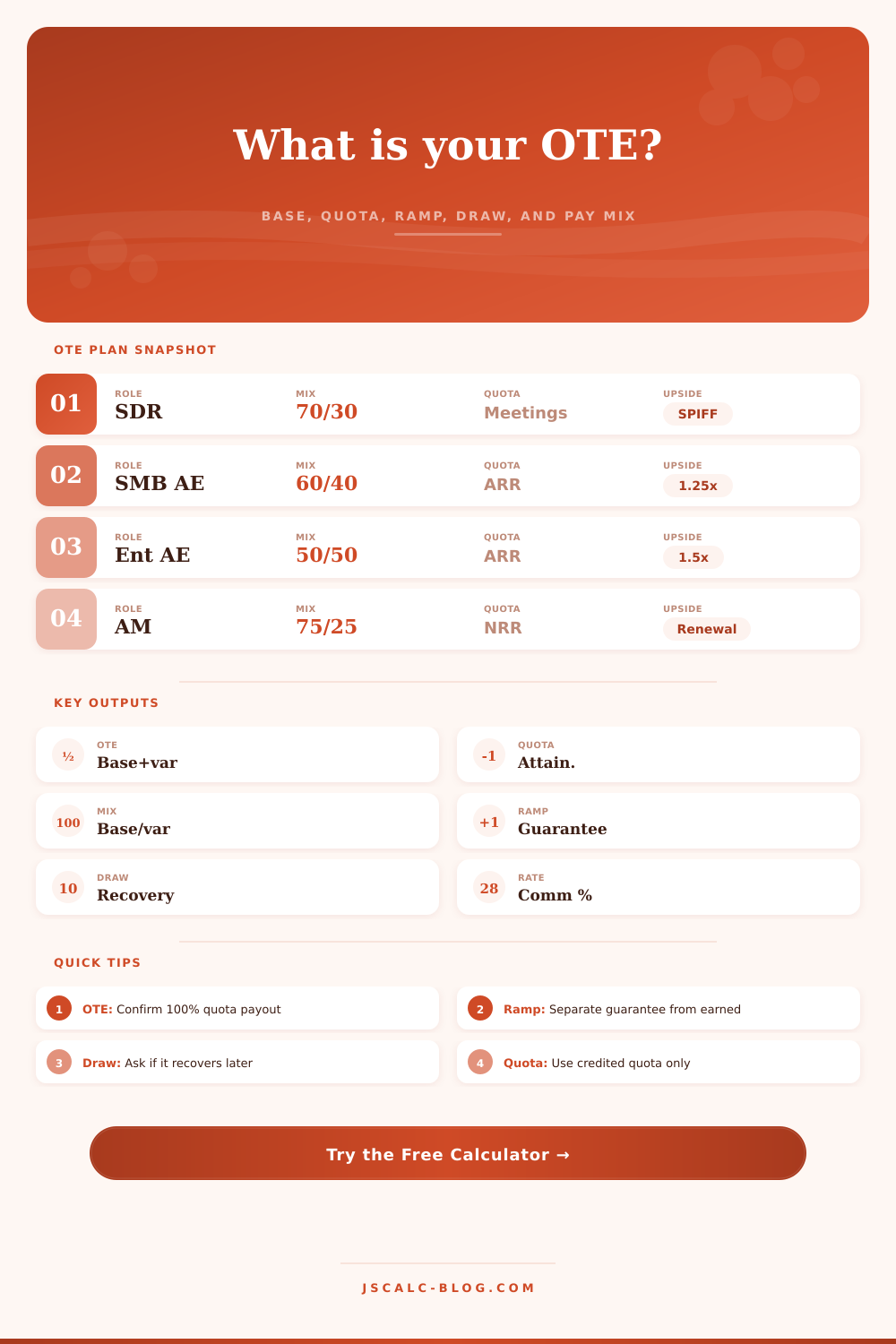
| SDR / BDR | 70/30 to 80/20 | Meetings, pipeline, SQLs | Activity or sourced pipeline target | Per-meeting bonus or quality kicker | Quality rules can reduce credit |
| SMB AE | 60/40 to 65/35 | Monthly or quarterly ARR bookings | Closed-won revenue at quota | Simple accelerator after 100% | Small deal churn may claw back pay |
| Mid-market AE | 55/45 to 60/40 | Quarterly ARR or ACV quota | Revenue credit against ramped quota | Tiered rate at 100% and 125% | Split-credit deals need clean inputs |
| Enterprise AE | 50/50 to 55/45 | Annual ARR, ACV, or TCV quota | Large-deal booking credit | High accelerator for over-quota dollars | Caps and mega-deal clauses matter |
| Account manager | 70/30 to 75/25 | Renewal, expansion, or NRR | Retention target plus expansion credit | Expansion multiplier above base | Churn deductions may offset expansion |
| Customer success | 75/25 to 85/15 | GRR, NRR, adoption, renewals | Scorecard or renewal quota target | Balanced bonus with caps | Non-revenue metrics change payout |
| Channel manager | 65/35 to 75/25 | Partner-sourced bookings | Credited partner revenue at target | Override or tiered partner bonus | Partner attribution can be disputed |
| Sales manager | 60/40 to 70/30 | Team quota and forecast accuracy | Team attainment against period target | Override plus team accelerator | Team composition affects predictability |
| Attainment band | Linear payout | Threshold curve | Tiered curve | Accelerated curve |
|---|---|---|---|---|
| Below 50% | Paid pro rata | Often $0 variable | Reduced factor | No accelerator |
| 50%-79% | 50%-79% of target variable | Begins after threshold | Lower band payout | Base rate only |
| 80%-99% | Near-target payout | Pro rata after gate | Standard band payout | Base rate only |
| 100% | 100% target variable | 100% if threshold cleared | 100% target variable | Target variable paid |
| 101%-124% | Pro rata over target | Pro rata over target | First accelerator tier | Accelerator on overage |
| 125%-149% | Higher than target | Higher than target | Second accelerator tier | Multiplier often increases |
| 150%+ | May continue uncapped | May continue uncapped | Top tier or review | Caps may apply |
| Setup | How it affects OTE cash | Calculator input | Result behavior |
|---|---|---|---|
| No ramp | Earned variable follows quota attainment | Ramp months 0 | No guarantee added |
| Three-month guarantee | Guarantees a portion of variable while ramping | Ramp months 3, guarantee 100% | Compares earned variable with guaranteed amount |
| Partial ramp | Guarantees less than full target variable | Guarantee below 100% | Adds only the shortfall above earned variable |
| Recoverable draw | Advance is recovered from future commission | Recoverable draw and prior balance | Deducts draw recovery before payout |
| Non-recoverable draw | Guarantee is not carried forward | Non-recoverable draw | Uses greater of earned variable or draw |
| Prior balance | Old recoverable draw reduces current cash | Prior recoverable balance | Tracks remaining balance after earned variable |
| Base salary | Target variable | OTE | Pay mix | Implied quota rate on $1M quota |
|---|---|---|---|---|
| $60,000 | $20,000 | $80,000 | 75/25 | 2.0% |
| $70,000 | $30,000 | $100,000 | 70/30 | 3.0% |
| $90,000 | $60,000 | $150,000 | 60/40 | 6.0% |
| $110,000 | $90,000 | $200,000 | 55/45 | 9.0% |
| $125,000 | $125,000 | $250,000 | 50/50 | 12.5% |
| $150,000 | $150,000 | $300,000 | 50/50 | 15.0% |
Prepared for JSCalc-Blog.com calculators.
The offer letter is before you and, hey, the bottom-line amount looks good…until you start reading between the lines. “On-target earnings” seems simple enough, but there’s some friction here. It mean what you’d make if you meet precisely one-hundred-percent of quota. No more, no less. Not the ceiling. Not the floor. This is a hypothetical midpoint based off the company’s definition of success and its willingness to reward overachievers. The formula above do all the heavy lifting, translating vague phrases such as draw recovery and accelerators into dollars-and-cents reality. But looking closer reveal a deeper understanding of how math works.
First up: pay mix. What’s the combination of base + variable? Is it a 70/30 (three-quarters of your earnings are stable but capped)? Or a 50/50 (more risk but potentially more reward)? Knowing what side of that continuum you’re comfortabley on is key. Is it heavier on base? That’s safe if you’re new to sales (or you’re entering into an unstable market). Is there a higher variable component? More risk yes, but also more of the real money are on that end of things. It breaks down both the base and variable part to help you see exact dollar amounts on each.
Understanding Your Pay Plan Details
Guaranteed vs. Earned. The variable part come from meeting quotas. Most plans pay at a steady rate up to the hundredth percentile: On each dollar earned up to quota, you get paid at your target commission rate. Once you reach quota, most plans shifts to an accelerated formula. For each additional dollar above quota, you earn a percentage that’s higher then your target.
It answers the question of “how much does additional effort pay off?” A weak accelerator means that going to 125% quota will feel like a heck of a lot of effort to recieve a tiny bump. A strong accelerator make the final 25% of your quota worth a large chunk of your overall bonus. Always look to see when the accelerator kicks in, and how steeply it ramps.
And then you’ve got ramp time. In most cases, new rep rarely hit full quota in their first quarter. To compensate for this, companies offer what’s called a ramp guarantee, so you’ll be paid your target amount despite having to establish your own pipeline. That’s good, but not free. Some guarantees is recoverable draws (i.e., loans from your upcoming commission checks), which you’ll eventually have to pay back. Other guarantees are non-recoverable, with the company eating the loss. The larger your draw balance, the longer it could of take for you to regain your earnings… In some cases up to several years! Make sure you know whether you’re receiving a real guarantee or something that will need to be repaid.
But there’s another level of complexity: split credits and threshold rules. Split credits means that if you’re part of a team, then maybe you’ll only recieve credit for a fraction of the value of the deal. So although it’s still real revenue, it may not count toward your quota as much. And thresholds means you won’t receive anything at all unless you reach some minimum % of quota (hence why they call it a “cliff“, missing the mark by just a little bit can be deadly). How these factors impact each role is shown in the reference table below (although yours probably has some twists and turns unique to your plan):
Last, review the cap. If you had a killer quarter, it can be irritating when some companies caps your earning potential. Your interests should align with the company’s, so go for an uncapped plan that lets your earnings scale based off your results.
During the negotiation process, don’t just focus on the number at target. Inquire about the ramp guarantee terms, the accelerator curve and any caps. Be truthful about how much you expect to attain (and what rules apply). Since the calculator is only as good as the inputs you plug in. Knowing the mechanics will give you a crystal-clear picture of financial plan you’re agreeing to.