Ohm's Law Calculator
Enter any two of voltage, current, resistance, or power and this calculator solves the remaining two using Ohm's law and the full power wheel, with unit conversion for milliamps, kilohms, and milliwatts.
⚡Real Circuit Presets
🔌Known Values
Only the two boxes in your chosen pair are active; the rest are solved for you.
🔢Quantity Snapshot
🛞Power Wheel: All 12 Formulas
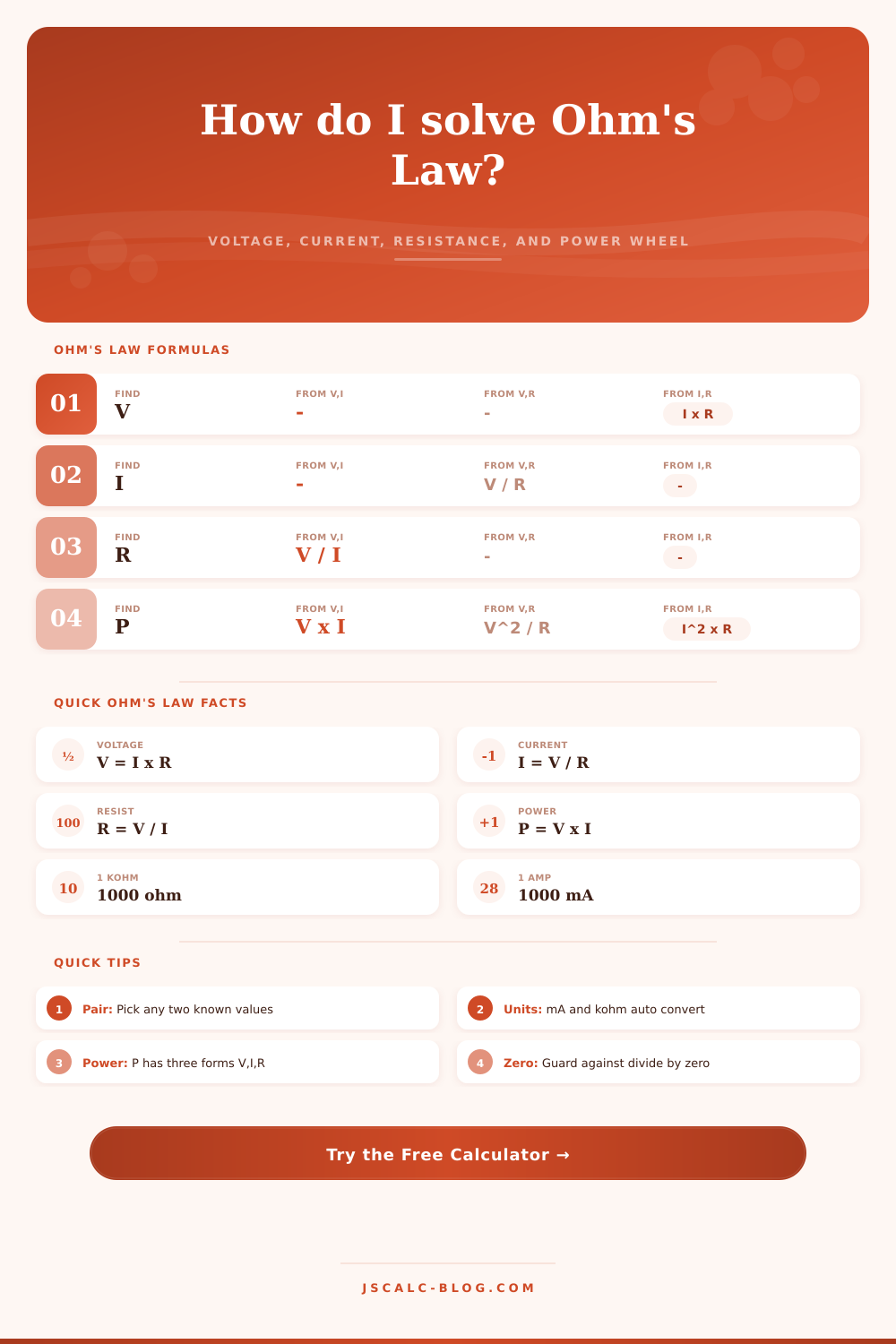
| Find | Using V and I | Using V and R | Using I and R |
|---|---|---|---|
| Voltage V | – | – | V = I × R |
| Current I | – | I = V / R | – |
| Resistance R | R = V / I | – | – |
| Power P | P = V × I | P = V² / R | P = I² × R |
| Find | Using P and V | Using P and I | Using P and R |
|---|---|---|---|
| Voltage V | – | V = P / I | V = √(P × R) |
| Current I | I = P / V | – | I = √(P / R) |
| Resistance R | R = V² / P | R = P / I² | – |
| Power P | – | – | – |
🔋Common Voltage Reference
| Source | Voltage | Type | Typical Use |
|---|---|---|---|
| AA / AAA cell | 1.5 V | DC | Small electronics |
| Lithium cell | 3.7 V | DC | Phones, packs |
| USB port | 5 V | DC | Charging, logic |
| 9V battery | 9 V | DC | Smoke alarms |
| Car system | 12 V | DC | Auto electrical |
| US mains | 120 V | AC | Home outlets |
| EU mains | 230 V | AC | Home outlets |
| Dryer / heater | 240 V | AC | Large appliances |
🔥Resistor Power Rating Guide
| Rating | Safe Draw | Body Size | Where Used |
|---|---|---|---|
| 1/8 W | ≤ 0.125 W | Tiny | Signal, logic lines |
| 1/4 W | ≤ 0.25 W | Small | General hobby use |
| 1/2 W | ≤ 0.5 W | Medium | LED strings, bias |
| 1 W | ≤ 1 W | Large | Power supplies |
| 5 W | ≤ 5 W | Ceramic | Loads, dummy loads |
| 10 W+ | ≤ 10 W | Wirewound | Heaters, braking |
📏Unit Prefix Reference
| Prefix | Symbol | Factor | Example |
|---|---|---|---|
| Micro | µ | × 0.000001 | 500 µA = 0.0005 A |
| Milli | m | × 0.001 | 20 mA = 0.02 A |
| Base | – | × 1 | 5 V = 5 V |
| Kilo | k | × 1000 | 4.7 kΩ = 4700 Ω |
| Mega | M | × 1000000 | 1 MΩ = 1000000 Ω |
📊Worked Comparison Grid
| Scenario | Voltage | Current | Resistance | Power | Known Pair |
|---|---|---|---|---|---|
| 12V, 100Ω load | 12 V | 120 mA | 100 Ω | 1.44 W | V & R |
| LED at 20mA | 3.3 V | 20 mA | 165 Ω | 66 mW | V & I |
| 60W light bulb | 120 V | 500 mA | 240 Ω | 60 W | P & V |
| 5V USB, 500Ω | 5 V | 10 mA | 500 Ω | 50 mW | V & R |
| 240V heater | 240 V | 6.25 A | 38.4 Ω | 1500 W | P & V |
| 9V, 470Ω | 9 V | 19.1 mA | 470 Ω | 172 mW | V & R |
| Car 12V, 5A | 12 V | 5 A | 2.4 Ω | 60 W | V & I |
| 8Ω speaker | 8 V | 1 A | 8 Ω | 8 W | V & R |
⚙Full Formula Breakdown
💡Practical Ohm's Law Tips
Ohm’s Law is an equation that explains how electricity works by defining relationship between power, current, resistance and voltage. While it may be an abstract concept, it becomes a useful one when you’re trying to retrofit a light fixture in your garage or wire a simple circuit of LEDs for your kid’s science project. You might not understand something about those components or their power source, such as whether they will work together or how bright they will shine., than Ohm’s Law comes into play. In short, you’d be guessing as to whether or not your component will smoke or shine nicely.
These are electrical terms. Voltage is the electrical pressure that causes electrons to move along a wire. Current is the movement of electrons along a wire. Resistance resists the flow of electron. These three things is related; they affects each other when any one changes. For example: When you raise your voltage and hold resistance steady, current will increase. The calculator figures out this math for you on the fly, but it’s helpful to know what’s going on so you can have faith in the number. Knowing how these forces act on each other in actual circuit makes memorizing all combinations of formulas unnecessary.
How Ohm’s Law Works
The variable that frequently confuses people are power, which is the rate at which a component dissipates (or consumes) energy. Power in a light bulb is light and heat. Power in a resistor is nearly all heat. Why does this matter? Because exceeding the power rating of a component result in failure. Although a small signal may be OK through a standard quarter-watt resistor, a big current driven through it will cause it to burn out. The physical sizes and corresponding applications is shown in the reference tables on the page in terms of wattage ratings.
Because it’s so simple to mistakenly enter milliamperes instead of amperes, or millivolts instead of volts, using these equations for unit conversion is tricky. Mistakes occur easily, resulting in answers that differ from a factor of a thousand. To overcome this, the tool will convert any milliamps, kilohms, and milliwatts into their base units first, then crunch those numbers together. That way, there’s no room for errors due to fumbling with decimal points (a novice mistake). Enter values in whichever scale is most comfortabley, and the system will convert them for you.
What happens when instead you plug a 100-ohm resistor into a 12 volt battery? According to Ohm’s Law, the current is about 83 milliamperes. That shouldn’t be too bad: less than a watt lost across the resistor. But now imagine replacing it with a 10 ohm resistor. Current rises to more than an ampere. Wires may heat up and the battery can empty rapidly. Until you do some calculations, you don’t see these trade-offs.
Some people gets obsessed with voltage and overlook current limitations. A 5-volt device should of been powered by a 5-volt source, right? That’s very wrong! A tiny coin-cell battery will provide less current than a wall charger, which means you might have a problem when your circuit try to pull too much. Either your battery voltage will drop, or the cell may leak. By understanding how much current something uses, you’ll know what kind of power source to use for it. You won’t get failures where things appear to work fine, but fail miserably once you give them some load.
The power wheel expands Ohm’s law by adding energy considerations. If you see the power rating for something and the voltage it runs on, you can calculate the resistance in ohms. For example, look at the label on your appliances. If it says they draw 60 watts on 120 volts, then you know they run on.5 amps. That translates to information about the kind of fuse or wire that’s required for safety. It converts a label into engineering data you can do something with. It makes electrical systems seem like a balance equation instead of a mystery box.
Regardless of confidence level, there’s no cheating the math with electricity. Whether it’s a small component or 12v batteries, taking time to work out the numbers prior to soldering transitions you from experimentation to deliberate design. There is a difference between building something that lasts and one that simply works because it happened. And when it comes down to it, the numbers always tells you the truth of what’s going on inside your wires if you remember those relationships.