Dilution Calculator
Solve the C1V1 = C2V2 dilution equation for stock volume, final volume, or concentration, find how much diluent to add, read the dilution factor, and plan serial dilutions across M, mM, %, and x units.
🧪Real Dilution Presets
📝Dilution Inputs
C2 must be less than or equal to C1; dilution cannot concentrate.
1:10 means factor 10, so each step is a 10-fold dilution.
🔢Formula Snapshot
📊Serial Dilution Steps
| Step | Ratio | Cumulative Fold | Concentration | Transfer | Diluent |
|---|---|---|---|---|---|
| Enter values above to generate the serial dilution steps. | |||||
📏Dilution Factor Reference
| Ratio | Fold | % of Stock | Stock : Diluent | Per 10 mL Final |
|---|---|---|---|---|
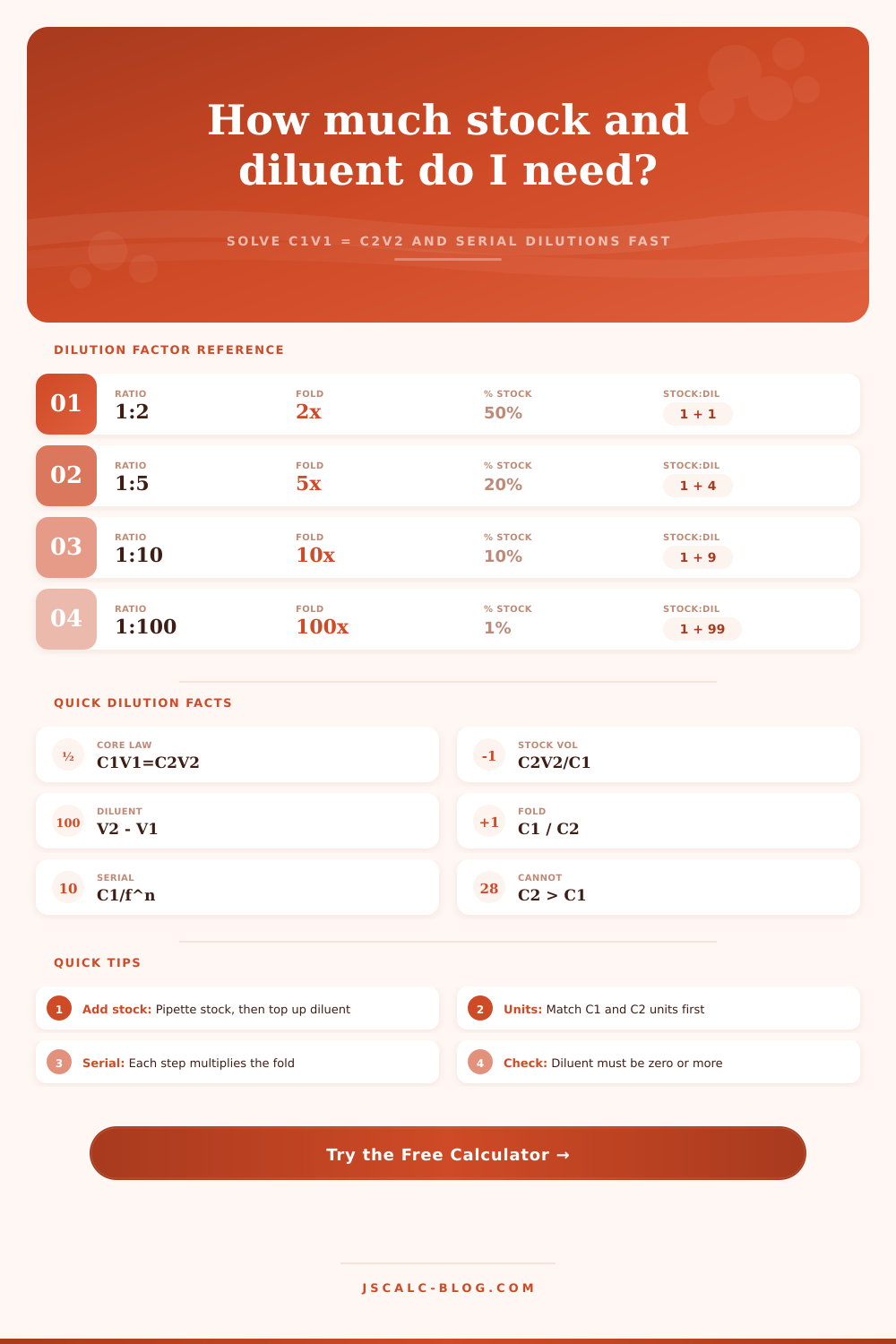
| 1:2 | 2x | 50% | 1 + 1 | 5 mL + 5 mL |
| 1:3 | 3x | 33.3% | 1 + 2 | 3.33 mL + 6.67 mL |
| 1:4 | 4x | 25% | 1 + 3 | 2.5 mL + 7.5 mL |
| 1:5 | 5x | 20% | 1 + 4 | 2 mL + 8 mL |
| 1:10 | 10x | 10% | 1 + 9 | 1 mL + 9 mL |
| 1:20 | 20x | 5% | 1 + 19 | 0.5 mL + 9.5 mL |
| 1:50 | 50x | 2% | 1 + 49 | 0.2 mL + 9.8 mL |
| 1:100 | 100x | 1% | 1 + 99 | 0.1 mL + 9.9 mL |
🧮Concentration Unit Reference
| Unit | Meaning | Relative to M | Convert to M | Typical Use |
|---|---|---|---|---|
| M | Moles per liter | 1 M | × 1 | Reagent stocks, buffers |
| mM | Millimolar | 0.001 M | ÷ 1000 | Assay working ranges |
| µM | Micromolar | 0.000001 M | ÷ 1,000,000 | Drug and inhibitor doses |
| nM | Nanomolar | 1e-9 M | ÷ 1e9 | Primers, high-affinity ligands |
| % | Percent (w/v or v/v) | Relative scale | Keep C1 and C2 in % | Bleach, ethanol, detergents |
| x | Fold concentrate | Relative scale | Keep C1 and C2 in x | Buffers, gels, master mixes |
🧴Common Lab Stock Dilutions
| Reagent | Stock (C1) | Working (C2) | Fold | Per 50 mL | Note |
|---|---|---|---|---|---|
| TAE / TBE buffer | 50x | 1x | 50x | 1 mL + 49 mL | Gel running buffer |
| PBS | 10x | 1x | 10x | 5 mL + 45 mL | Wash and dilute cells |
| Tris-HCl | 1 M | 50 mM | 20x | 2.5 mL + 47.5 mL | Match pH before use |
| NaCl | 5 M | 150 mM | 33.3x | 1.5 mL + 48.5 mL | Physiological salt |
| Bleach (NaOCl) | 8.25% | 0.26% | 32x | 1.56 mL + 48.44 mL | 1:32 surface sanitizer |
| Ethanol | 100% | 70% | 1.43x | 35 mL + 15 mL | Disinfectant strength |
| Antibody | Neat | 1:500 | 500x | 0.1 mL + 49.9 mL | Blot or stain dilution |
| DNA loading dye | 6x | 1x | 6x | 8.33 mL + 41.67 mL | Add to sample volume |
⚙Full Formula Breakdown
💡Practical Dilution Tips
In nearly all wet labs, there’s this tension: a given amount of concentrated stock solution cost more per milliliter than gold; you don’t want to waste any; now how do you make some working reagent? Dilution math is deceptively simple: you take solute from one container, add solvent (in an appropriate way), then repeat until its concentration are at the desired level. Yet even with such simplicity, people screw up on this routinely, daily because they think of concentration as linear and volume as additive in their heads.
Thankfully, the core equation, C1V1 = C2V2. Does the algebra for us, letting us solve for whatever variable we’re lacking from our protocol. To use the calculator (above), just set your starting conditions and your desired final concentration/stock strength, and let the calculator do the math for you. Enter volume of reagent you want to make and the amount of each component you’re starting with.
How to Dilute Solutions Correctly
The calculator will tell you the exact amount of expensive stock to pipette out and how many ml of water/buffer you should of add to get to the right volume. That’s the part about dilution volumes versus total final volumes that trips people up, since it can be tempting to assume “ten percent” means adding ten percent solvent, when really it means your solute take up only ten percent of the TOTAL space. When you add ten mL of stock to ninety mL of water, you end up with one hundred milliliters of final product. To find the diluent volume, subtract the stock volume from the final volume.
It’s not quite as simple, and it gets trickier still when you try to mix concentrations. Whether you use ten X buffer, percentage solutions, or molarity, the ratio stay the same regardless of unit used. If you’re starting with concentrate (relative to the solution you want), then a five fold dilution will cut its concentration in half. And the handy reference table on the page makes it all clear, spelling out exactly how much diluent and how much stock to use for any desired final volume (e.g., ten milliliters) and common ratios (e.g., one to hundred, one to ten).
That way you can see just how the arithmetic comes out the same despite a one to five dilution feeling very different than a one to fifty dilution. In serial dilutions, each step multiplies the previous number rather than adding to the dilution, which makes it easy to lose track of your progress. If you do three 10 fold steps, then you have a thousand fold dilution, not thirty. That’s important if you are doing antibiotic susceptibility testing or creating a standard curve for other kinds of tests such as ELISAs.
The calculator will walk you through the serial dilutions, showing you the cumulative dilution in each tube so you know how much range you end up with and whether it match what your assay can measure. When you get down to really tiny volumes, pipetting accuracy is plummeting rapidly, which means that what gets calculated often fail in practice. Far better to make an intermediate dilution in ten milliliters, then take aliquots out of there. You are much less likely to mess up by accidently pipetting one microliter into ninety nine microliters.
Mixing thoroughly at each serial step is non negotiable. Incomplete mixing just compounds the error as it goes forward. If the first tube is a little under-mixed, every following tube become more incorrect, and with six or eight steps like this, the error add up fast.
Add stock to volume: This method will guarantee that your final concentration is correct even if you are off by a little when you initialy read the meniscus. Because you are adding the stock first and then bringing it up to volume in the volumetric flask or graduated cylinder, you know exactly what your final volume is rather than guessing at volumes from an open beaker. It is a little habit, but it helps save on reagent and prevents you from needing to start over late in the day.
Once you understand this, diluting stuff goes from being a tedious task to an exact means of achieving wanted results. It’s no longer guesswork; it becomes engineering your solution by design. Next time you have a precious vial of stock, recall that what you pull out is everything, it’s all about how much volume you remove. Nail down that initial step and everything else falls into place.