Next Leap Year Calculator
Find the next Gregorian leap year, count down to February 29, check the previous leap year, and list upcoming leap years from a selected date or year.
Leap Year Results
| # | Leap Year | February 29 | Days From Start | Year Gap |
|---|---|---|---|---|
| 1 | 2028 | Tue, Feb 29 | 581 | 4 years |
| Year | Divisible by 4 | Divisible by 100 | Divisible by 400 | Leap Year? |
|---|---|---|---|---|
| 2028 | Yes | No | No | Yes |
| Century Year | Gregorian Result | Why | Next Leap Year |
|---|---|---|---|
| 1900 | Common year | Divides by 100, not 400 | 1904 |
| 2000 | Leap year | Divides by 400 | 2000 |
| 2100 | Common year | Divides by 100, not 400 | 2104 |
| 2200 | Common year | Divides by 100, not 400 | 2204 |
| 2300 | Common year | Divides by 100, not 400 | 2304 |
| 2400 | Leap year | Divides by 400 | 2400 |
| Step | Formula | What It Checks | Output |
|---|---|---|---|
| Leap test | year % 4 = 0 | Most four-year years | Possible leap |
| Century test | year % 100 = 0 | Century exceptions | Usually common |
| 400-year test | year % 400 = 0 | Century override | Leap year |
| Forward search | first passing year | Candidate Feb 29 date | Next leap year |
| Countdown | Feb 29 - start | UTC calendar days | Days and exact Y-M-D |
We are taught that leap years is simply mechanical: Add four to the year. And there you have it! Four every four years, February 29th comes around like clockwork. For most of us this holds true throughout our lives. But stare deep into the logic of the calendar and you’ll see where things go wrong.
The Gregorian calendar isn’t as straightforward than four years. In fact, its rules depend on strict conditions.
How Leap Year Rules Really Work
Plug in your start date into the calculator above and it does the work for you. You won’t get tripped up on century exceptions that catch everyone else off guard.
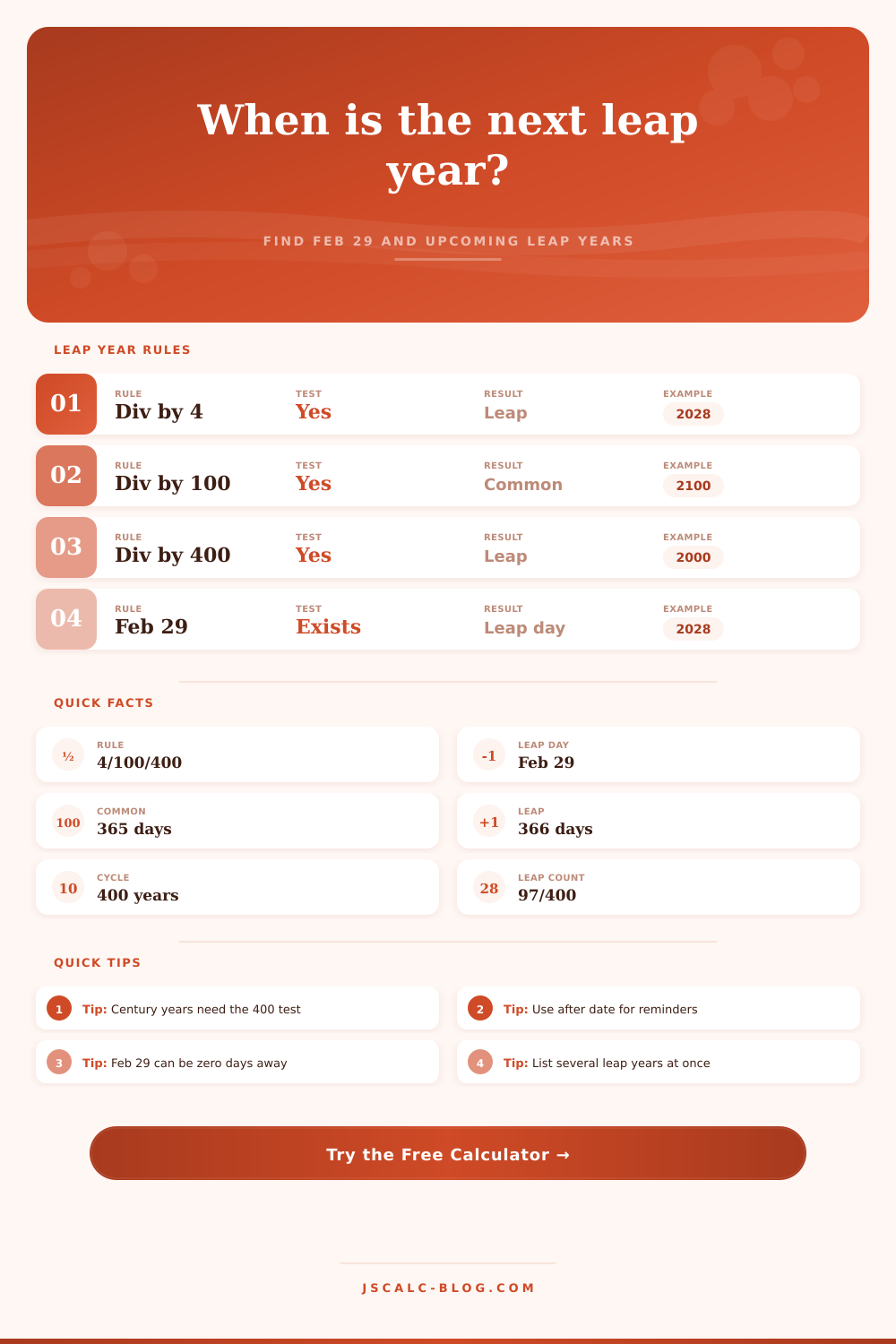
Here’s the simple rule. A leap year is any year divisible by 4. Twenty-eight works just right for two thousand twenty-eight. But the calendar gives us old curve ball of making every one-hundredth year stop being a leap year. That’s because if a year is also divisible by one hundred then it becomes a non-leap year. Otherwise, the calendar would fall out of sync too quickly.
Except, the calendar fixes its own mistake every four hundred years. That’s why two thousand was a leap year. It is also why two thousand one hundred won’t be. This understanding are important if you plan to schedule things far out in time.
When you want to schedule a financial goal or other project months or even decades ahead, having to assume every fourth year is a leap year throws off calculations in subtle ways that add up over time. The calculator gives you the chance to check certain years against the rules. You’ll learn how for example two thousand one hundred doesn’t work whereas two thousand four hundred does.
That’s because over a four-hundred-year cycle, there are a few fewer leap years than normal, ninety-seven instead of a hundred. So after four hundred years, there aren’t a hundred leap years. Just ninety-seven. That accuracy keeps the seasons from moving an entire day every one-hundred-and-twenty-eight years.
This also helps clarify when to start counting. Depending on when you begin counting, the next leap year might end up in same calendar year you started with. This could happen, for example, if you haven’t hit February 29th yet. You can tell it either to include current year in the results, or only look ahead.
That difference is important for reminders. When I’m setting a reminder for something like February 29th, do I want today’s date included? Strict mode excludes the current day, meaning it will always show you a future occurrence.
That’s not just some novelty. It’s how we can begin visualizing (and counting down to) a date like February 29th. This makes it feel less like a cold, impersonal number of days from now and more like a date that we can wrap our heads around as humans.
Not only does the tool break it down into years, months, and days, but if you happen to be someone who needs accounting or budgeting reasons to care about leap day, it’ll tell you what fiscal year contains the leap day. For example, sometimes fiscal years don’t coincide with calendar years, so knowing whether or not the leap day will land within your current/next fiscal period could affect your quarterly estimates.
The day number of the year isn’t something most of us consider. February 28th is actualy the fifty-ninth day of the year (in a common year). Because of this, entire rest of the year gets pushed forward a day. Take note of birthstone associations and other things that depend on specific dates and day counts.
For instance, leap day is the sixtieth day of the year. It all sounds trivial, but it has an effect. That is why the calculator will show you ordinal info so you can see where you are in the calendar year.
The tool lists the divisibility rules neatly in the reference tables. It’s easy to see at-a-glance which years are leap years and why. That level of transparency doesn’t just help you memorize a list; it also helps you learn the pattern. If you know the four hundred-year cycle, it’s easy for you to predict leap years with no need for a calculator.
Until then, though, the tool takes the guesswork out of it. What might otherwise be a possibly confusing arithmetic problem is now simply an answer.
At the end of the day, however, the calendar is a human invention attempting to impose order onto the chaotic world. Our solution should of been the leap year. When we go too fast, we skip a day. When we go too slow, we add one back.
And this is where the calculator comes in. It transforms those abstract rules into concrete dates. If you want to know when the next February 29th will be or how many years you have until retirement, it lets you get a grip on time. Once you know exactly how many days there are, you can make them do what you want.
But the next leap year isn’t just another number. It’s a marker in the constant movement of the seasons.