Mounjaro Half-Life Calculator
Estimate tirzepatide decay from your last dose, the weekly accumulation ratio, steady-state peak and trough, and how long it takes to plateau. Uses a ~5-day half-life with once-weekly dosing. Educational estimate only.
💉Tirzepatide Dose Presets
📝Dose & Timing Inputs
Mounjaro pens: 2.5, 5, 7.5, 10, 12.5, 15 mg.
Tirzepatide is cited near 5 days (~116 hours).
Once weekly = 7 days between injections.
Number of weekly doses taken so far.
Days elapsed since your most recent injection.
🔢Formula Snapshot
📉Single-Dose Decay By Day
| Day | Fraction Left | Percent Left | mg From Your Dose |
|---|---|---|---|
| Enter values above to build the decay table. | |||
📈Weekly Accumulation Timeline
| Week / Dose | Peak (mg) | Trough (mg) | % Of Steady State |
|---|---|---|---|
| The accumulation timeline appears after calculation. | |||
🗂Percent Remaining Comparison Grid
| Days Since Dose | % Remaining | 2.5 mg | 5 mg | 10 mg | 15 mg |
|---|---|---|---|---|---|
| 0 days | 100.0% | 2.50 mg | 5.00 mg | 10.00 mg | 15.00 mg |
| 1 day | 87.1% | 2.18 mg | 4.35 mg | 8.71 mg | 13.06 mg |
| 2 days | 75.8% | 1.89 mg | 3.79 mg | 7.58 mg | 11.37 mg |
| 3 days | 66.0% | 1.65 mg | 3.30 mg | 6.60 mg | 9.90 mg |
| 5 days | 50.0% | 1.25 mg | 2.50 mg | 5.00 mg | 7.50 mg |
| 7 days | 37.9% | 0.95 mg | 1.89 mg | 3.79 mg | 5.68 mg |
| 10 days | 25.0% | 0.63 mg | 1.25 mg | 2.50 mg | 3.75 mg |
| 12 days | 18.9% | 0.47 mg | 0.95 mg | 1.89 mg | 2.84 mg |
| 14 days | 14.4% | 0.36 mg | 0.72 mg | 1.44 mg | 2.15 mg |
| 21 days | 5.5% | 0.14 mg | 0.27 mg | 0.55 mg | 0.82 mg |
⚖Accumulation Ratio vs Half-Life
| Half-Life | τ/t₁₂ (7-day) | 0.5^(τ/t₁₂) | Accumulation R | Peak Of 5 mg |
|---|---|---|---|---|
| 3 days | 2.33 | 0.198 | 1.25× | 6.23 mg |
| 4 days | 1.75 | 0.297 | 1.42× | 7.11 mg |
| 5 days | 1.40 | 0.379 | 1.61× | 8.05 mg |
| 6 days | 1.17 | 0.445 | 1.80× | 9.01 mg |
| 7 days | 1.00 | 0.500 | 2.00× | 10.00 mg |
💊Tirzepatide Dose Steps
| Pen Strength | Typical Use | Steady Peak (5-day) | Steady Trough |
|---|---|---|---|
| 2.5 mg | Starting / initiation | 4.03 mg | 1.53 mg |
| 5 mg | First maintenance | 8.05 mg | 3.05 mg |
| 7.5 mg | Titration step | 12.08 mg | 4.58 mg |
| 10 mg | Maintenance | 16.10 mg | 6.10 mg |
| 12.5 mg | Titration step | 20.13 mg | 7.63 mg |
| 15 mg | Maximum dose | 24.15 mg | 9.15 mg |
⚙Full Formula Breakdown
💡Tirzepatide Half-Life Tips
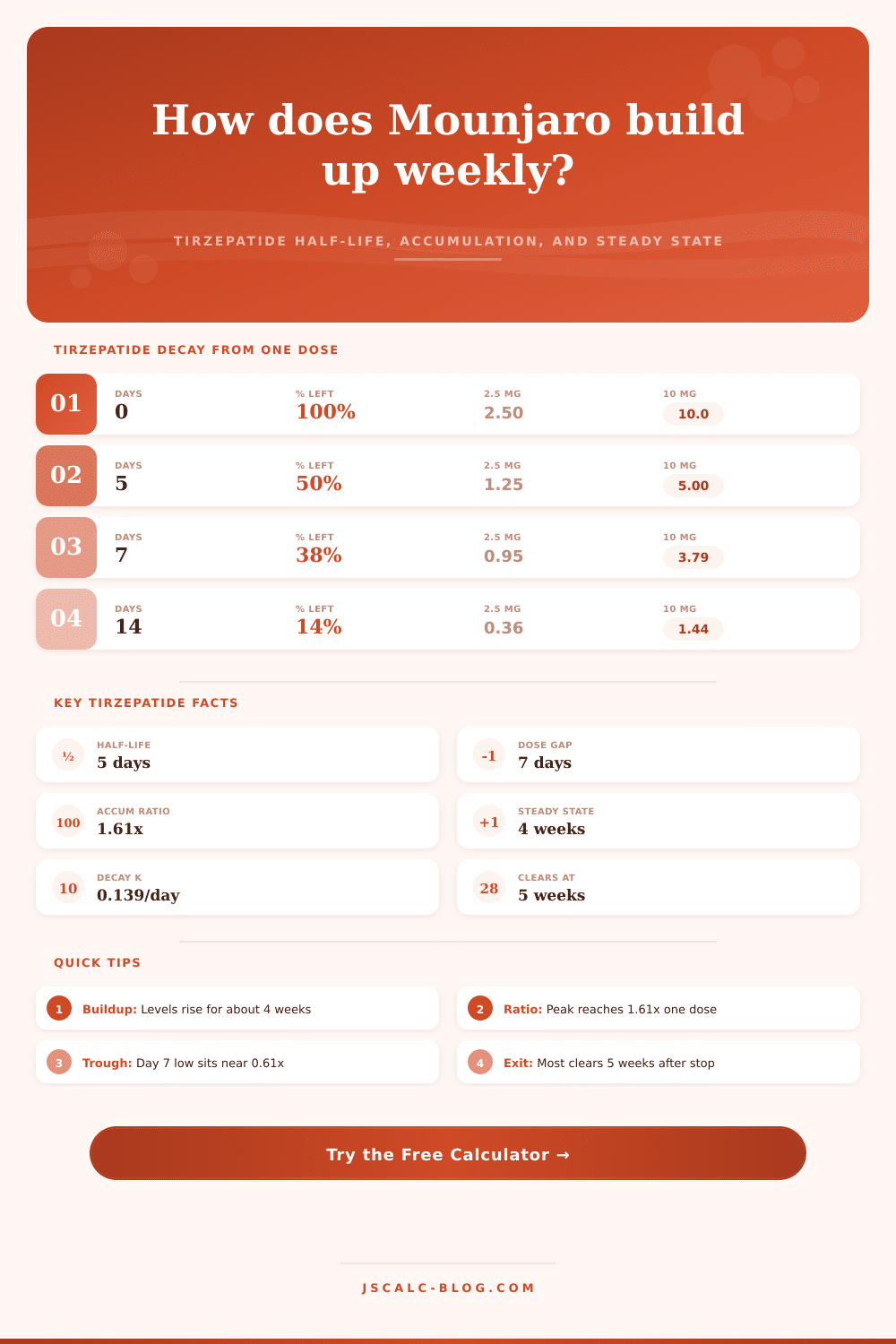
Injecting yourself with Mounjaro? You may assume it does its thing for a week… And then wears off, never to be heard from again. This isn’t how drugs work. Instead, it’s mathematicaly and gradual. Tirzepatide leaves your body gradually, at a constant rate. So each next shot contribute to the remaining stockpile from last week. Knowing this pattern explains why Week 1 feels different than Week 10. It is not because you need to memorize equations, but because you need to understands the buildup.
Tirzepatide has a ~five day half life. That means it stay around for approximately five days in your bloodstream. Because you inject once per week, it doesn’t go down before you top up again. So as time goes by, the amount in your blood increase each week until you reach a level known as steady state, where the amount remains constant. Typically this take 4 weeks. During that period, your body adjust to higher concentrations. You don’t have to guess at the shape of those curve; the calculator will take care of the math once you enter your own dosage and timing.
How Mounjaro Builds Up in Your Body
For tolerance reasons most folks begins at 2.5 milligrams. In that first month, however, you’re not at steady state. You’ll have higher blood levels right after an injection than you will as time goes on, and lower ones again just before the next shot. Side effects might seem unpredictable based off these swings. Once you’ve increased yourself up to 5 mg or more, these swings even out. That’s because of something called the accumulation ratio. It narrows down the concentration band of your baseline. Compared with what you started with, peak level of a 10 mg dose is much higher, but the trough is too. The steadiness makes it easier for doctors to predict how well it will work, and control side effects.
This equilibrium gets thrown off when you miss a dose. If you miss a week, then total amount of drug that’s still present will still be dropping by half every five days. Only a tiny fraction of what was there before will remain on day ten or even day fourteen. When you finally do re-inject after an extended period, you’re back to climbing up that dosage hill from scratch. And that could of mean another round of side effects like you felt during initial dosing. This happens not just because you missed a single shot, but because you reset your bodys biological clock and it hasn’t been in sync since.
Then there’s the whole thing about discontinuing the meds altogether. People tend to think that when they stop taking the injection, weight loss effects halt immediately. Truth is, the drug doesn’t dissapears instantly, but then neither do the changes in their appetite response. Tirzepatide will take about five weeks before it leave your body completely. Throughout that time, there will be some remaining amount affecting your sense of fullness and blood sugar control. That delay should factor into your thinking about transition periods or longer-term maintenance plans. Just like with starting, there is no accelerating this departure. With the reference tables supplied in the kit, you can see the amount of drug remaining over time. For example, by day seven, 38 percent of your dose will remain.
You look at these numbers and realize they’re what cause drugs to not reset but rather build up over time. Half-life. An abstract concept until now, is given solid ground to stand on. It’s arithmetic in action. It shows that biology is also arithmetic and that numbers play just as important a role in your experience as the strength of the dosage.
So, in conclusion, be patient with the timeline when it comes to managing Mounjaro. The body’s pace of action depends on the elimination rate rather than calendar days, whether you are ramping up or winding down. Being aware of how long it will take your body to reach steady state (weeks) helps manage expectations as you adjust up and down. Likewise, knowing the timeline for clearance help avoid frustration at lingering effects after stopping. The math is consistent, though the physical response can feel variable. When I keep this in mind, what felt like a black box becomes a predictable, manageable process.