Melatonin Half-Life Calculator
Estimate how much supplemental melatonin remains in your system, the percent left, the elimination constant, and the time to near-complete clearance using first-order elimination math for sleep timing.
😴Common Dose Presets
💊Dose & Timing Inputs
Enter in the dose unit selected below.
Immediate release 20–50 min; extended release longer.
Scales the base half-life to reflect clearance speed.
Used when target basis is percent. 5% is roughly sleep-relevant clearance.
Used when target basis is absolute amount (same unit as dose).
🔢Decay Formula Snapshot
📉Your Decay Timeline
| Elapsed | Half-Lives | Remaining | Percent Left | Status |
|---|---|---|---|---|
| Enter a dose and half-life above to build your personal decay timeline. | ||||
📊Remaining Over Time by Dose
| Time (45 min t½) | 1 mg | 3 mg | 5 mg | 10 mg | % Left |
|---|---|---|---|---|---|
| 0 min (dose) | 1.000 mg | 3.000 mg | 5.000 mg | 10.000 mg | 100% |
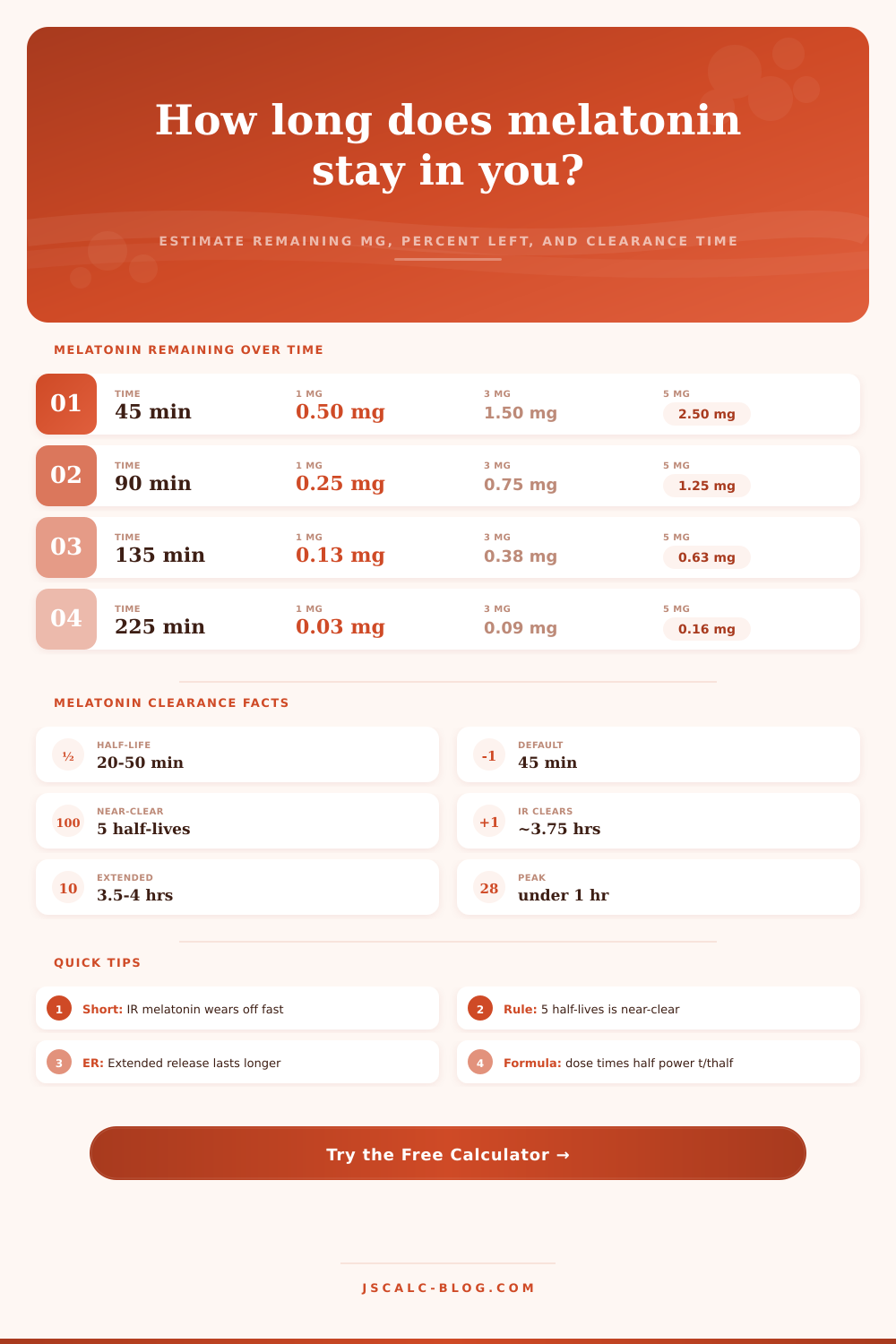
| 45 min | 0.500 mg | 1.500 mg | 2.500 mg | 5.000 mg | 50% |
| 90 min | 0.250 mg | 0.750 mg | 1.250 mg | 2.500 mg | 25% |
| 135 min | 0.125 mg | 0.375 mg | 0.625 mg | 1.250 mg | 12.5% |
| 180 min | 0.063 mg | 0.188 mg | 0.313 mg | 0.625 mg | 6.25% |
| 225 min | 0.031 mg | 0.094 mg | 0.156 mg | 0.313 mg | 3.13% |
| 270 min | 0.016 mg | 0.047 mg | 0.078 mg | 0.156 mg | 1.56% |
| 315 min | 0.008 mg | 0.023 mg | 0.039 mg | 0.078 mg | 0.78% |
♻Percent Remaining Per Half-Life
| Half-Lives | Time at 45 min t½ | Fraction | Percent Left | Meaning |
|---|---|---|---|---|
| 0 | 0 min | 1 | 100% | Full dose in system |
| 1 | 45 min | 1/2 | 50% | Half eliminated |
| 2 | 90 min | 1/4 | 25% | Wearing off |
| 3 | 135 min | 1/8 | 12.5% | Low level |
| 4 | 180 min | 1/16 | 6.25% | Trace level |
| 5 | 225 min | 1/32 | 3.13% | Near-complete clearance |
| 6 | 270 min | 1/64 | 1.56% | Effectively cleared |
⚖Immediate vs Extended Release
| Property | Immediate Release | Extended Release |
|---|---|---|
| Typical half-life | ~45 min (20–50) | ~3.5–4 hrs effective |
| Peak level | Within ~1 hr | Spread across hours |
| Near-clear (5 t½) | ~3.75 hrs | ~17–20 hrs |
| Wears off | Quickly overnight | Gradual, longer tail |
| Common use | Sleep onset help | Sleep maintenance |
| Morning grogginess | Less likely | More possible |
📋Common Melatonin Dose Ranges
| Scenario | Typical Dose | Form | Notes |
|---|---|---|---|
| Micro-dose | 0.3–1 mg | Immediate | Low physiologic range |
| Standard adult | 1–3 mg | Immediate | Common starting point |
| Bedtime higher | 5 mg | Immediate | Frequent OTC size |
| High dose | 10 mg | Immediate | Upper OTC size |
| Extended release | 2–5 mg | Prolonged | Longer-acting tablet |
| Jet lag timing | 0.5–3 mg | Immediate | Taken near target bedtime |
⚙Full Formula Breakdown
💡Melatonin Clearance Tips
Educational estimate only. This tool models simple first-order decay and does not replace medical advice, product labeling, or guidance from a healthcare professional. Individual clearance varies.
Half life. Most people overlook this. They don’t realize that the pill’s effectiveness doesn’t depend as much on willpower; rather, it depends on the time between taking it (at say, nine) and waking up (at three, feeling wired again). Or you might take it at eight and not be able to shake off grogginess when the alarm rings at seven.
Melatonin isn’t an “on” switch for sleep… It’s a chemical timer whose fuse burns out way too fast. Once you enter in your formulation and dose, the calculator above do the math. This spares you from guessing whether you’ve cleared drug from your system enough to be rested come morning.
Respect the Half-Life of Melatonin
When you take immediate-release melatonin, it doesn’t last long at all. For most people, its half life is about forty-five minutes. That means within forty-five minutes of taking a dose, half will be gone from your bloodstream. Within an hour and a half, it’s down to a quarter. In three hours, it might as well not even exist.
What they’re measuring isn’t what happens to it when it gets into your stomach. They’re measuring how soon it gets chopped up by your liver and flushed away. And there is a reason. Melatonin wants to be in your system only when it’s dark outside, not for the next three days.
One attempt at cheating this biological clock are extended release tablets, which wrap their dose inside of a matrix that dissolves slowly over time. It stretches the effective half-life to several hours, keeping levels steady throughout the night rather than spiking and crashing. The downside is feeling groggy in the morning. That lingering trace can feel like a hangover, especially if your body clears drugs slowly. This is common as we get older or with some liver condition.
You can adjust metabolism factor on the tool above if you know you’re one of these people, since it’s not uncommon. This will give you an idea of exactly when different mixtures drop below useful doses.
Once you pass the one milligram mark, dosage plays a bigger role in side effects than in sleep quality. But beyond a milligram, dosage has a greater impact on the side-effects then on how well you sleep. You don’t sleep twice as deep taking ten milligrams. All you do is have more chemicals to process before your brain wakes up on its own.
This becomes apparent when looking at the decay timeline. After 90 minutes, you’ve got about one and a quarter milligrams left from a five milligram dose. Though you may feel fine, if you attempt to drive home too early, that remaining dose could of be enough to cause drowsiness. Here context is important. Biologically speaking, “cleared” doesn’t mean zero, it means under the biological threshold of effect. Only about three percent of your initial dose remains at five half lives. This is why most consider five half lives to be a sort of clearing point.
Of course, all of this is subject to individual variation. Everyone metabolizes their melatonin differently. Some process it fast enough to shorten its forty-five minute half-life to as little as half-an-hour, while others process it slowly enough to extend it to an hour or longer. You can play with this parameter in the calculator, drawing from your own experience. Always feeling groggy? Tweak the metabolism slider to reflect a slower rate, and observe the way the clearance time adjusts.
Abstract science becomes something practical and useful. There is no more guesswork, just clockwork. The goal isn’t just to fall asleep. You want to wake up and work. Knowing how long it lasts allow you to match the dose to your schedule. Do you find yourself needing help getting to sleep? Or do you wake up early and want to be alert? Try low dose immediate release instead of high dose extended release, which lingers into the morning.
This is a little thing. And yet it matters. The half-life doesn’t give a damn about what you intend to do. Only about time and biology. Respect the half-life. The rest tends to follow.