Cocaethylene Half-Life Calculator
Model first-order clearance of cocaethylene – the metabolite formed when cocaine and alcohol are used together. Estimate percent remaining over time, the elimination rate constant k, and the time to near-negligible levels. Educational only.
🧪Clearance Presets
📝Clearance Inputs
Starting level at time zero (peak).
Default 2.5 h; typical range ~2–3 h.
Used in amount-remaining mode.
Used in time-to-threshold mode.
Carboxylesterase clearance varies by person.
🔢Formula Snapshot
⚖Half-Life Comparison
| Compound | Typical Half-Life | Elim. Constant k | ~5 Half-Lives | Context |
|---|---|---|---|---|
| Cocaine | ~1 hour | 0.693 /hr | ~5 hours | Parent drug, fast clearance |
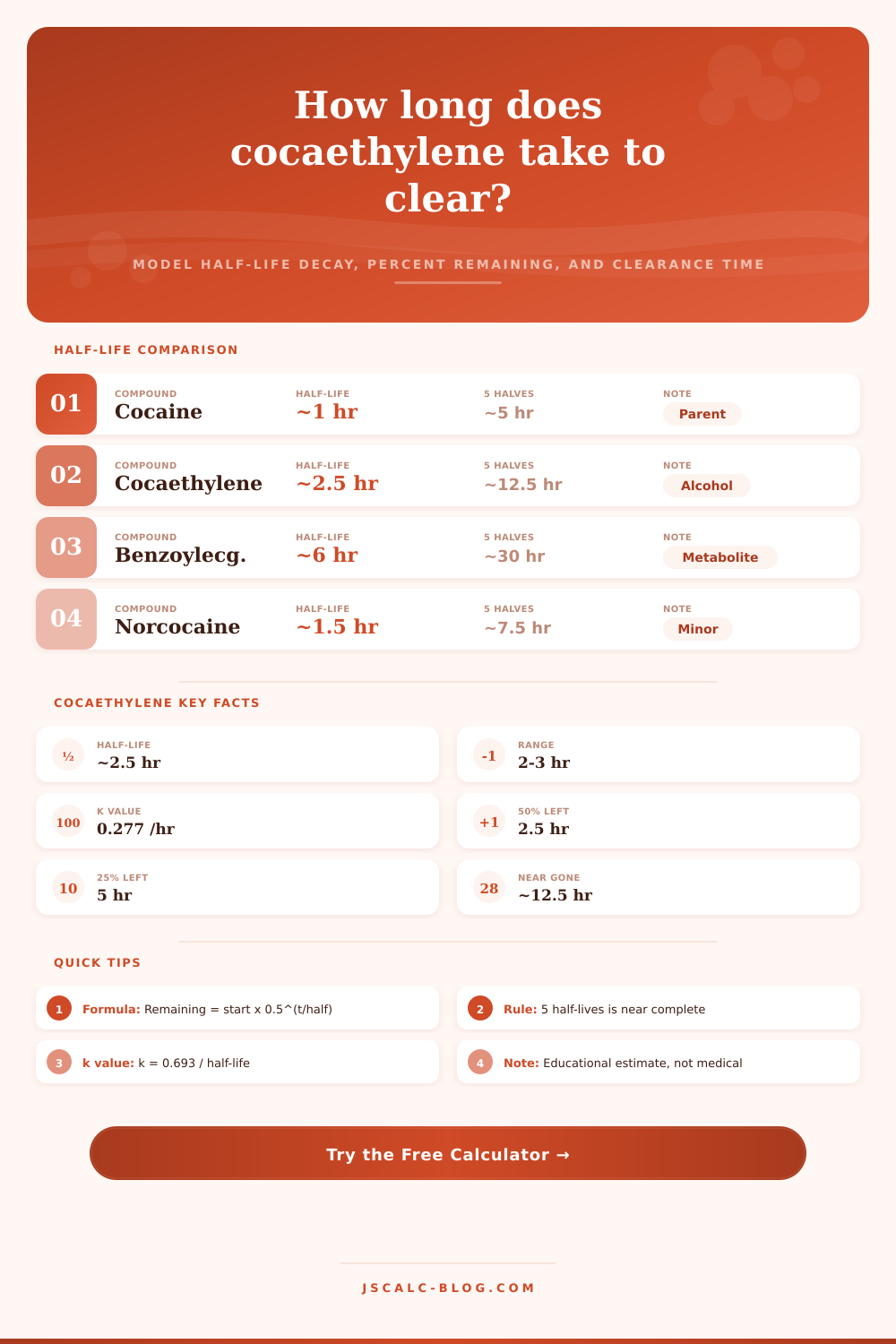
| Cocaethylene | ~2.5 hours | 0.277 /hr | ~12.5 hours | Forms with alcohol, longer |
| Benzoylecgonine | ~6 hours | 0.116 /hr | ~30 hours | Inactive urine metabolite |
| Norcocaine | ~1.5 hours | 0.462 /hr | ~7.5 hours | Minor active metabolite |
| Ecgonine methyl ester | ~3.5 hours | 0.198 /hr | ~17.5 hours | Non-oxidative metabolite |
📉Percent Remaining Per Half-Life
| Half-Lives | Elapsed at 2.5h | Percent Remaining | Fraction | Stage |
|---|---|---|---|---|
| 0 | 0 h | 100% | 1 / 1 | Peak level |
| 1 | 2.5 h | 50% | 1 / 2 | Half cleared |
| 2 | 5.0 h | 25% | 1 / 4 | Three quarters gone |
| 3 | 7.5 h | 12.5% | 1 / 8 | Mostly cleared |
| 4 | 10.0 h | 6.25% | 1 / 16 | Near trace |
| 5 | 12.5 h | 3.13% | 1 / 32 | Practically gone |
| 6 | 15.0 h | 1.56% | 1 / 64 | Negligible |
⏱Elapsed-Time Decay Table
| Hours Elapsed | Half-Lives Passed | % Remaining (2.5h) | Left From 100 mg | Left From 300 ng/mL |
|---|---|---|---|---|
| 0.5 h | 0.20 | 87.1% | 87.1 mg | 261 ng/mL |
| 1 h | 0.40 | 75.8% | 75.8 mg | 227 ng/mL |
| 2 h | 0.80 | 57.4% | 57.4 mg | 172 ng/mL |
| 3 h | 1.20 | 43.5% | 43.5 mg | 131 ng/mL |
| 4 h | 1.60 | 33.0% | 33.0 mg | 99 ng/mL |
| 6 h | 2.40 | 18.9% | 18.9 mg | 57 ng/mL |
| 8 h | 3.20 | 10.9% | 10.9 mg | 33 ng/mL |
| 12 h | 4.80 | 3.6% | 3.6 mg | 11 ng/mL |
🧫Typical Detection Windows
| Test Type | Target Analyte | Approx. Window | Notes |
|---|---|---|---|
| Blood | Cocaethylene | ~12 hours | Tracks the parent-drug window |
| Saliva / oral fluid | Cocaethylene | ~1 day | Reflects recent co-use |
| Urine | Benzoylecgonine | 1–3 days | Longer for heavy use |
| Urine (cocaethylene) | Cocaethylene | ~1 day | Marks alcohol co-use |
| Hair | Cocaethylene | Up to ~90 days | Long-term exposure marker |
🗂Half-Life Sensitivity Grid
| Hours | % at 2.0h Half | % at 2.5h Half | % at 3.0h Half | Left From 100 | Stage (2.5h) |
|---|---|---|---|---|---|
| 1 h | 70.7% | 75.8% | 79.4% | 75.8 | Early decline |
| 2 h | 50.0% | 57.4% | 63.0% | 57.4 | Falling |
| 2.5 h | 42.0% | 50.0% | 56.1% | 50.0 | One half-life |
| 3 h | 35.4% | 43.5% | 50.0% | 43.5 | Past halfway |
| 4 h | 25.0% | 33.0% | 39.7% | 33.0 | One third left |
| 6 h | 12.5% | 18.9% | 25.0% | 18.9 | Mostly cleared |
| 8 h | 6.3% | 10.9% | 15.7% | 10.9 | Near trace |
| 10 h | 3.1% | 6.3% | 9.9% | 6.3 | Low trace |
| 12.5 h | 1.3% | 3.1% | 5.6% | 3.1 | ~5 half-lives |
⚙Full Formula Breakdown
💡Educational Notes
When you mix alcohol with cocaine, chemistry changes, creating a new compound that standard drug tests often fail to capture. Your body also produce a new substance called cocaethylene, which has its own rate of leaving your system. Knowing this distinction is key because it lasts longer than cocaine itself. It will determine how long your markers remains detectable.
To save yourself from guessing at any drug’s decay rate, simply plug in your info into the calculator on top and let numbers work themselves out.
How Cocaethylene Affects Drug Tests and Your Body
First, let’s look at concept of half-life. Half-life is defined as amount of time required to eliminate half of a drug from your system. The half-life of pure cocaine is approximately an hour; it’s easily metabolized by liver’s efficient enzymes and excreted out relatively fast. However, the half-life of cocaethylene average 2.5 hours. This translates into much longer amounts of time that compound remains in bloodstream compared to what many would assume. It’s important for you to understand the implications of this when considering how long it will take for cocaine to clear your body and be detected.
You can also change the half-life based off metabolism speed using the input options. Because we’re all different (genetically, by age, by health), liver function will differ from person to person. Some people has fast carboxylesterase activity, clearing the compound within two hours; others have slower processing, taking three hours or longer. You can toggle these presets on the calculator to view effect of slight shifts in metabolism on the final result. A small tweak to input results in a big difference to the output timeline.
To put things in perspective, here’s that comparison table from the reference: That metabolite (benzoylecgonine) has an approximate half-life of six hours; hence urine tests may be positive for several days following the end of effect. For our purposes, we are concerned with the initial clearance phase. The calculator should of provide an idea of the time-to-detection-limit, which is when levels in blood or saliva decreases below the test threshold.
The main point is that not all tests looks for the same markers: blood shows recent use, while hair samples shows use over a longer period of time. Also, take note of elimination constant k. This is the rate at which it clears mathematically speaking and the higher the number, the quicker it goes away. The tool calculates this for you so you can watch its concentration decrease. In general, you’re looking at approximately five half-lives before it reach an insignificant level (meaning only 3% of what was there originally). That’s like twelve and a half hours after maximum blood levels for cocaethylene.
Note that this model assume first-order kinetics, i.e., the elimination rate depends upon amount of substance currently in your system. So it doesn’t apply to heavy chronic usage or repeated dosing (which can saturates your liver enzymes and slow things down). In other words, it’s much simpler than the real world, where clean lines on a graph don’t apply. Use these numbers as an estimate of what may happen in the real world. Not medical advice.
This is just an educational tool designed to teach you about the pharmacology of mixing substances. That answers the question: How long do I have before someone detects cocaethylene? The answer? Long enough to make it behave different than straight cocaine. And with a slower rate of clearing, there is a longer window for detection and potentially more pronounced effects.
If you want to know how your own variations on these factors will affect timing, you can play with the numbers. This isn’t about pinpointing an exact minute but understanding the biology of combining drugs. The equations shows us what’s really happening behind the scenes… Converting abstract chemical formulas into concrete time frames.