Molarity to Volume Calculator
Solve for the solution volume you need. Enter moles or mass with a target molarity to get the flask volume in liters and milliliters, or run a C1V1 = C2V2 dilution to find the stock volume and diluent to add.
🧪Preparation Presets
⚖Solution Inputs
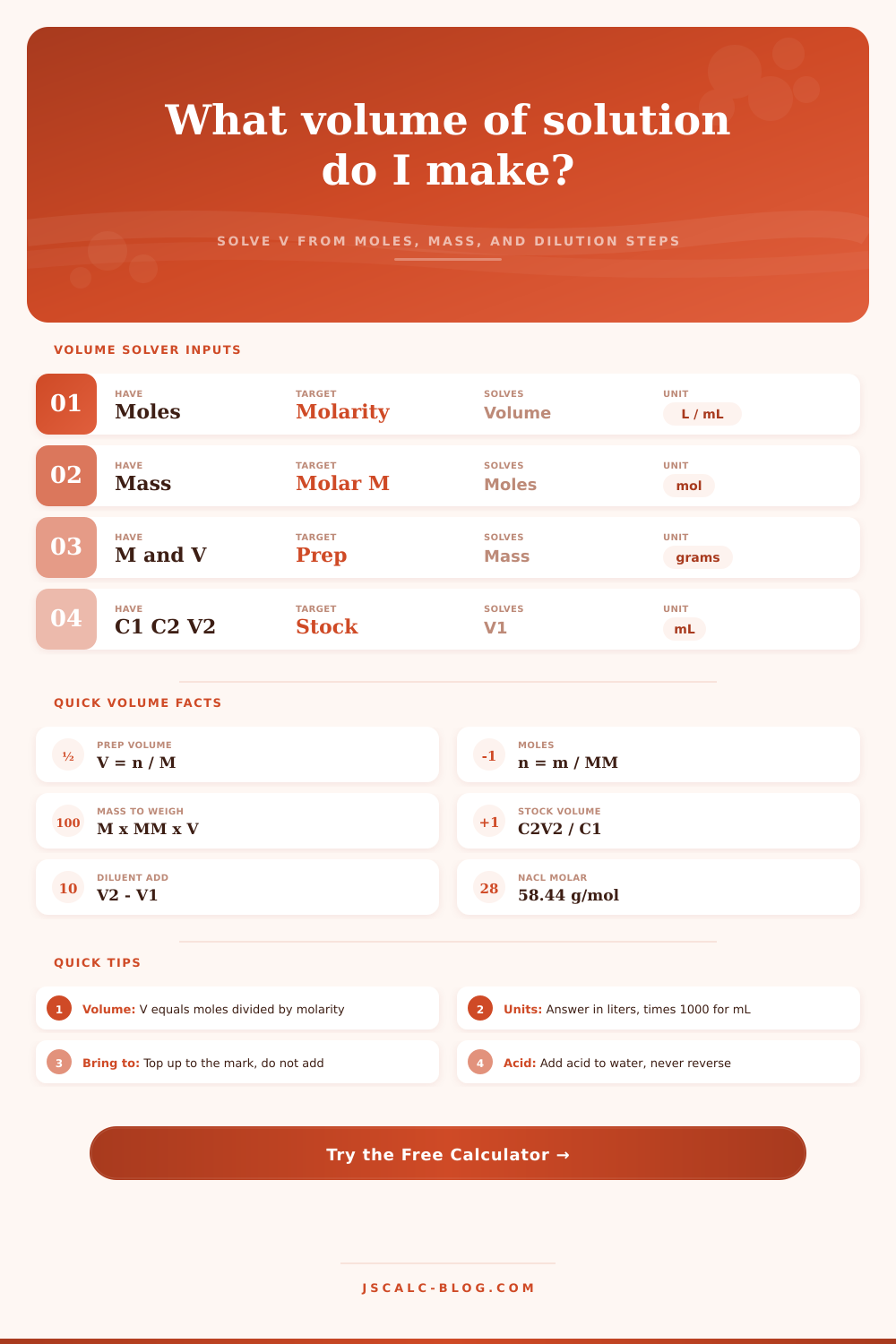
Prep mode uses V = moles / molarity. Dilution modes use C1V1 = C2V2.
Used when amount is given as moles.
Used when amount is given as grams.
Adjusts the mass you weigh out for less-than-pure reagents.
🔢Formula Snapshot
🧴Common Molar Masses
| Compound | Formula | Molar Mass | Mass for 1 L of 1 M |
|---|---|---|---|
| Sodium chloride | NaCl | 58.44 g/mol | 58.44 g |
| Sodium hydroxide | NaOH | 40.00 g/mol | 40.00 g |
| Hydrochloric acid | HCl | 36.46 g/mol | 36.46 g |
| Glucose | C6H12O6 | 180.16 g/mol | 180.16 g |
| Potassium chloride | KCl | 74.55 g/mol | 74.55 g |
| Sulfuric acid | H2SO4 | 98.08 g/mol | 98.08 g |
📏Prep Volume for a Fixed 0.10 mol of Solute
| Target Molarity | Volume (L) | Volume (mL) | Best Flask |
|---|---|---|---|
| 2.0 mol/L | 0.050 L | 50 mL | 50 mL flask |
| 1.0 mol/L | 0.100 L | 100 mL | 100 mL flask |
| 0.50 mol/L | 0.200 L | 200 mL | 200 mL flask |
| 0.40 mol/L | 0.250 L | 250 mL | 250 mL flask |
| 0.20 mol/L | 0.500 L | 500 mL | 500 mL flask |
| 0.10 mol/L | 1.000 L | 1000 mL | 1 L flask |
💧C1V1 = C2V2 Worked Dilutions (to 100 mL)
| Stock C1 | Desired C2 | Factor | Stock V1 | Diluent to Add |
|---|---|---|---|---|
| 12 M | 1 M | 12× | 8.33 mL | 91.67 mL |
| 18 M | 2 M | 9× | 11.11 mL | 88.89 mL |
| 10 M | 1 M | 10× | 10.00 mL | 90.00 mL |
| 6 M | 0.5 M | 12× | 8.33 mL | 91.67 mL |
| 5 M | 0.5 M | 10× | 10.00 mL | 90.00 mL |
| 1 M | 0.1 M | 10× | 10.00 mL | 90.00 mL |
🗂Target Molarity Comparison Grid
| Target M | Volume Made | Moles Needed | NaCl Mass | Glucose Mass | Note |
|---|---|---|---|---|---|
| 0.10 M | 1 L | 0.100 mol | 5.84 g | 18.02 g | Dilute buffer |
| 0.50 M | 1 L | 0.500 mol | 29.22 g | 90.08 g | Common bench stock |
| 0.90 % | 1 L | 0.154 mol | 9.00 g | – | Physiological saline |
| 1.00 M | 1 L | 1.000 mol | 58.44 g | 180.16 g | Molar reference |
| 2.00 M | 500 mL | 1.000 mol | 58.44 g | 180.16 g | Concentrated prep |
| 3.00 M | 250 mL | 0.750 mol | 43.83 g | 135.12 g | Near KCl saturation |
| 5.00 M | 100 mL | 0.500 mol | 29.22 g | – | High-solubility salts |
⚙Full Formula Breakdown
📋Volume Reference Values
| Quantity | Symbol | Formula | Output Unit |
|---|---|---|---|
| Solution volume | V | moles / molarity | liters (×1000 = mL) |
| Moles of solute | n | mass / molar mass | mol |
| Mass to weigh | m | M × MM × V | grams |
| Stock volume | V1 | C2 × V2 / C1 | mL |
| Final volume | V2 | C1 × V1 / C2 | mL |
| Diluent volume | Vd | V2 – V1 | mL |
💡Practical Prep Tips
You’ve got a spatula loaded with some white powder. It’s sitting there on your beaker, waiting for you to do something. Wait…what are you gonna do? How much water should I add? It sounds like a simple task, but this is a deep one.
Not only is it practically important, it’s basically so: volume isn’t just solvent + mass. As the solute dissolves, its density change. If you dump in a certain amount of liquid, you are likely getting the wrong concentration. Instead, you want to raise the solution to a mark on the container. Most lab techs and even home chemists stumbles here.
Why Solution Volume Is Tricky
This connects the microscopic world of particles to the macroscopic world of glassware: Molarity links moles of solute to liters of solution. So if you want to find that last volume, all you have to do is divide moles by your targeted molarity. Sounds easy enough on paper, but before you can do that, you first have to translate the grams into moles based off molar mass.
This is where the calculator above do the work for you, because it doesn’t require you to guess the molecular weights of common salts (such as glucose and sodium chloride) or search through reference books. All you need to know is how much of each compound you weighed out.
Dilution sounds like a different skill entirely to many, but is just the same math phrased differently: instead of dividing something, you are conserving mass (C1V1 = C2V2). If you’re starting with a solid powder and not a more concentrated stock solution, the relationship is simply V1/V2 = C2/C1, where V stands for volume and C stand for concentration. The calculator changes mode to calculate how much concentrated stock you need to pipette into your solution. Then it will tell you what volume of diluent to add to reach your final target volume.
That way, you don’t make the common mistake of taking your measured volume of water and adding the stock, which would give you a bit less concentration then you wanted due to making your final volume a little larger than planned. Getting these ratios exact is important, since often the results of an experiment depend heavily on that precision.
The tool also considers more practical issues like what flask size to choose, and it suggests using standard volumetric glassware for that (it’s good advice). Your calculation might indicate 320 milliliters, but you don’t happen to have a 320 milliliter flask on the bench. So now you either has to scale up, or work at a slightly lower concentration different than the one you calculated.
The reference table that comes with the tool shows the standard volumes and common molar masses so you can see those tradeoffs ahead of time, before you mix something up. For example, it tells you that 1 M NaCl would require almost 60 grams of salt per liter. That’s a lot of salt, and it impacts both cost and solubility limits.
This is also where temperature becomes a crucial though less obvious factor: Because mass doesn’t change and volume does as it warms up, a solution made at room temperature isn’t exactly the same when we measure it in warmer or cooler surroundings. Most labs operate around 20 degrees Celsius, which means any time you’re making solutions in a warmer lab or storing them in a cooler space, their true molarity is drifting further from what the numbers on paper say they should of been. While our calculator can’t account for ambient conditions, being aware of this variable help understand how two seemingly identical batches may differ in behavior under assay conditions.
It’s the unseen variable between good data and great data.
Keep in mind safety considerations, too; after all, we’re talking about acids here. Always remember the official rule “add acid to water” (it’s more than an official warning). It’s a thermodynamic requirement. Diluting concentrated HCl or H2SO4 emits tremendous amounts of heat. Splashing and boiling corrosive chemicals will result if you pour water onto the acid. Adding the acid slowly to a large volume of water allows the heat to dissipate without harming anyone nearby.
The tool gives you the volumes, but your technique prevents you from being dissolved while mixing them.
Making solutions requires precision and patience. Weigh out the solid, dissolve it into less than total volume, stir until dissolved, and finally carefully make up to the marked line on the flask. Do not guess; just follow each step for accurate results you can repeat. From a basic saline wash through to a complicated cell culture medium: the process is the same.
Always use precise starting materials, understand the distinction between volume and mass, and always bring your solution up to mark rather than adding solvent blindly. It is a tiny detail that matters.