Concentration to Molarity Calculator
Convert a concentration written in g/L, mg/mL, g per 100 mL, percent weight/volume, mg/dL, ppm, or micrograms/mL into molarity (mol/L) using the molar mass, and see the full unit conversion chain plus mM and µM.
🎯Real Concentration Presets
📝Concentration Inputs
Enter the number as written on the label or protocol.
Molar mass of the dissolved solute (formula weight).
Only used when the unit is % w/w. Water is about 1.000.
Percent of the stated mass that is the actual solute.
🔢Formula Snapshot
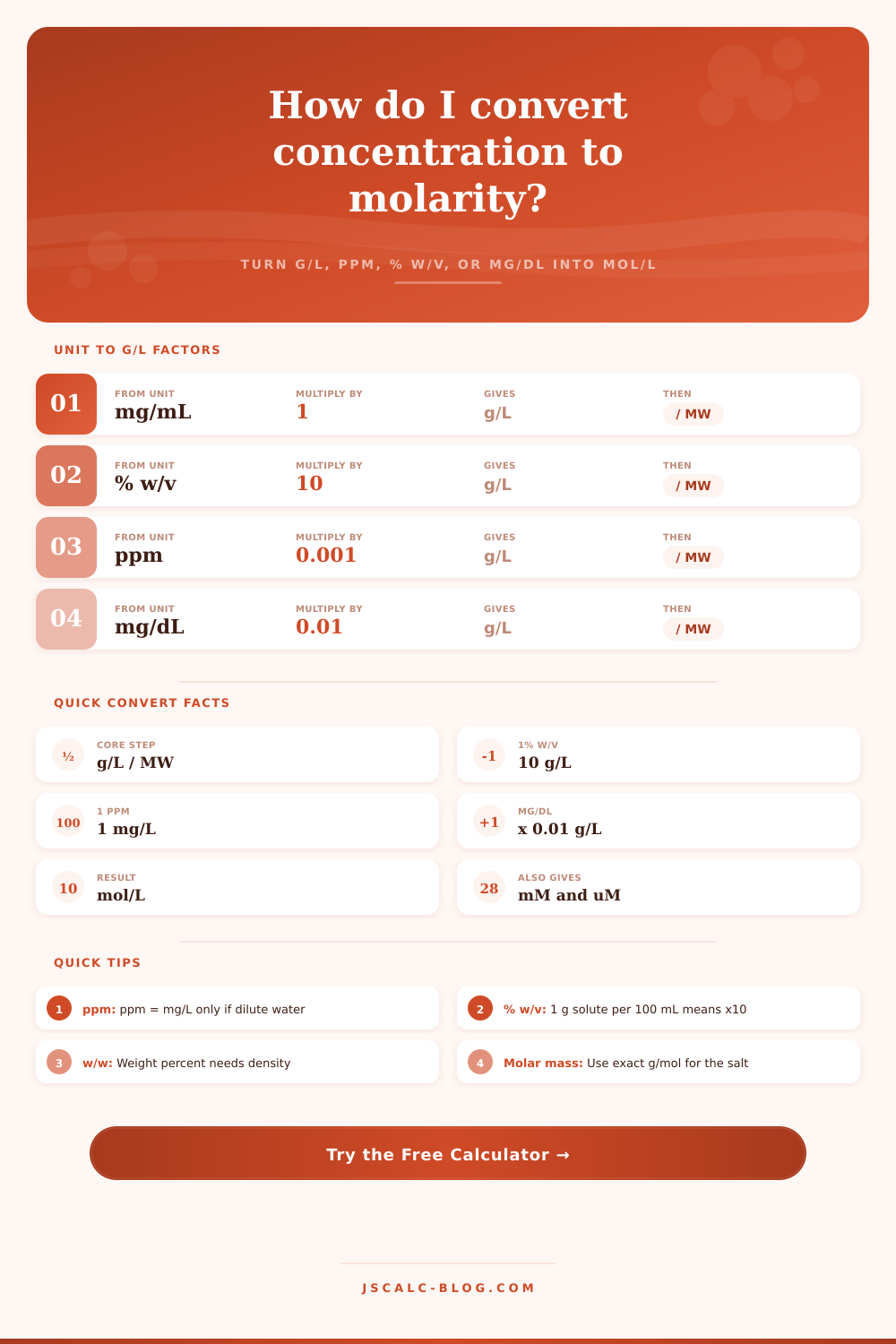
🧮Unit to g/L Conversion Factors
| Input Unit | Meaning | To Get g/L | Example |
|---|---|---|---|
| g/L | Grams per liter | Value × 1 | 5 g/L = 5 g/L |
| mg/mL | Milligrams per mL | Value × 1 | 5 mg/mL = 5 g/L |
| g/100 mL | Grams per 100 mL | Value × 10 | 5 g/100mL = 50 g/L |
| % w/v | Grams per 100 mL | Value × 10 | 0.9% = 9 g/L |
| mg/dL | Milligrams per deciliter | Value × 0.01 | 100 mg/dL = 1 g/L |
| ppm | Roughly mg/L in water | Value × 0.001 | 500 ppm = 0.5 g/L |
| µg/mL | Micrograms per mL | Value × 0.001 | 500 µg/mL = 0.5 g/L |
| % w/w | Grams per 100 g solution | Value × density × 10 | 37% at 1.18 = 436.6 g/L |
⚖Common Compound Molar Masses
| Compound | Formula | Molar Mass | Typical Use |
|---|---|---|---|
| Sodium chloride | NaCl | 58.44 g/mol | Saline, buffers |
| Glucose | C6H12O6 | 180.16 g/mol | Blood sugar, media |
| Sodium hydroxide | NaOH | 40.00 g/mol | Base titrations |
| Hydrogen chloride | HCl | 36.46 g/mol | Acid stocks |
| Potassium chloride | KCl | 74.55 g/mol | Electrolytes |
| Calcium chloride | CaCl2 | 110.98 g/mol | Brines, media |
| Calcium carbonate | CaCO3 | 100.09 g/mol | Water hardness |
| Sulfuric acid | H2SO4 | 98.08 g/mol | Acid reagents |
| Ethanol | C2H6O | 46.07 g/mol | Solvent, spirits |
| Sucrose | C12H22O11 | 342.30 g/mol | Sugar solutions |
🗂Concentration to Molarity Comparison Grid
| Compound | Molar Mass | 1% w/v → M | 1 g/L → M | 100 ppm → M | Note |
|---|---|---|---|---|---|
| NaCl | 58.44 | 0.1711 M | 0.01711 M | 1.711 mM | Physiological salt |
| Glucose | 180.16 | 0.0555 M | 0.00555 M | 0.555 mM | Heavier sugar |
| NaOH | 40.00 | 0.2500 M | 0.02500 M | 2.500 mM | Strong base |
| HCl | 36.46 | 0.2743 M | 0.02743 M | 2.743 mM | Gas basis mass |
| KCl | 74.55 | 0.1341 M | 0.01341 M | 1.341 mM | Potassium source |
| CaCl2 | 110.98 | 0.0901 M | 0.00901 M | 0.901 mM | Anhydrous basis |
| CaCO3 | 100.09 | 0.0999 M | 0.00999 M | 0.999 mM | Hardness as CaCO3 |
| H2SO4 | 98.08 | 0.1020 M | 0.01020 M | 1.020 mM | Diprotic acid |
| Sucrose | 342.30 | 0.0292 M | 0.00292 M | 0.292 mM | Large molecule |
🔗ppm, Percent, and Molarity Relationship
| Expression | Same As | In g/L | NaCl Molarity |
|---|---|---|---|
| 1 ppm | 1 mg/L | 0.001 g/L | 17.11 µM |
| 10 ppm | 10 mg/L | 0.01 g/L | 0.1711 mM |
| 100 ppm | 0.01% w/v | 0.1 g/L | 1.711 mM |
| 1000 ppm | 0.1% w/v | 1 g/L | 17.11 mM |
| 1% w/v | 10 g/L | 10 g/L | 0.1711 M |
| 10% w/v | 100 g/L | 100 g/L | 1.711 M |
⚙Full Conversion Breakdown
💡Practical Conversion Tips
A bottle sits in your hand, labeled with an abstraction: a percentage of something you aren’t sure about. You’re standing in a lab where the rules call for a molarity. A number too exact to be real, it seems. Many mistakes in chemistry come from this disconnection between how we buy and use chemicals.
Because concentration measurements by weight or volume do not change during shipping, manufacturers package them that way. Chemists requires moles per liter because chemical reactions occur based off particle number, not just mass. Bridging this divide is not just about dividing one number by another; it is about knowing what each starting value mean and how the ending value will affect your work.
How to Convert Chemical Concentrations Easily
Getting past that confusion, core mechanic is simple. In the end, all of your concentration expressions need to convert to grams per liter. That’s what molarity is. That’s where most people mess up. It’s an intermediary step.
Converting from milligrams per milliliter is easy; those units convert directly to grams per liter. But converting from percent weight per volume, well, then we’re doing some mental math. Percent translates as one gram of solute for every hundred milliliters of solution. Multiply by ten to get grams in a whole liter. A tiny change in the math early on makes everything else later different than expected. The converter above takes care of those unit conversions for you and spares you having to stop yourself and work out the conversion factor every time.
Mostly it comes down to knowing what is being measured. Is it percent weight per weight? Or is it percent weight per volume? In other words, is mass being compared to mass or mass being compared to volume? They coincide only if solution’s density is precisely one gram per milliliter, which is rare outside of pure water or very dilute mixtures. Very dilute solutions come close, as does pure water. But most liquids has densities that vary significantly away from that value, especially concentrated acids or a brine.
Density is not something you can safely forget about if you’re using a concentrated acid or some kind of brine as a reagent. And that’s why every solid stoichiometry conversion tool will have a place where you enter the density of your solution when you’re working with weight percent. You could of gotten good stoichiometry without taking density into account. The table on the page clearly explains how density closes the gap between volume-based concentration (percent weight per volume) and mass fraction (percent weight per weight).
Purity adds another level of complexity. Pure reagents aren’t common. Perhaps a bottle claims to be 50% hydrochloric acid but in reality it has some water and/or stabilizers. Without adjusting for these other ingredient, you’ll overstate the final molarity because you’re assuming the weight on the label represents full strength solute. So adjust down the effective mass of the solute (before division by molar mass) based on its assay percentage. Many protocols neglects this additional step, which results in batches where the yield or speed is lower than expected. Enter this purity factor into the calculator and get a final mole count that’s representative of what you actualy have chemically to work with.
The whole process hinges around something called molar mass. No matter how precisely you convert units, if you enter an incorrect molecular weight, then all bets is off. Make sure the formula weight matches the actual salt (or hydrated salt) being used. Sodium bicarbonate and sodium chloride may appear identical on paper, but their behavior in solution couldn’t be more different. Failure to account for the water content of a hydrated compound will wildly throw off your calculations due to the use of generalized atomic weights.
This is where folks screw up. They think the compound name equates to a single constant weight. It doesn’t. Convert mass to grams/liter. Adjust that for purity. Divide by molar mass. There are moles/Liter.
Scale up/down from there to suit what you require: a micromolar or millimolar solution perhaps? Maybe a biologist wants ten micromolars of a drug candidate, whereas an industrial chemist prepares a five molar stock solution. The scale shifts but the reasoning stays the same. Instead of weighing out particles, you’re now counting them. That change in perspective allows exact replication at various scales and laboratory.
That is what makes this conversion so valuable: it’s predictable. You can be confident that there are a certain number of moles per liter of solution, which translates into knowing how much reactivity you possess within each drop. Percentages becomes something you use rather than guess. Dilution factors don’t appear out-of-the-blue; they’re calculated with confidence. These little things can mean the difference between a do-over or a success.
Knowing the molar mass, recognizing the purity, and respecting the density make your solutions act precisely according to theory. That’s what takes the madness out of making chemicals.