Molarity to PPM Calculator
Convert molar concentration to parts per million and mg/L for aqueous solutions, plus µg/mL, ppb, grains per gallon, and % w/v, with an optional density correction for concentrated brines.
🧪Solution Presets
📝Concentration Inputs
Used in Molarity → ppm mode.
Used in ppm → Molarity mode.
1.000 for dilute water; higher for brines.
🔢Formula Snapshot
⚖Common Ion & Compound Molar Masses
| Species | Formula | Molar Mass (g/mol) | ppm at 1 mM | Typical Use |
|---|---|---|---|---|
| Sodium chloride | NaCl | 58.44 | 58.44 mg/L | Saline, salinity |
| Calcium carbonate | CaCO3 | 100.09 | 100.09 mg/L | Hardness as CaCO3 |
| Calcium ion | Ca²⁺ | 40.08 | 40.08 mg/L | Water hardness |
| Sodium ion | Na⁺ | 22.99 | 22.99 mg/L | Sodium in water |
| Chloride ion | Cl⁻ | 35.45 | 35.45 mg/L | Chloride, seawater |
| Magnesium ion | Mg²⁺ | 24.31 | 24.31 mg/L | Water hardness |
| Potassium ion | K⁺ | 39.10 | 39.10 mg/L | Fertilizer, blood |
| Bicarbonate | HCO3⁻ | 61.02 | 61.02 mg/L | Alkalinity |
| Sulfate | SO4²⁻ | 96.06 | 96.06 mg/L | Sulfate in water |
| Glucose | C6H12O6 | 180.16 | 180.16 mg/L | IV fluids, biology |
| Nitrate | NO3⁻ | 62.00 | 62.00 mg/L | Drinking water limit |
🔎Molarity to PPM Quick Lookup
| Compound | Molar Mass | 0.001 M | 0.01 M | 0.1 M |
|---|---|---|---|---|
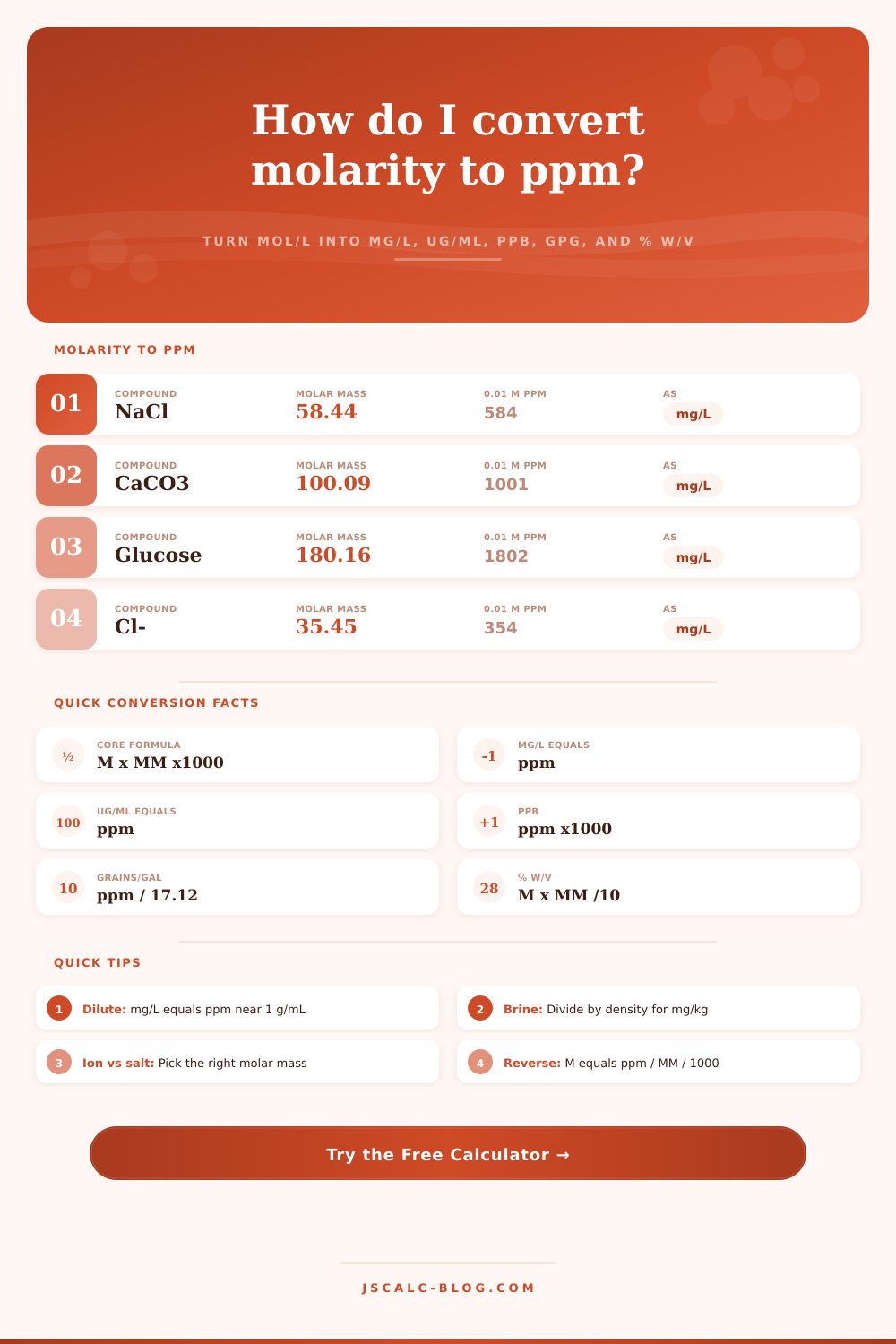
| NaCl | 58.44 | 58.4 ppm | 584 ppm | 5,844 ppm |
| CaCO3 | 100.09 | 100.1 ppm | 1,001 ppm | 10,009 ppm |
| Ca²⁺ | 40.08 | 40.1 ppm | 401 ppm | 4,008 ppm |
| Cl⁻ | 35.45 | 35.5 ppm | 354 ppm | 3,545 ppm |
| Glucose | 180.16 | 180.2 ppm | 1,802 ppm | 18,016 ppm |
| NO3⁻ | 62.00 | 62.0 ppm | 620 ppm | 6,200 ppm |
| SO4²⁻ | 96.06 | 96.1 ppm | 961 ppm | 9,606 ppm |
🔄PPM to Other Units Conversion
| From (ppm / mg/L) | µg/mL | ppb | Grains/gallon | mg/kg at 1.0 g/mL |
|---|---|---|---|---|
| 1 ppm | 1 | 1,000 | 0.058 | 1 |
| 10 ppm | 10 | 10,000 | 0.584 | 10 |
| 100 ppm | 100 | 100,000 | 5.84 | 100 |
| 500 ppm | 500 | 500,000 | 29.21 | 500 |
| 1,000 ppm | 1,000 | 1,000,000 | 58.42 | 1,000 |
| 10,000 ppm | 10,000 | 10 million | 584.2 | 10,000 |
💧Water Hardness PPM Ranges (as CaCO3)
| Classification | ppm as CaCO3 | Grains/gallon | Approx Molarity | Note |
|---|---|---|---|---|
| Soft | 0 to 60 | 0 to 3.5 | ≤ 0.0006 M | Little scaling |
| Moderately hard | 61 to 120 | 3.6 to 7.0 | ~0.0009 M | Mild scaling |
| Hard | 121 to 180 | 7.1 to 10.5 | ~0.0015 M | Scaling likely |
| Very hard | 181 to 500 | 10.6 to 29.2 | ~0.0035 M | Softener helps |
| Extremely hard | Over 500 | Over 29.2 | Over 0.005 M | Heavy scaling |
🗂Compound Comparison Grid
| Compound | Molar Mass | ppm at 0.001 M | ppm at 0.01 M | ppm at 0.1 M | Note |
|---|---|---|---|---|---|
| Sodium chloride | 58.44 | 58.4 | 584.4 | 5,844 | Common saline salt |
| Calcium carbonate | 100.09 | 100.1 | 1,001 | 10,009 | Hardness reference |
| Glucose | 180.16 | 180.2 | 1,802 | 18,016 | Heavy molecule |
| Chloride ion | 35.45 | 35.5 | 354.5 | 3,545 | Light single ion |
| Nitrate | 62.00 | 62.0 | 620.0 | 6,200 | 10 ppm N limit note |
| Sulfate | 96.06 | 96.1 | 960.6 | 9,606 | Taste at high ppm |
| Potassium ion | 39.10 | 39.1 | 391.0 | 3,910 | Fertilizer nutrient |
| Magnesium ion | 24.31 | 24.3 | 243.1 | 2,431 | Lightest listed ion |
⚙Full Formula Breakdown
💡Practical Conversion Tips
Chemistry occurs at molecular level, which means you begin with a molarity value. One mole of something per liter of water is just dandy for a beaker sitting on a lab bench. But here is the problem: it is hard to discuss that solution with someone who isn’t at the lab bench. What do people think in? Parts per million, maybe. Or mg/L. Or perhaps grains per gallon if they’re working with water softeners. There’s a huge disconnect there between molecular reality of the situation and how it is measured in practice. This conversion bridges that gap.
Once you enter your particular compound and concentration into the calculator above, it will do all the math for you, saving you time from having to wrestle with molar masses and units manualy. Despite the jargon-heavy language, the math behind it all is fairly straightforward. Simply multiply the molarity (moles per liter) times the molar mass of whatever it is you’re measuring. The result will be grams per liter. If we then divide by 1000, we arrives at mg/L, which are equal to parts per million. Since a kilo is a kilogram and a liter of dilute water contain about one kg of water, parts per million is just a fraction of a gram of something per kilogram of water.
How to Convert Molarity to PPM
Until you consider that different things has different weights. A mole of sodium chloride is lighter then a mole of calcium carbonate. Even though they both have the same number of molecules, the resulting concentration number can change dramaticly based on weight. And this is also where selecting the right compound become important. Whether you measure raw calcium ions or the total calcium carbonate equivalent will affect your answer. Calcium itself has roughly forty grams per mole. Then add on the carbonate portion and that goes up above one-hundred. Getting the incorrect molar mass screws up the rest of your calculation by a factor of two and a half. It is more than you’d think, actualy. Some people pick out the first entry on periodic table and go from there, forgetting about everything else attached to atom in solution.
The other factor that doesn’t get as much attention but really matters here is density. Typically when talking about tap water or very dilute saline solutions, the density is essentially one gram per milliliter, which means you can safely ignore it. One milliliter of water weigh one gram, so “mg/L” aligns perfectly with “mg/kg. But enter concentrated brines or syrupy industrial solutions and that no longer hold true. The solution becomes denser. Saturated saltwater weighs greater then one kilogram per liter. In fact, if you’re measuring true mass-based ppm, you’ll need to divide your starting result by actual density of the fluid. Otherwise, your results may look great on paper, but won’t hold up in practice.
So why are there output options? Because each industry has its own language. Medical labs tend to go with micrograms per milliliter for accuracy reasons. Grains per gallon is what water treatment plants commonly work in because that’s how their equipment is set. To get grains per gallon, you divide your ppm value by roughly 17.1. So if your ppm number is 5, then just divide 5 by 17.1 and that’s it. You can convert back and forth among all of these units so you don’t end up with a treatment system or chemical order that your plumber cannot understand.
And these reverse conversions can be equally handy. If you know that a solution contains five-hundred ppm of salt and want to calculate its molarity for some kind of reaction stoichiometry problem, just run the math backwards. Divide the ppm by one-thousand, then divide it again by the molar mass. It seems too easy that a tool could do this for you in an instant, but that’s not what accuracy means. Accuracy means avoiding stupid arithmetical errors because you’re in a hurry or exhausted.
Once you understand those conversions, it completely alters the meaning of concentration data. It isn’t just some random number. Rather, it’s a relationship between molecular count, volume and mass. Whatever unit you use to express concentration should help rather than hide your understanding. If you’re analyzing well water, mixing a buffer solution, or anything else for that matter, make sure all the variables match the physical reality of what is in front of you. Pick the appropriate molar mass, get density correct, and everything falls into place from there.