Molarity to mg/mL Calculator
Convert a molar concentration into mass concentration. Enter molarity and pick a compound to get mg/mL, µg/µL, g/L, percent w/v, and the milligrams contained in any dose volume, with an optional purity adjustment for weighing out.
🎯Real Stock Solution Presets
📝Concentration Inputs
Reverse mode reads the mg/mL field and solves for molarity.
Set by the compound list or type your own MW.
Only used when direction is mg/mL → molarity.
Actual weigh-out = ideal mass / purity fraction.
🔢Formula Snapshot
⚖Compound Molar Mass Reference
| Compound | Formula | Molar Mass (g/mol) | mg/mL at 1 M | Common Use |
|---|---|---|---|---|
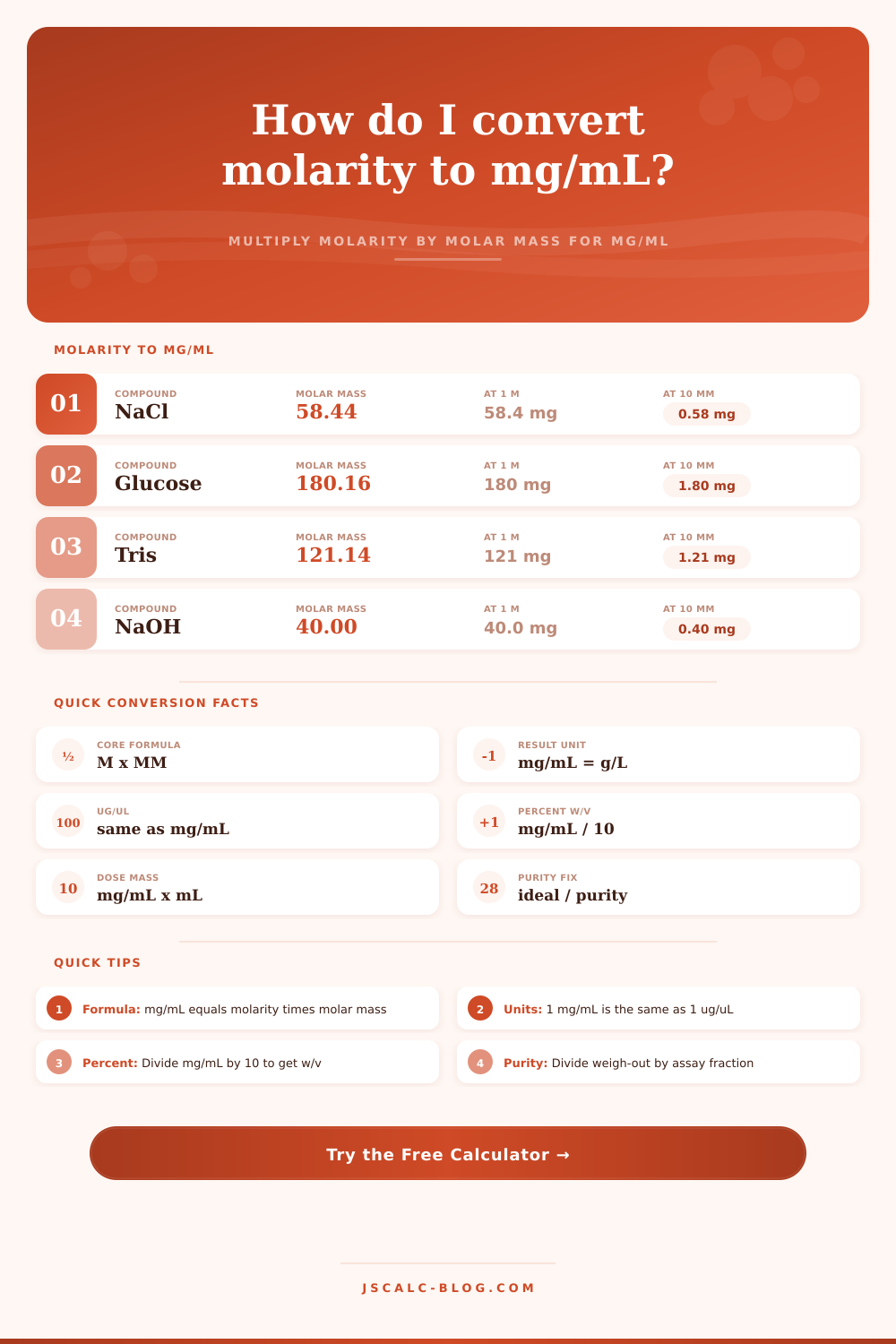
| Sodium chloride | NaCl | 58.44 | 58.44 | Saline, buffers |
| D-Glucose | C6H12O6 | 180.16 | 180.16 | Media, standards |
| Tris base | C4H11NO3 | 121.14 | 121.14 | Tris-HCl buffer |
| Sodium hydroxide | NaOH | 40.00 | 40.00 | pH adjust, titration |
| Potassium chloride | KCl | 74.55 | 74.55 | Electrolyte stock |
| Calcium chloride | CaCl2 | 110.98 | 110.98 | Competent cells |
| Magnesium sulfate | MgSO4 | 120.37 | 120.37 | Media supplement |
| EDTA (free acid) | C10H16N2O8 | 292.24 | 292.24 | Chelator, TAE/TE |
| Ampicillin (Na) | C16H18N3NaO4S | 349.41 | 349.41 | Selection antibiotic |
| BSA | protein | 66430 | 66430 | Protein standard |
🔎Molarity to mg/mL Lookup
| Compound | 10 mM | 100 mM | 250 mM | 500 mM | 1 M |
|---|---|---|---|---|---|
| NaCl (58.44) | 0.584 | 5.844 | 14.61 | 29.22 | 58.44 |
| Glucose (180.16) | 1.802 | 18.02 | 45.04 | 90.08 | 180.16 |
| Tris (121.14) | 1.211 | 12.11 | 30.29 | 60.57 | 121.14 |
| NaOH (40.00) | 0.400 | 4.000 | 10.00 | 20.00 | 40.00 |
| KCl (74.55) | 0.746 | 7.455 | 18.64 | 37.28 | 74.55 |
| CaCl2 (110.98) | 1.110 | 11.10 | 27.75 | 55.49 | 110.98 |
| EDTA (292.24) | 2.922 | 29.22 | 73.06 | 146.12 | 292.24 |
🧮mg/mL to % w/v and g/L
| mg/mL | µg/µL | g/L | % w/v | mg per 10 mL |
|---|---|---|---|---|
| 0.5 | 0.5 | 0.5 | 0.05% | 5 mg |
| 1 | 1 | 1 | 0.1% | 10 mg |
| 2 | 2 | 2 | 0.2% | 20 mg |
| 5 | 5 | 5 | 0.5% | 50 mg |
| 10 | 10 | 10 | 1.0% | 100 mg |
| 50 | 50 | 50 | 5.0% | 500 mg |
| 100 | 100 | 100 | 10.0% | 1000 mg |
🧴Common Lab Stock Concentrations
| Stock | Molarity | Molar Mass | mg/mL | Note |
|---|---|---|---|---|
| NaCl stock | 5 M | 58.44 | 292.2 | Near saturation |
| Tris-HCl | 1 M | 121.14 | 121.1 | pH 7.5 to 8.8 |
| EDTA pH8 | 0.5 M | 292.24 | 146.1 | Needs NaOH to dissolve |
| KCl stock | 3 M | 74.55 | 223.7 | Reference electrode |
| MgCl2 | 1 M | 95.21 | 95.21 | PCR supplement |
| Glucose | 20% w/v | 180.16 | 200.0 | About 1.11 M |
| Ampicillin | 2 mg/mL | 349.41 | 2.000 | About 5.72 mM |
⚙Full Formula Breakdown
📋Reference Values
| Quantity | Symbol | Unit | Relationship |
|---|---|---|---|
| Molarity | M | mol/L | Moles of solute per litre |
| Molar mass | MM | g/mol | Mass of one mole |
| Mass concentration | ρ | mg/mL | M × MM |
| Percent w/v | % w/v | g/100 mL | mg/mL ÷ 10 |
| Dose mass | m | mg | mg/mL × volume mL |
💡Practical Conversion Tips
You’ve got a protocol that requires 10 millimolar Tris buffer. You’re standing in a lab with a bottle of powder and a protocol that requires 10 millimolar Tris buffer. How many grams of solid go into 50 ml of water? That’s not what the paper tells you. It doesn’t try to, because it assume you already know how to convert mass concentration (mg/ml) to molarity (mM).
Most people don’t remember the bridge, for good reason: they never have had to memorize it. All they needed to learn was that mg/ml refers to grams/liter, whereas mM refers to moles/liter. Moles/liter and grams/liter is two sides of the same coin; all you need is a fixed property of your chemical, its molar mass, to do the conversion.
How to Use the Solution Calculator
That’s where the calculator comes in. And that’s why you don’t have to pull out a periodic table or even mentally crunch any numbers with a pipette in hand. Just choose the compound from the list above, enter your target molarity (concentration), and it will tell you how many milligrams of material to dissolve into every milliliter of solvent. It will take care of those pesky unit conversions for you as well: one mg/mL = one microgram/µL. Numerically the same thing, no reason to double-check yourself at all, so stop doubting yourself. The calculator makes that clear, too.
Mass concentration is expressed as particles per unit volume, or just per liter. It’s a measure of actual physical weight of whatever it is that you’re making. In biology, this is almost always called “molarity”. The reason for that is that biological reactions happens based off the number of individual molecules bumping into each other, not their mass.
How do these relate? Well, the answer is the molar mass. The molar mass of sodium chloride is very easy to find, because there are only two component and they have masses of 23 and 35.5 respectively. Combined, that gives you a mass of 58.44g/mole. In other words, one mole of sodium chloride is 58.44 grams. So a one molar solution will weigh 58.44 grams per liter. This is 58.44 mg/mL.
Now things becomes more interesting when we add purity into the mix, since few commercial reagents are exactly one hundred percent pure. If you have a 95% assay bottle, you want to adjust your mass accordingly to account for the impurities. There’s a field in the calculator where you can do this, entering a percentage value, and it’ll adjust the weigh out amount upwards. People mess up here, calculating the ideal mass of a pure compound and grabbing that same mass from an impure bottle. The resulting concentration is just a hair lower than intended, which may be fine if you’re making a rough wash buffer but will ruin a precise kinetic assay.
And what about reverse mode? If you have a stock solution of unknown molarity, use reverse mode too. You can titrate the solution or otherwise determine its density (mass concentration). Then, divide by the molar mass to convert back to moles per liter. That same tool turns that reasoning on its head with equal ease, and even provides the calculation for percent weight by volume (common in older methods and clinical settings). One percent w/v = 10 mg/mL; i.e., it’s a division by ten. A small detail, but when reading old literature that avoids metric prefixes, it matters.
The pitfalls are obvious: not taking unit scaling into account. Typing in “ten” when asked to type in concentration in molarity will result in 1000x higher concentrations because it’s assumed you mean ten moles/liter instead of ten millimoles/liter. The calculator assumes those units, so you can just type in nmol/L, pmol/L, whatever and get the right answer. You won’t waste any more time or precious reagent on decimal issues, making this process a painless check rather than an ordeal.
It doesn’t replace knowledge of your chemistry. But it eliminates math dread. Ultimately, it’s about reproducibility. If you know how many moles of solute are in your solution, then you know your experiment will work the same way day to day. When you split physical mass into two parts (particle count & solute mass), the math becomes simple. And the calculator at the top of this page runs them through for you, freeing you up to measure and mix instead. It connects theory and practice with very little trouble. Enter a molarity and get a mass, enter a purity and get a corrected weigh out.
Actually, it would of helped if we used the correct units from the start. If you want to make it more luxurios for your lab work, use this tool. Just dont forget that mg/ml refers to grams/liter naturaly. It is diffrent than what people think. You should of checked it earlier. The calculation could absorbs any error if you are careful. This makes the process more comfortabley.