Midterm and Final Weight Calculator
Project a course grade from coursework, midterm, and final exam weights, then solve the final score or midterm score needed for a target grade on JSCalc-Blog.com.
Load a common syllabus pattern, then edit every score, weight, target, cap, rounding rule, and reweighting scenario.
Formula: course grade = coursework score x coursework weight + midterm score x midterm weight + final score x final weight.
Enter each part as a score percentage and its course weight. The live grid shows contribution, target pressure, and whether each component is locked or still planned.
| Component | Score | Effective weight | Contribution | Status |
|---|
| Scenario | Coursework weight | Midterm weight | Final weight | Projected grade | Target margin |
|---|
| Target grade | Needed final | Needed midterm | With scenario final | Projected letter |
|---|
| Course type | Coursework | Midterm | Final | Planning note |
|---|---|---|---|---|
| Balanced lecture | 40% to 50% | 20% to 30% | 25% to 35% | One exam rarely decides the whole course, but the final can still move a letter. |
| Final-heavy survey | 25% to 35% | 20% to 25% | 40% to 50% | Use the needed final score early because each final point carries more weight. |
| Lab or studio | 55% to 70% | 10% to 20% | 15% to 25% | Coursework stability matters more than a single exam swing. |
| Seminar course | 65% to 80% | 0% to 15% | 10% to 25% | Projects and participation often dominate the grade calculation. |
| Exam replacement | 35% to 50% | 20% to 30% | 30% to 45% | Some syllabi allow a stronger final to replace a weak midterm score. |
| Pass threshold | 40% to 60% | 15% to 25% | 25% to 40% | Compare the needed final with the pass mark, not just the letter grade target. |
This JSCalc-Blog.com calculator is for academic planning. Always follow the exact grading rules in your syllabus or learning management system.
Midterm’s over; got the score. You know your score, so now you wonder what happens next. Can I still pull off an A? Maybe I could scrape by with a B?
The calculator help because it turns vague worry into concrete percentages. But most student view their syllabus as more like a menu: They’ll look at it, but not order from it. They may think that each assignment carry equal weight, or fear falling short after an unfortnate quiz grade.
How to Use the Grade Calculator
In fact, grades is weighed portfolios. Twenty percent for that midterm. Your final might carry thirty percent. That’s a five point swing that could mean the difference between a scholarship and no scholarship.
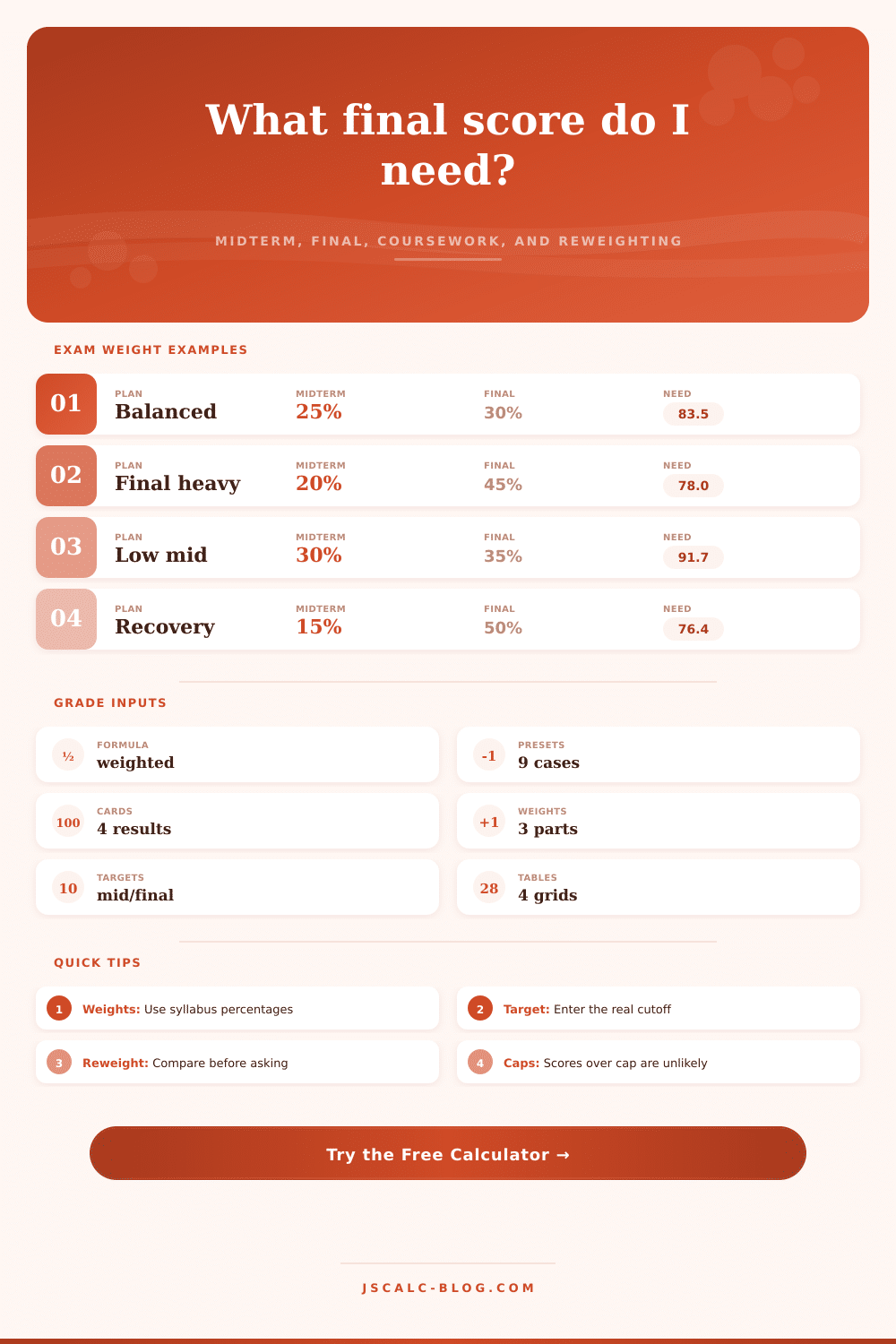
You select your current score in the tool, which sets your starting line. It tells you down to the decimal point what you must earn on the final in order to hit your target. And if it tells you you need a ninety-two when you know finals is curved, you’ve got a gameplan. Or it tells you you need a one-oh-five? You’ve got a problem.
Rather then hoping for a curve, people should of calculate their actual shortfall. It has adjustable weights too. Maybe some profs follow the syllabus to a T and some will bend based off how they feel you performed. If you can demonstrate that you perform better with different distribution of the course, you may be able to negotiate.
This calculator allows you to play with shifting the weights among categories. What would happen if you dropped the midterm and had a final? How about increasing the percentage given to work you do? Use this data when you speak to professor.
“I’m stressed so I need a curve” is weak. “Here’s the math showing why I think a different distribution makes sense, let me know if you agree?” is strong. The former asks for something; the latter provides evidence.
Comment The realistic score cap is something you don’t want to skip over. Sure, it’s a small thing, but it’s important. A hundred and five? That’s a warning. Ninety-eight percent? That’s possible. The cap prevents you from burning yourself out by pursuing a number that doesn’t exist. It will help you distinguish a dead end from a hard goal. And you can change this cap if you’re taking an extra-credit test or getting some bonus points. Adding bonus quizzes if your instructor give those will change everything. Most students keep this at zero, though that’s okay.
Presets are also good for that. Are you in a class with a lot of focus on the final? That’s very different than a well-balanced semester. Is it a lecture or a lab class? Typically speaking, the former have a more important exam while the latter will have a lot of coursework. When you load up a preset, you get an idea for how the class is structured and what the pressure points are.
Midterm low? Don’t sweat it if you get average grades there. Final high? Every hour studying counts double. These are the kinds of tradeoffs the tool makes visible.
The grades themselves, they’re simply a set of numbers. They become important and seem like destiny, but in fact they is also nothing more than numbers. If you understand how they add up, you can control them. Use the calculator; it’ll do the math for you and spare you any guesswork about converting.
Studying is something else entirely that no tool will ever substitute for. Studying’s what helps you learn the material. What it can absorbs is how much you should study. There’s nothing complicated about it really.
Check your baseline. Know your weights. Go for that target. A difference between knowing and guessing may be as little as one letter grade.
That reference table shows the impact of weight on score changes, but the true effort begins when you plug in your personal numbers. Hopes don’t matter to the math. Only what you input matters. Do it right and the rest falls into place.