Meeting Cost Calculator
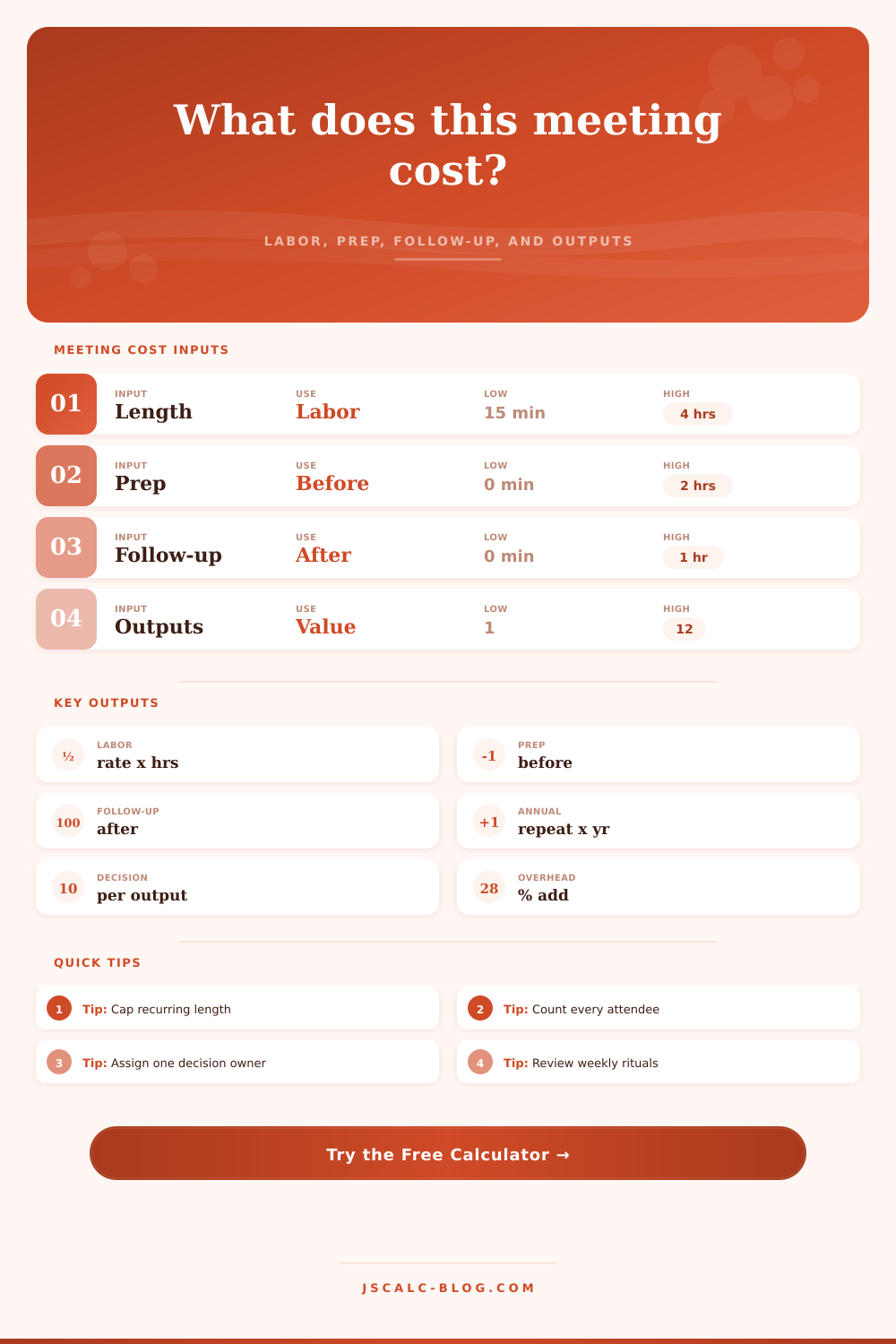
Estimate attendee labor, preparation, follow-up, recurring frequency, and cost per decision or output.
Salary mode converts salary to hourly using annual work hours.
Common defaults: 2,080 gross, 1,880 adjusted, 1,720 productive.
Use for calendar churn, switching time, late starts, and recap handling.
| Role group | Attendees | Salary or hourly rate | Load multiplier |
|---|---|---|---|
| Executives / directors | |||
| Managers / leads | |||
| Senior specialists | |||
| Core contributors | |||
| Contractors / consultants |
Meeting Cost Results
Hourly rate from salary: loaded hourly rate = annual salary / annual work hours x load multiplier.
Attendee labor cost: sum of each role group hourly rate x attendee count x meeting hours.
Prep and follow-up cost: sum of each role group hourly rate x attendee count x prep/follow-up hours.
Total meeting cost: meeting labor + prep/follow-up labor + coordination overhead.
Cost per decision/output: total meeting cost / number of useful decisions or deliverables.
Annualized recurring meeting cost: total meeting cost x annual occurrences from the selected frequency.
Use the annual work-hours setting that best matches what you want to count in salary conversion.
| Work-hour basis | Annual hours | What it includes | Best use |
|---|---|---|---|
| Gross full-time schedule | 2,080 | 40 hours x 52 weeks | Simple salary conversion |
| Paid-time-off adjusted | 1,920 | Holiday and vacation drag | People teams and finance models |
| Available work time | 1,880 | Working days after common leave | Operational planning |
| Productive capacity | 1,720 | Admin, training, and interruptions removed | Knowledge-work opportunity cost |
| Billable capacity | 1,600 | Client-billable or focused delivery time | Agencies and consultancies |
| Executive focus time | 1,400 | High-leverage time after standing obligations | Senior leadership tradeoffs |
Annualized cost uses the multiplier below: total meeting cost x annual occurrences.
| Meeting rhythm | Occurrences per year | Typical control point | Review cadence |
|---|---|---|---|
| Every workday | 260 | Keep under 15 minutes | Monthly |
| Three times per week | 156 | Rotate async updates | Monthly |
| Twice per week | 104 | Require a live blocker list | Monthly |
| Weekly | 52 | Attach agenda before invite | Quarterly |
| Biweekly | 26 | Bundle topics in batches | Quarterly |
| Monthly | 12 | Pre-read before discussion | Semiannual |
| Quarterly | 4 | Define decisions in advance | Annual |
| One-time | 1 | Close with owner and date | After action |
These ranges are practical modeling ranges; replace them with your own compensation data whenever available.
| Role group | Annual salary range | Hourly at 2,080 hours | Common load multiplier |
|---|---|---|---|
| Executive / director | $160k to $300k | $77 to $144/hr | 1.25 to 1.45 |
| Manager / team lead | $105k to $180k | $50 to $87/hr | 1.20 to 1.35 |
| Senior specialist | $95k to $160k | $46 to $77/hr | 1.18 to 1.30 |
| Core contributor | $65k to $120k | $31 to $58/hr | 1.15 to 1.28 |
| Coordinator / analyst | $50k to $85k | $24 to $41/hr | 1.12 to 1.25 |
| Contractor / consultant | Hourly direct | $75 to $250/hr | 1.00 to 1.10 |
Use this 6-column grid to pressure-test whether a live meeting is the right format.
| Format | People | Minutes | Prep | Expected output | Risk signal |
|---|---|---|---|---|---|
| Daily standup | 5 to 9 | 10 to 15 | 0 to 5 min | Blocker list | Status drift |
| Decision review | 4 to 7 | 30 to 60 | 15 to 45 min | One decision | No owner |
| Executive committee | 5 to 10 | 60 to 90 | 30 to 90 min | Priority choices | Slide review only |
| Pipeline review | 6 to 12 | 30 to 60 | 10 to 30 min | Forecast changes | No account actions |
| Escalation bridge | 6 to 14 | 30 to 120 | 0 to 15 min | Incident actions | Too many watchers |
| Hiring debrief | 4 to 8 | 30 to 45 | 10 to 20 min | Hire/no-hire call | Weak scorecards |
| Planning workshop | 8 to 18 | 120 to 240 | 60 to 180 min | Roadmap tradeoffs | No pre-read |
| Training session | 10 to 60 | 45 to 90 | 10 to 30 min | Skill adoption | No practice block |
| Client status | 4 to 10 | 30 to 60 | 15 to 45 min | Next actions | Repeats old updates |
Imagine you have a one-hour meeting with a team of seven people. They’re all in the room, and they feel productive. You leave thinking you’ve resolved a problem.
Here’s how much that one hour realy costs your organization: It wasn’t an hour of time. It was seven hours of work, plus prep time for each person ahead of time and follow-up work for everyone after. Multiply those by salaries, and that hour probably cost your company more then five-hundred bucks. Most managers is shocked when they hear this. But if you track this regularly, you won’t be surprised anymore.
Why Meetings Cost So Much Money
“Meetings are free.” That’s the trap. It’s a very expensive trap. Meetings sucks up the time of your most expensive workers. They’re a huge cost on your operating budget. Your director or senior engineer is highly paid… For both her base pay and all the other infrastructure costs associated with her: office space, equipment, benefits, etc. Every hour you extract her from her desk are an hour of that combined hourly rate that isn’t working on her core job.
The killer is opportunity cost. Not only do you pay her for the time she spends talking, you pay her for the time it takes her to listen.
The best way to understand your real burn rate, however, is not by looking at the clock. The majority of us only take the cost of meeting and leave it at that. We ignore the fact that meetings are just surface-level tip of an iceberg. Before the call, there’s time spent prepping. After the call, there’s follow-up work. And there’s the mental cost of pausing your deep work to participate followed by the effort required to re-enter your flow state.
A tool that factors in all those variables provide a far clearer picture of your operational efficiency. By adjusting inputs for attendee roles and adding prep and follow-up time, you can see meeting’s true economic value. It’s this method that shows you why a 30-minute sync with five execs might end up costing more than a two-hour workshop with entry level staffers.
The math gets real in terms of frequency. On paper, a weekly meeting sounds doable. But times 52 weeks in a year, you’re looking at a huge number. And if nothing tangible come out of that meeting, if there’s no clear decision made, then you’ve rented that time for no return. The value of a meeting relates directy to the outputs. So if you pay two grand for a monthly strategy session and walk away without any decisions, then your cost-per-decision = infinity.
That tells you something: Change the format. Perhaps it should of an email. Or perhaps it should be a document review. Reserve live time for debate, not information transfer.
To begin cutting back, audit your calendar for recurring items. The biggest leaks will be the ones with no decision owner and no agenda. Trim down the attendees to just the people needed to execute the outcome (or make a decision). Send them all the summary after and let everyone else read it later. Take out one person from the invite list and the hourly burn rate go down a lot.
Meetings aren’t going anywhere. Some are required for complex problem solving and alignment. Instead, we want them to become intentional. View your meeting time as a use of capital. If you wouldn’t waste five hundred dollars buying a software license unless you were getting something out of it, why do you squander your team’s time without equal consideration? Value their time properly and you begin to ask better questions. Is this something that needs us in the room? Should this happen async? What exact decision do we leave with?
When you put a dollar sign next to your calendar, things change. You assign owners. You set time limits. You send agendas. You stop inviting people just to keep them in the loop. The calendar becomes a ledger of your most valuable asset. You no longer treat time as an endless resource, instead, you begin to think about it as cash. It is a slight mindshift, but one that will pay off in terms of your own profitability and productivity.
You’ll start respecting the price tag of interruption. You’ll recognize each click on “accept” as a cost. And make sure it counts.