Margin vs Markup Calculator
See gross margin and markup side by side, convert one into the other, and solve for selling price, cost, or profit. Every result shows both percentages and the exact formula so the numbers never get confused.
🎯Real Pricing Presets
📝Enter Your Numbers
Only the fields the mode needs stay visible.
🔢The Two Formulas Side by Side
📊Markup % to Margin % Conversion
| Markup % | Margin % | Price / Cost | Cost at $100 Price | Profit at $100 Price |
|---|---|---|---|---|
| Calculating conversion table. | ||||
Markup is measured against cost, so the same profit always shows a larger markup than margin. The active row highlights the markup closest to your inputs.
🔁Margin % to Markup % Conversion
| Margin % | Markup % | Price / Cost | Price at $100 Cost | Profit at $100 Cost |
|---|---|---|---|---|
| Calculating conversion table. | ||||
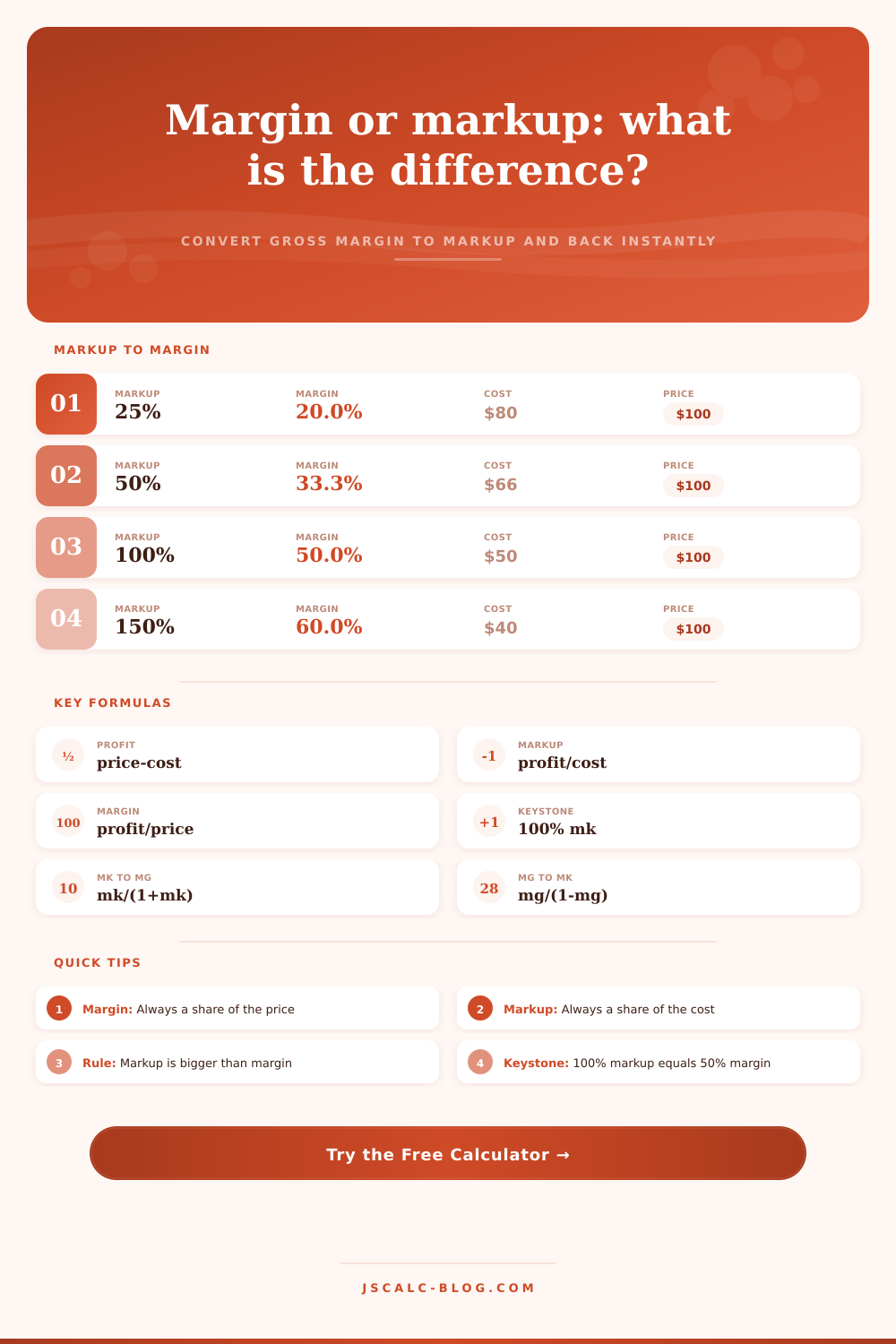
Going the other way, margin = markup / (1 + markup) and markup = margin / (1 – margin). Notice 50% margin needs 100% markup, the classic keystone rule.
📋Cost, Price & Profit Reference (Your Cost)
| Target Margin | Equivalent Markup | Selling Price | Profit / Unit | Multiple |
|---|---|---|---|---|
| Enter a cost above to build the reference table. | ||||
Each row applies a target gross margin to your entered cost and shows the price you must charge plus the markup it represents.
🏭Industry Margin Benchmarks
| Industry | Typical Margin | Equivalent Markup | Price / Cost | Pricing Style | Notes |
|---|---|---|---|---|---|
| Grocery retail | 2% to 5% | 2% to 5% | 1.02x to 1.05x | Thin margin, high volume | Wins on turnover, not per-unit profit |
| Restaurant food | 60% to 70% | 150% to 233% | 2.5x to 3.3x | High markup on ingredients | Labor and rent eat the raw food margin |
| Apparel retail | 50% to 55% | 100% to 122% | 2.0x to 2.2x | Keystone or above | Markdowns pull the realized margin lower |
| Electronics | 5% to 15% | 5% to 18% | 1.05x to 1.18x | Competitive, thin | Accessories carry the fatter margins |
| Jewelry | 40% to 60% | 67% to 150% | 1.67x to 2.5x | High markup goods | Keystone pricing is common at retail |
| Software / SaaS | 75% to 90% | 300% to 900% | 4.0x to 10.0x | Very high margin | Near-zero cost to serve one more user |
| Furniture | 40% to 50% | 67% to 100% | 1.67x to 2.0x | Keystone range | Freight and storage reduce net margin |
| Automotive parts | 20% to 40% | 25% to 67% | 1.25x to 1.67x | Moderate markup | OEM parts sit lower, aftermarket higher |
⚙Full Formula Breakdown
💡Margin vs Markup Tips
A widget costs twenty bucks and you sell it for thirty. Easy math, right? Until you want to tell someone how much profit that represents. Did you mark it up fifty percent? Nope, says your partner, looking at the same piece of paper with price tag: The margin is only thirty-three percent. And your partner is correct, though both of you have measured something different than another starting point. That’s where pricing strategy gets confusing.
Once you’ve plugged in your own numbers (costs, targets), the calculator do the math, saving you the effort of estimating whether a given target percentage will get you too far out of the market or leave you grasping for pennies.
The Difference Between Markup and Margin
Margin is profit as a percent of your selling price. It tells you what slice of every dollar you earn go into your pocket. This is also known as profit as a percentage of sales (or gross profit).
Markup is profit as a percent of your cost. It tells you how much you’ve added on top of what you invested. The selling price is always greater then the cost; therefore, the markup percentage will always exceed the margin percentage (for the same transaction). This makes all the difference when you’re negotiating with suppliers (and setting limits on how high you can sell things for at retail).
You might assume that a 50% markup represent a 50% return on sales revenue. You’ll bleed cash before you even pay rent by underpricing your wares.
Let’s take an example: the traditional keystone markup found in many items like jewelry or apparel. Double it, right? That gives you a one hundred percent markup. It sounds good. Everyone thinks they’re done here; its huge. Guess what? That one hundred percent markup leave you with a gross margin of just fifty percent. You’ve got to pay yourself and everyone else for all of those costs (overhead, marketing, labor) along with the price of the product itself. So you’re splitting every sale right down the middle, half goes toward the goods, half go toward paying you back. And if thirty percent of sales go to operating expenses, then before we even talk about taxes, you are left with a twenty percent profit margin.
See the handy chart on the page that breaks this down into a nice visual? A “generous” markup, once expressed as a margin, get pretty small. The higher the number, however, more the gap between the two metrics widens, and when we get to a 200% markup, our margin is only 67%. The two numbers pull apart very quickly. This makes it tempting to grossly overestimate your profitability, especially if you aren’t paying attention to which percentage metric you are looking at.
This means understanding how your industry measures itself. Is it based off volume? Volume is key for grocery stores, which means they has razor-thin margins. Or is it based on huge margins (like software companies where the marginal cost is practically nothing)? This also means understanding the language used by your competitors and benchmarking yourself accordingly.
When someone tells you they’ll sell you something at X dollars per unit, you can immediately tell them what percentage of your selling price will go towards that item. Similarly, when they say “We’ve already got a 30% markup baked in here,” you can immediately know exactly what percentage of your selling price that markup is.
OTOH, if you’re trying to get a gross margin of 40%, then putting 40% onto your cost doesn’t mean you’ll have a gross margin of 40%. Because what you added isn’t a margin: it’s a markup. A markup is less than an actual margin, meaning you take home less money than you expected.
The beauty here is that this thing does all the math for you… In real time, so that you can try things out without having to pull up a spreadsheet. That will protect your business from blind missteps. It will guard against accidentally draining your bucket of profit by offering too many promotions, discounts or price increases. It will help you understand how your business will be affected if a supplier raise its price by 10%. Will you need to raise your own selling price by the exact same amount to achieve the same margin? What kind of discount could you offer without sacrificing your minimum level of profitability?
The math is simple, but the slips occur when you’re pressed for time and trying to apply it to hundreds of different product. Once you become familiar with this profit-price-cost dance, you’ll have the confidence to negotiate prices and know how much to charge for each item based on its true worth, not some random number plucked out of thin air.
In the end, being able to distinguish a margin from a markup isn’t simply a matter of mathematics. It’s a way to gain clarity over exactly how much money you stand to keep from every single sale.