Lumber Weight Calculator
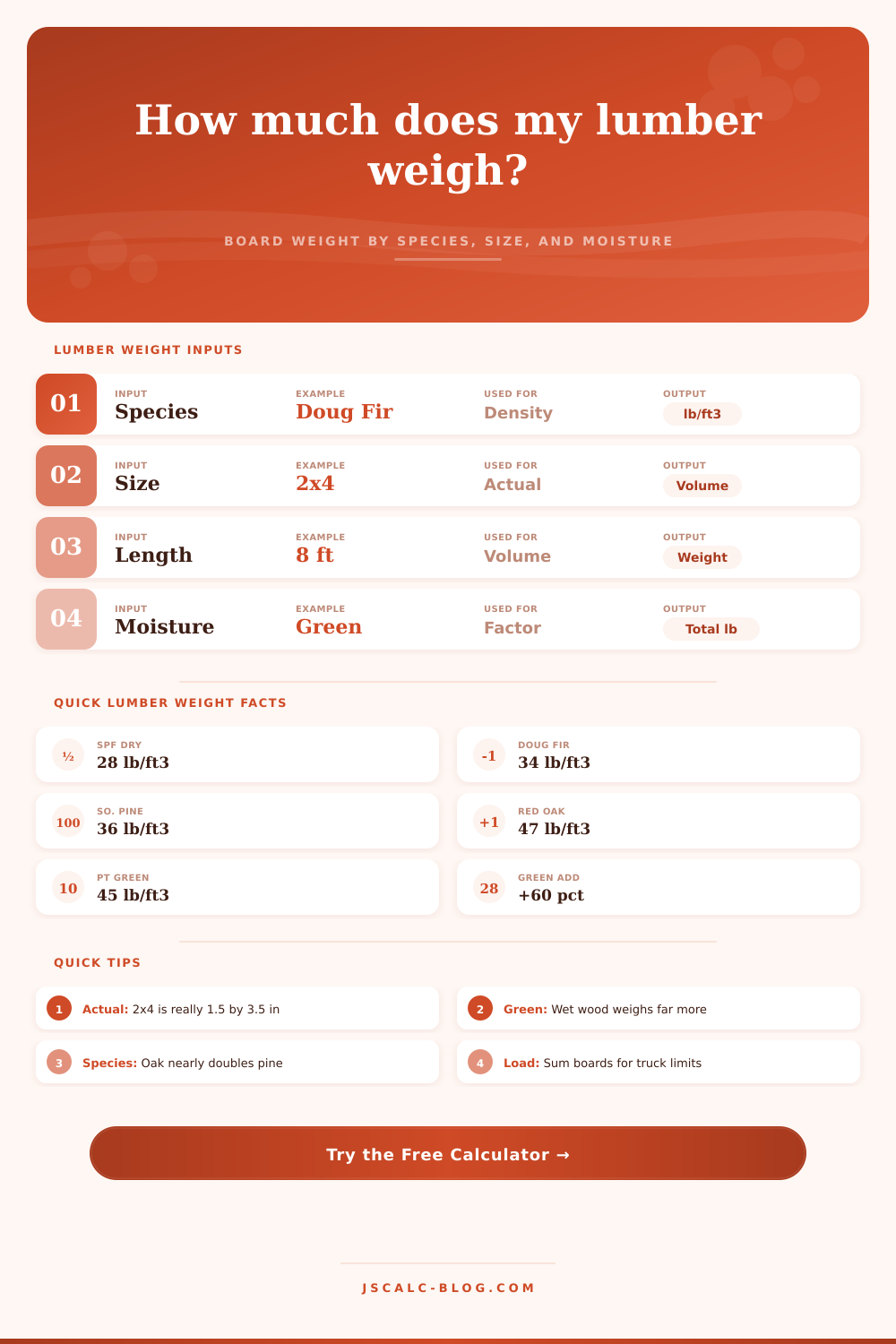
Estimate the weight of dimensional lumber and boards by wood species density, nominal or custom size, length, piece count, and moisture condition from kiln-dried through green and pressure-treated for load and transport planning.
🎯Real Lumber Presets
📝Lumber Inputs
Density is oven-dry-basis weight at about 12% moisture; the moisture selector adjusts it.
Water in the cells adds weight; green softwood can weigh 60% more than kiln-dried.
Nominal names use larger numbers than the real planed size used for weight.
Used only when size method is custom.
Enter the planed face width for custom stock.
Optional add-on for nails, plates, or banding on a load.
🔢Weight Formula Snapshot
🌲Wood Species Density Reference
| Species | Group | KD lb/ft³ | Green lb/ft³ | 2x4x8 KD (lb) |
|---|---|---|---|---|
| Western Red Cedar | Softwood | 23 | 37 | 7.8 |
| Eastern White Pine | Softwood | 26 | 42 | 8.9 |
| SPF (Spruce-Pine-Fir) | Softwood | 28 | 45 | 9.6 |
| Hem-Fir | Softwood | 28.5 | 46 | 9.7 |
| Douglas Fir-Larch | Softwood | 34 | 55 | 11.6 |
| Southern Yellow Pine | Softwood | 36 | 58 | 12.3 |
| Hard Maple | Hardwood | 44 | 58 | 15.0 |
| Red Oak | Hardwood | 47 | 64 | 16.0 |
| White Oak | Hardwood | 49 | 66 | 16.7 |
| Hickory | Hardwood | 52 | 70 | 17.7 |
📏Nominal to Actual Size Reference
| Nominal | Actual (in) | Area (in²) | Volume 8 ft (ft³) | Board Feet 8 ft |
|---|---|---|---|---|
| 1x4 | 0.75 × 3.5 | 2.63 | 0.146 | 2.67 |
| 1x6 | 0.75 × 5.5 | 4.13 | 0.229 | 4.00 |
| 2x4 | 1.5 × 3.5 | 5.25 | 0.292 | 5.33 |
| 2x6 | 1.5 × 5.5 | 8.25 | 0.458 | 8.00 |
| 2x8 | 1.5 × 7.25 | 10.88 | 0.604 | 10.67 |
| 2x10 | 1.5 × 9.25 | 13.88 | 0.771 | 13.33 |
| 4x4 | 3.5 × 3.5 | 12.25 | 0.681 | 10.67 |
| 6x6 | 5.5 × 5.5 | 30.25 | 1.681 | 24.00 |
Weight uses the actual planed size, while board feet use the nominal size, so the two measures differ.
💧Moisture Content Weight Effect
| Condition | Approx. MC | Factor | SPF 2x4x8 (lb) | Doug Fir 2x4x8 (lb) |
|---|---|---|---|---|
| Oven-dry | 0% | 0.92× | 8.8 | 10.7 |
| Kiln-dried (KD) | 12% | 1.00× | 9.6 | 11.6 |
| Air-dried | 15-19% | 1.06× | 10.1 | 12.3 |
| Partly seasoned | 30% | 1.35× | 12.9 | 15.7 |
| Green / fresh | 60%+ | 1.62× | 15.5 | 18.8 |
| PT wet | Treated | 1.75× | 16.8 | 20.3 |
Factors are applied to the kiln-dried baseline density for each species.
📊Per-Board Weight Comparison Grid
| Size × Length | Cedar KD | SPF KD | Doug Fir KD | SYP KD | Red Oak KD | SPF Green |
|---|---|---|---|---|---|---|
| 2x4 × 8 ft | 6.7 | 8.2 | 9.9 | 10.5 | 13.7 | 13.2 |
| 2x4 × 10 ft | 8.4 | 10.2 | 12.4 | 13.1 | 17.2 | 16.6 |
| 2x6 × 8 ft | 10.5 | 12.8 | 15.6 | 16.5 | 21.5 | 20.8 |
| 2x8 × 10 ft | 17.4 | 21.1 | 25.7 | 27.2 | 35.5 | 34.2 |
| 2x10 × 12 ft | 26.6 | 32.4 | 39.3 | 41.6 | 54.3 | 52.4 |
| 4x4 × 8 ft | 15.7 | 19.1 | 23.2 | 24.5 | 32.0 | 30.9 |
| 6x6 × 8 ft | 38.6 | 47.0 | 57.1 | 60.5 | 79.0 | 76.2 |
| 2x4 stud 92-5/8 in | 6.5 | 7.9 | 9.6 | 10.1 | 13.2 | 12.7 |
All values are pounds per single board at the stated species and moisture; multiply by piece count for a bundle.
⚙Full Formula Breakdown
🚚Load and Transport Reference
| Scenario | Make-up | Species / Moisture | Approx. Weight |
|---|---|---|---|
| Single stud | 1 × 2x4x8 | SPF kiln-dried | ~9.6 lb |
| Small truck load | 50 × 2x4x8 | SPF kiln-dried | ~480 lb |
| Framing pack | 100 × 2x6x10 | Doug Fir kiln-dried | ~1,950 lb |
| Green treated pallet | 60 × PT 2x6x12 | Southern pine green | ~2,500 lb |
| Hardwood order | 40 × Oak 1x6x8 | Red oak kiln-dried | ~450 lb |
| Deck post set | 10 × PT 6x6x8 | SYP treated wet | ~1,060 lb |
Use these as sanity checks against payload ratings for a pickup, trailer, or roof rack.
💡Practical Lumber Weight Tips
When loading lumber into the back of a pickup, be careful of how heavy it is. Wet lumber are extremely heavy because it still has all its water content. This is why green lumber is so heavy different than dry. If you don’t factor that into the equation, it could ruin your pickup’s frame and throw off balance of the load. Always consider the weight before picking up the lumber and save your axle.
After selecting the dimensions and species, calculator does the rest. It eliminates guesswork when trying to estimate how dense something is. We see many folks who rely on name of what’s in the package and not size of actual board. Two-by-four implies two inches by four inches, right? Nope! That’s the nominal size (the one we bill you for). The actual planed size are 1-1/2 inches by 3-1/2 inches. If you use nominal size, you’ll end up overestimating the load by almost sixty percent. It is not such a big deal unless you are checking whether your roof rack can holds what you want to carry or are trying to stay below payload limit.
How to Calculate Wood Weight
The last part of the equation is species. Framing lumber are often softwood. Southern Yellow Pine and Spruce-Pine-Fir are common choices because of their strength-to-weight ratio. They is easy to carry by hand, but they still hold nails well. Hardwoods are another story altogether. Due to their tighter grain, hardwoods such as Red Oak or Hickory pack more mass in the same space. A red oak board can weighs nearly double that of a pine board of identical dimensions. Knowing the weight gives you an idea of number of trips required to move the furnitures upstairs.
Another factor in any calculation is moisture content. Until wood reaches equilibrium with surrounding atmosphere, it will soak up surrounding humidity. Out of the mill, green wood contains more than twice as much water (by weight) than dry. That water resides in the wood’s cavities and cell walls of its fiber. When kiln dried, which is typically 12-percent moisture, the wood sheds this load. Web-based calculators accounts for such conditions by changing their baseline densities with a multiplying factor to reflect the additional mass of water. Because pressure treated is delivered with water under high pressure, the wood is both heavier and wetter, treated with chemicals, in comparison to regular stud lumber. These chemicals arrive dissolved in water, which remains inside the wood for months, even after your departure from home center lot.
Weight is another line item that will fall into your materials budget. Consider it with cost and availability. If you go with a heavy wood like a hardwood, it’s durable, but keep in mind that extra weight mean more work for your body to move. A light weight softwood is easy to handle, but make sure the lighter weight doesn’t affect strength of the structure under shear wall and wind load. The density adjustments in the reference tables demonstrates how species and conditions impact density. To calculate an accurate transport estimate, simply adjust the weight per board by your actual quantity of pieces and multiply the two values together. You should of used a calculator for this.
So, how do we make sense of it all? Let’s break down weight. What exactly is being weighed? Water, density and volume. If you’re able to distinguish those elements in your head, weight becomes a limitation you can handle. For instance, if you know an eight-foot stud weighs approximately ten pounds, you can go ahead and put 50 of ’em in your truck with confidence. That way, when you carry a load, you won’t risk damaging your vehicle along the way. It also ensures your car or truck stays intact. At the same time, your load remains protected. You will recieve actualy better results if you plan ahead.