Loan Amortization Calculator
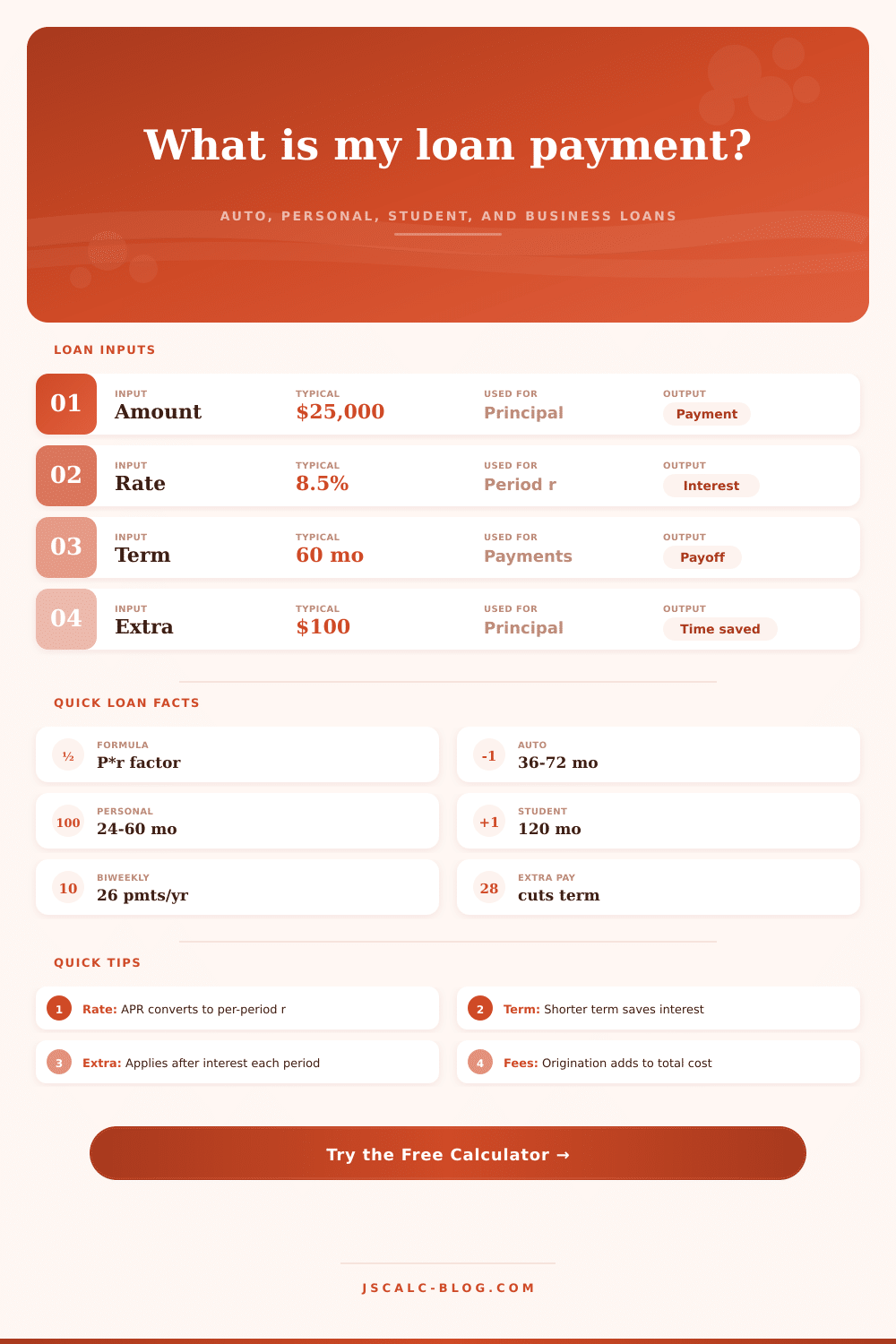
Estimate the periodic payment, total interest, total cost, and payoff time for auto, personal, student, and business installment loans, then view a full amortization schedule with extra payments and origination fees.
🎯Real Loan Presets
📝Loan Inputs
One-time fee financed or paid up front; added to total cost.
🔢Formula Snapshot
📊Amortization Schedule
First 12 periods, yearly milestones, and the final payment are shown from the real computed schedule.
| # | Date | Payment | Principal | Interest | Extra | Balance |
|---|---|---|---|---|---|---|
| Enter values above to build the amortization schedule. | ||||||
🗓Yearly Summary
| Year | Payments | Principal Paid | Interest Paid | Extra Paid | Ending Balance |
|---|---|---|---|---|---|
| The yearly summary appears after calculation. | |||||
🗂Loan-Type Reference
| Loan Type | Typical Amount | Common Term | Rate Range | Collateral |
|---|---|---|---|---|
| Auto (new) | $20k – $45k | 48 – 72 mo | 5% – 9% | Vehicle |
| Auto (used) | $12k – $30k | 36 – 60 mo | 7% – 13% | Vehicle |
| Personal | $3k – $40k | 24 – 60 mo | 8% – 24% | Unsecured |
| Student (federal) | $5k – $50k | 120 mo | 5% – 8% | Unsecured |
| Business (term) | $25k – $250k | 36 – 120 mo | 7% – 18% | Varies |
| Debt consolidation | $5k – $50k | 24 – 84 mo | 7% – 20% | Unsecured |
⚖Interest by Term
Same amount and rate as your inputs, compared across terms. Longer terms lower the payment but raise total interest.
| Term | Payments | Payment | Total Interest | Total Cost |
|---|---|---|---|---|
| The interest-by-term table appears after calculation. | ||||
🔍Loan Scenario Comparison
| Scenario | Amount | Rate | Term | Payment | Total Interest |
|---|---|---|---|---|---|
| Auto 5-year | $30,000 | 7.00% | 60 mo | $594 | $5,639 |
| Auto 6-year | $30,000 | 7.00% | 72 mo | $512 | $6,842 |
| Personal 3-year | $10,000 | 12.00% | 36 mo | $332 | $1,957 |
| Student 10-year | $25,000 | 6.00% | 120 mo | $278 | $8,306 |
| Business 7-year | $50,000 | 9.50% | 84 mo | $818 | $18,676 |
| Consolidation 5-year | $20,000 | 11.00% | 60 mo | $435 | $6,088 |
| 0% promo auto | $28,000 | 0.00% | 60 mo | $467 | $0 |
| Boat 8-year | $40,000 | 8.50% | 96 mo | $576 | $15,278 |
⚙Full Formula Breakdown
📋Reference Values
| Item | Common Entry | How It Is Used | Schedule Effect |
|---|---|---|---|
| Loan amount | $3k to $250k | Sets P in the formula | Scales payment and interest |
| Annual rate | 0% to 24% | Rate / 100 / periods | Higher rate raises interest |
| Term | 24 to 120 months | Sets n payments | Longer term lowers payment |
| Frequency | Monthly or biweekly | Sets periods per year | Biweekly pays down faster |
| Extra payment | $25 to $500 | Added to principal reduction | Shortens payoff, saves interest |
| Origination fee | 0% to 8% of loan | Added to total cost | No principal effect by default |
💡Practical Loan Tips
If you have ever bought a car or taken out a personal loan, then you know how it works: you get a contract from the bank with information about the schedule of your payments (amortization), your principal balance, interest rate, etc… and you gets a monthly payment that fits within your budget. What does all this mean? That’s exactly what you need to know.
Most people is concerned only with their “monthly payment”… Because it affects their immediate cash flow. But they don’t realize the overall cost of that loan. Which will affect them for years.
How Loans Work
This means that your early payments goes heavily towards interest. Your later payments will knock off more of the principal then they do earlier in the timeline because they are based on a smaller balance. Want to see this play out in action? The calculator above show exactly which portion of each payment goes to the bank and which part goes to paying down your debt.
Length. Most folks get derailed here. Length is where lenders like to trap you. They love having borrowers tied into their system for as long as possible. So they offer 72 months loans (which may drop your monthly payment a hundred bucks from a 60-month loan), and hey, it looks great on your tight-budget-spreadsheet.
But you know what else? That one extra year of payments can tack on thousands of extra dollars in raw interest charge. To put it bluntly: Do you want to save $100 right now at the expense of shelling out an additional grand or two over an extra year? The table below will make that clear with a comparison of the overall cost between different lengths.
Now, if you throw extra money at your debt, then those payments goes straight toward reducing the principal, which lowers the base amount used to calculate interest. A little bit goes a long way. If you add even just $50 per month, you’ll shave several months from the back-end of your loan.
And this makes sense! Reducing the principal more quickly shrinks the base that accrues interest each following month. This is a compounding effect in reverse: You’re shrinking the problem rather than just managing its symptoms. People often think that big lump sums is required for this to help them, but with amortization, it’s all about consistency (not size).
In addition, how often you pay also matter. By paying every two weeks (as opposed to once a month), you’ll be making 26 half-payments each year, rather than 12 full payments. This amounts to an additional full payment annually, and speeds up the process without dramatically altering your weekly cash flow. This small advantage lowers their interest income but lenders rarely point it out.
Fees are the other side of price. Even though they don’t affect the monthly-payment equation, origination fees and down payments still add to the overall sum of what you’ll pay, or how much out-of-pocket cash you need. The calculator includes those expenses in the ultimate dollar tally, so you know the real-world price tag of your financing choice.
Remember, a loan isn’t simply a monthly bill. A loan is a wealth transfer from you, straight to the lender. Similarly, consider a business line of credit or student loans. How long will it hurt? The term (duration) is one variable. What’s the price tag on the money? The rate is another. And what is the final tally on the bill? That’s the principal, the mountain we’re trying to conquer.
Learning about these three variables, their interplay and impact, gives you the power to change the way you repay, or renegotiate a better deal in the first place. For example: Maybe a lower rate for 10 years actualy costs you more than a slightly higher rate with a shorter term. You should of looked at that earlier.
At the end of the day, however, borrowing isn’t an event, it’s a process. It’s a means to invest in opportunities that grow and assets that increase in value, not liabilities that lose value. Whether it’s paying off credit cards or buying a new truck, you want to reduce your rate as much as possible so you can keep as many dollars in your pocket. You should of checked the math.
If you spend five minutes learning how this math works, it doesn’t need to scare you anymore. A complex contract becomes a doable plan when you know exactly where every dollar will go. When you’re staring at the schedule, the doubt dissapears.