Laws of Exponents Calculator
Apply the exponent rules to two same-base terms. Choose the product, quotient, power of a power, power of a product, negative, zero, or fractional law, simplify the expression, see which rule was used, and evaluate the numeric value.
🎯Worked Exponent Presets
📝Exponent Inputs
Use a letter like x, a, or y for the symbolic answer.
Numeric value substituted for the base symbol.
The coefficient in (b·x)^n, e.g. the 2 in (2x)^3.
🔢Rule Snapshot
📐The Laws of Exponents Reference
| Law Name | Rule (Formula) | What Happens | Condition |
|---|---|---|---|
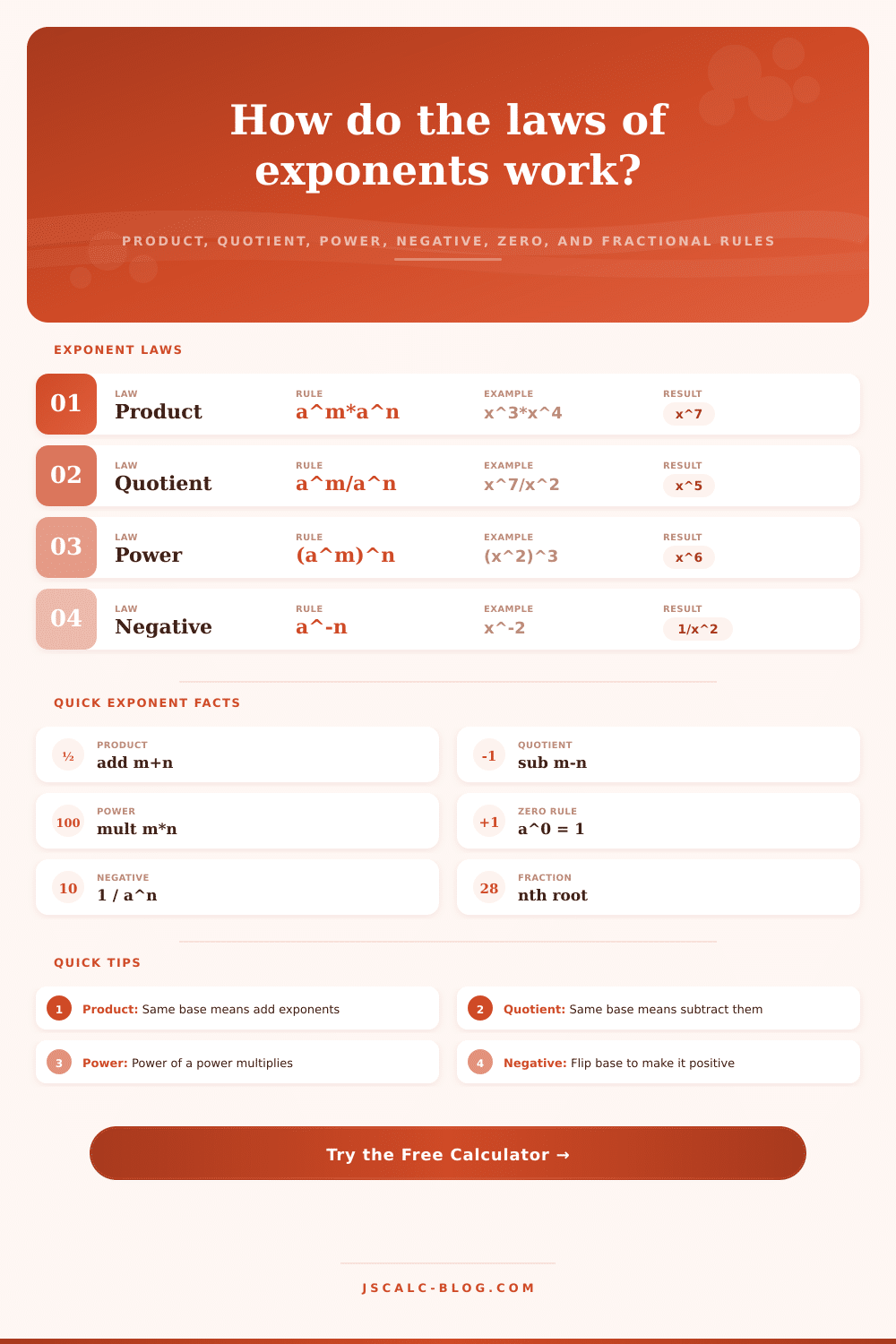
| Product of powers | a^m × a^n = a^(m+n) | Add the exponents | Same base a |
| Quotient of powers | a^m / a^n = a^(m–n) | Subtract the exponents | Same base, a ≠ 0 |
| Power of a power | (a^m)^n = a^(m×n) | Multiply the exponents | Any base a |
| Power of a product | (a·b)^n = a^n × b^n | Distribute the power | Any bases a, b |
| Negative exponent | a^-n = 1 / a^n | Reciprocal of positive power | a ≠ 0 |
| Zero exponent | a^0 = 1 | Result is always 1 | a ≠ 0 |
| Fractional exponent | a^(m/n) = nth-root(a^m) | Root and power combined | a ≥ 0 for even n |
📊Worked Examples By Law
| Expression | Law Used | Exponent Step | Simplified |
|---|---|---|---|
| x^3 × x^4 | Product | 3 + 4 = 7 | x^7 |
| x^7 / x^2 | Quotient | 7 – 2 = 5 | x^5 |
| (x^2)^3 | Power of a power | 2 × 3 = 6 | x^6 |
| x^5 × x^-3 | Product | 5 + (–3) = 2 | x^2 |
| x^-2 | Negative | flip to 1 / x^2 | 1 / x^2 |
| x^0 | Zero | any base → 1 | 1 |
| 8^(2/3) | Fractional | cube root of 8^2 | 4 |
✅Numeric Verification
| Expression | Expand Long Way | Law Short Way | Both Equal |
|---|---|---|---|
| 2^3 × 2^4 | 8 × 16 = 128 | 2^(3+4) = 2^7 | 128 |
| 2^6 / 2^2 | 64 / 4 = 16 | 2^(6–2) = 2^4 | 16 |
| (2^2)^3 | 4 × 4 × 4 = 64 | 2^(2×3) = 2^6 | 64 |
| 3^-2 | 1 / (3 × 3) | 1 / 3^2 | 0.1111 |
| 7^0 | empty product | a^0 rule | 1 |
| 9^(1/2) | square root of 9 | 9^(1/2) | 3 |
🗂Common Mistakes Comparison Grid
| Situation | Wrong Move | Wrong Result | Correct Rule | Correct Result |
|---|---|---|---|---|
| x^3 × x^4 | Multiply exponents | x^12 | Add: 3+4 | x^7 |
| x^7 / x^2 | Divide exponents | x^3.5 | Subtract: 7–2 | x^5 |
| (x^2)^3 | Add exponents | x^5 | Multiply: 2×3 | x^6 |
| x^0 | Set equal to 0 | 0 | Zero rule | 1 |
| x^-2 | Make negative | –x^2 | Reciprocal | 1 / x^2 |
| (2x)^3 | Cube only x | 2x^3 | Cube both | 8x^3 |
| x^2 + x^3 | Add exponents | x^5 | Unlike terms | x^2 + x^3 |
| 8^(2/3) | Multiply 8×2/3 | 5.33 | Root then power | 4 |
⚙Full Formula Breakdown
📋Quick Reference Values
| Base & Power | Meaning | Expanded | Value |
|---|---|---|---|
| 2^0 | Zero exponent | by definition | 1 |
| 2^3 | Positive power | 2 × 2 × 2 | 8 |
| 2^-2 | Negative power | 1 / (2 × 2) | 0.25 |
| 4^(1/2) | Square root | root of 4 | 2 |
| 27^(1/3) | Cube root | root of 27 | 3 |
| 10^6 | Large power | one million | 1000000 |
💡Practical Exponent Tips
On paper exponents seem like a strange symbol, but it’s a way of writing repeated multiplication that makes algebraic expression easier to read and handle vast numbers as well. If you understand how all these exponent rules work then you don’t have to memorize each one by rote: it’s a small set of patterns that build everything else.
Use the calculator above to crunch the number; you don’t have to get caught up in arithmetic mistakes. It also uses the zero, negative, fractional, product, quotient, and power rules. It simplifies the expression and checks if the result make sense. That division of labor is great, since it lets you catch where the pattern breaks down without creating an engineering flaw or grading mistake.
Easy Rules for Exponents
This mistake has tripped up people the most: they’ve confused the two rules for exponents with the operations corresponding to each. For instance, they think that multiplying powers equals multiplying exponents, but that is not true. That’s the product rule. Adding the exponents only applies when the bases matchs. It comes down to thinking about how many factor there are. So if you’re dealing with x cubed then x to the fourth (meaning multiplied together), you’re going to combine three x’s with another four x’s for a total of seven x’s.
On the other hand, the quotient rule does something similar except in reverse: since dividing factors means taking them away, you will therefore take away the exponent in the denominator and subtract it from the exponent in the numerator. It all makes sense. Accepting that multiplication adds and division takes away makes the subtraction/addition rules seem necessary rather than arbitrary.
Powers of powers become a little bit more abstract. In that case, you’re multiplying the exponents, not adding. A picture is helpful here: when you raise x squared to the third power, you’re taking three copies of x squared and multiplying them together. Expanding out x squared three times is just x times x again three times over. Altogether there are six x’s, so it works out to be x to the sixth.
Sure enough, the calculator confirms the symbolic simplification matches the numeric one too. Plug in a number for the base and watch whether the expanded version equal the compacted one. This lets you build intuition. You can connect the abstract with the concrete to see how the symbol work in practice.
I know what gives some people trouble with negative exponents, that they look like they should of mean you do subtraction instead, but that’s not how it works; negative exponents are just reciprocals. That negative sign swaps the positions of the base and the rest of the fraction. One over x squared is the same thing as x to the minus two. Whenever you have a division where the exponent on the bottom is bigger than the exponent on the top, this rule ensures consistency with math. When you subtract a big number from a little number, you get a negative answer. This is exactly what you want, since it tells you that the corresponding factor go into the denominator.
From here we can derive the zero exponent rule, following the same logic. Anything to the zeroth power is one (unless your base is zero!). This might not seem obvious until you remember that dividing a number by itself cancels out the exponents. There’s no multiplication left after the exponents cancel, only the identity value one.
The connection between roots and powers is fractional exponents. These are fractions where the numerator tells you the power and the denominator tell you what kind of root. In most cases it doesn’t matter which way round you do it. You just take the root then raise that number to a power or vice versa. However, working from left to right generaly helps to keep the numbers smaller and makes mental arithmetic simpler.
In the real world there’s rarely one rule. Engineering equations tend to be packed with multiplication, division, and fractional powers all mixed together. It’s far better to know how to break down these combined questions into component parts different than try to remember each fact alone. The tables I’ve put up on the page set these relationships out simply with examples of when they work in combination with others. When people forget to do this step, they make mistakes.
The exponents don’t simply add up if the bases aren’t equal. In those cases, you must treat them as separate problem, evaluating one at a time. It’s an important distinction when it comes to interpreting data and working with scientific notation. Misordering these can cost you; by orders of magnitude!, on an answer. Spending just a few seconds to double-check the structure will save you from expensive errors.
These checkers will confirm what you did right or flag something when you got it wrong. However, knowing which rule applies in advance is the secret to making exponent manipulation a useful tool instead of hard work. It becomes a trusted way to manage scale and growth.