Housing Cost Ratio Calculator
Compare monthly housing cost against gross income, then layer in PITI, HOA dues, PMI, and optional back-end debt-to-income checks.
| Scenario | Gross / mo | Home value | Housing cost | Front-end | Back-end | Signal |
|---|---|---|---|---|---|---|
| Run the calculator to populate the comparison grid. | ||||||
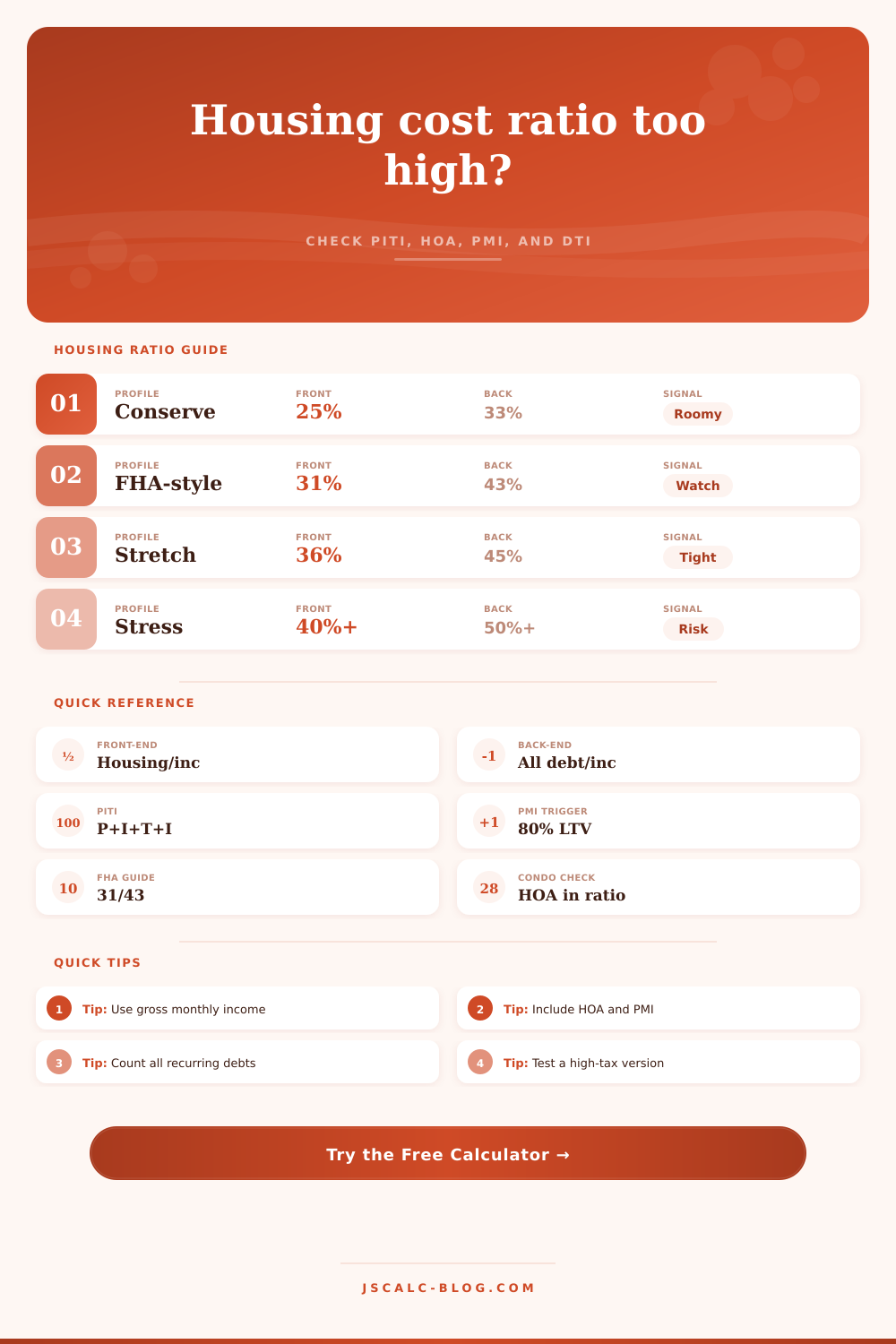
| Profile | Front-end guide | Back-end guide | Best fit | Watch point |
|---|---|---|---|---|
| Conservative | 25% | 33% | Single-income, irregular income, or faster savings goals | May understate buying power in stable low-debt households |
| Standard | 28% | 36% | Traditional front-end housing affordability check | Can feel tight when taxes, childcare, or commuting are high |
| FHA-style | 31% | 43% | Low down payment files that need a front-end benchmark | Approval depends on full underwriting, reserves, and credit profile |
| High-tax caution | 26% | 36% | Markets where tax reassessment can raise escrow sharply | Property tax growth can outpace income growth |
| Condo reserve | 27% | 36% | HOA-heavy condo or townhouse comparison | Special assessments are not included in normal HOA dues |
| Stretch | 36% | 45% | Stress testing a purchase with strong reserves | Small income drops can turn the payment house poor |
| Component | Monthly formula | Included in front-end? | Included in back-end? | Common adjustment |
|---|---|---|---|---|
| Principal and interest | Mortgage amortization payment | Yes | Yes | Changes with rate, term, and loan amount |
| Property tax | Annual tax divided by 12 | Yes | Yes | Use reassessed value in high-tax areas |
| Homeowners insurance | Annual premium divided by 12 | Yes | Yes | Increase for flood, wind, or wildfire exposure |
| PMI or MIP | Loan balance x annual rate / 12 | Yes | Yes | Usually applies above 80% LTV |
| HOA or condo dues | Monthly dues entered directly | Yes | Yes | Include regular dues, not one-time assessments |
| Other debts | Monthly debt entered directly | No | Yes | Count debts that appear in underwriting |
| Loan-to-value | Equity or down payment | PMI treatment | Ratio effect | Planning note |
|---|---|---|---|---|
| 80% or lower | 20%+ equity | Usually none | Lower front-end ratio | Still include tax, insurance, and HOA |
| 80.1% to 90% | 10% to 19.9% equity | Often moderate | Adds a monthly housing line | PMI may cancel later on many conventional loans |
| 90.1% to 96.5% | 3.5% to 9.9% equity | Often higher | Can push front-end above guide | Stress test cash reserves and escrow increases |
| Above 96.5% | Very low equity | High or specialized | Payment is rate-sensitive | Small value changes can affect refinance options |
The tension between wanting a home and being able to afford one is something you encounter all the time. It’s the tug-of-war between emotion (wanting) and money (limits). The monthly payment number dominate most buyers thinking. Why? Because it appears to be sole determiner of things. But it isn’t.
The actualy story happens where your earnings and your housing demands meet. That’s why you should look at the housing cost ratio: A financial speedometer instead of a mere tally of dollars spent in the gas station. The housing cost ratio indicates how quickly your money travels to the roof over your head compared than every other thing required to keep life moving. This is metric lenders are interested in. Do you have enough money left over after making payments to cover a broken-down car and rising interest rates?
Understand Your Total Housing Costs
They’ll analyze it in two buckets. The first bucket, or front-end ratio, only includes housing-related expenses. The second bucket (back-end debt-to-income ratio) drags in all your other financial commitments. To do the comparison, calculator above will crunch numbers for you. But how does it translate beyond just the monthly payment? What’s underneath it? Why is it possible to feel as though two identical mortgage amounts can feels very different?
Get under the hood to see ingredients of your payment. Get under the hood to see ingredients of your payment. The hidden peril of affordability is typically property taxes, which tend to rise frequent in places that reassess regularly. If your house’s assessed value rises by just a little bit, you’ll be handing hundreds more in escrow. But there’s no change whatsoever to your principal and interest. Insurance operates in the same way: It sneaks upward according to local fire risk or weather patterns unrelated to your creditworthiness.
Then there’s private mortgage insurance, which kicks in on any loan with less than twenty percent down. That’s an additional charge based off low equity. It is another piece added to your monthly statement while you gradually build up more equity. They pile up fast, making what seems like a reasonable payment suddenly become heavy burden for you to drag around.
The equation gets even more complicated by HOA fees (more so if you’re a condo owner). These can include landscaping, pool maintenance, etc., but often include an inflexible cost every month that never decreases. Depending on your lender, these dues may be considered a part of your front-end ratio (i.e., counted directly against your housing budget). This makes sense, you don’t get to choose whether or not to pay them; you’ll have to sell your home instead. For more detail on this, check the reference table on the page, where different profiles is shown with how they account for these variables.
If you’re in a high-cost market, you may stretch a little bit higher, but you must have full knowledge of what you’re doing and the potential risk. Alternatively, if you want some breathing room, you could target lower limits, with a conservative buyer. People go wrong here with the back end ratio. That’s when you has to include your mortgage payment. You also has to include your student loan debt, your car note, and your credit card minimum payment. You have to include everything.
Sure, maybe you could afford your mortgage alone. But combined? Maybe that’s another story, and one that should of worry you if it’s putting you near the edge of danger. This isn’t some “we want to say no so we made up rules” thing from a bank either. It’s: how do I live comfortabley with this? Can I save money for retirement or cover any surprise expenses, or am I constantly staring at my spreadsheets with a sense of impending doom? The latter makes the house a burden rather than an asset.
The best way to prevent buyer’s remorse down the road is to test your budget before signing on the dotted line. Run some what-if scenarios: how does it feel with lower income projections? Or how about an extra half-point of interest rate? Do the numbers stack up? If your ratio is already snug under normal circumstances, it’s going to snap like a twig under pressure. You’re trying to find a payment that fits comfortable into your lifestyle; not one that requires you to live paycheck-to-paycheck to pay the light bill.
Understanding your limitations before you begin house shopping puts you in a position of power during talks… And peace of mind after closing. Owning a house should never feel like a financial worry, but rather something you’re doing because you’re optimistic about the future. You’ve learned what every part of the mortgage means in terms of your total ratio, so now you’re able to choose based on what makes sense for your long term, instead of what would satisfy some short term desire.
Do you want to know you have a solid number? Or do you just want a nice kitchen and big yard and hope you didn’t overreach? The math isn’t complicated, when you lay it all out. And taking the time to get this right will save you years of wondering whether you made the correct decision.