Home Equity Loan Payment Calculator
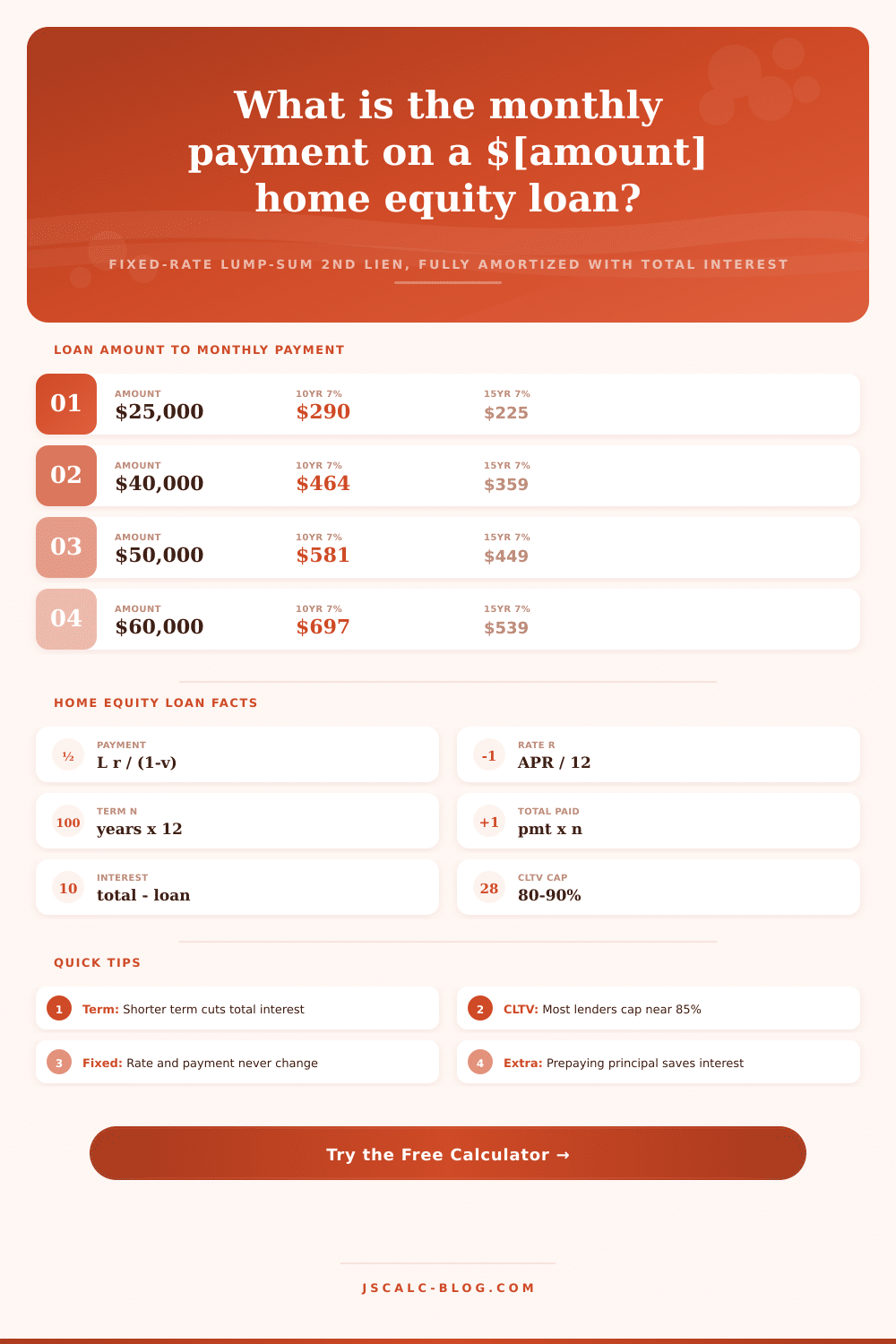
Estimate the fixed monthly payment on a lump-sum home equity loan, a fully amortized second lien. Enter the loan amount, fixed rate, and term to see your payment, total interest, total cost, and how the very first payment splits between principal and interest, plus an optional CLTV equity check.
🏡Real Home Equity Loan Presets
📝Loan Details
The lump sum borrowed against your equity (second lien).
Annual fixed rate; stays constant for the whole term.
Repayment length; home equity loans are typically 5 to 20 years.
Additional payment applied to principal each month.
Current appraised value; used for the CLTV equity check.
Remaining balance on your primary mortgage.
Lender combined loan-to-value ceiling, often 80 to 90 percent.
Controls how payment and cost figures are displayed.
🔢Formula Snapshot
📋Payment by Loan Amount at 7.5% (10-Year Term)
| Loan Amount | Monthly Payment | Total Interest | Total Cost |
|---|---|---|---|
| $15,000 | $178.09 | $6,370 | $21,370 |
| $25,000 | $296.81 | $10,617 | $35,617 |
| $40,000 | $474.90 | $16,988 | $56,988 |
| $50,000 | $593.62 | $21,235 | $71,235 |
| $75,000 | $890.44 | $31,852 | $106,852 |
| $100,000 | $1,187.25 | $42,470 | $142,470 |
| $150,000 | $1,780.88 | $63,705 | $213,705 |
| $200,000 | $2,374.50 | $84,940 | $284,940 |
📈How Rate Moves the Payment ($50,000 over 15 Years)
| Fixed Rate | Monthly Payment | Total Interest | Total Cost | Vs 6% |
|---|---|---|---|---|
| 6.0% | $421.93 | $25,947 | $75,947 | baseline |
| 7.0% | $449.41 | $30,894 | $80,894 | +$4,947 |
| 8.0% | $477.83 | $36,009 | $86,009 | +$10,062 |
| 9.0% | $507.13 | $41,283 | $91,283 | +$15,336 |
| 10.0% | $537.30 | $46,714 | $96,714 | +$20,767 |
| 11.0% | $568.30 | $52,294 | $102,294 | +$26,347 |
| 12.0% | $600.08 | $58,015 | $108,015 | +$32,068 |
🗄Term Comparison Grid ($60,000 Loan at 7.5%)
| Term | Payments (n) | Monthly Payment | Total Interest | Total Cost | Interest % of Loan |
|---|---|---|---|---|---|
| 5 years | 60 | $1,202.06 | $12,123 | $72,123 | 20.2% |
| 7 years | 84 | $918.71 | $17,172 | $77,172 | 28.6% |
| 10 years | 120 | $712.35 | $25,482 | $85,482 | 42.5% |
| 12 years | 144 | $635.52 | $31,515 | $91,515 | 52.5% |
| 15 years | 180 | $556.16 | $40,109 | $100,109 | 66.8% |
| 20 years | 240 | $483.28 | $55,987 | $115,987 | 93.3% |
💰CLTV Borrowing Capacity Reference
| Home Value | First Mortgage | 80% CLTV Room | 85% CLTV Room | 90% CLTV Room |
|---|---|---|---|---|
| $300,000 | $180,000 | $60,000 | $75,000 | $90,000 |
| $400,000 | $240,000 | $80,000 | $100,000 | $120,000 |
| $450,000 | $260,000 | $100,000 | $122,500 | $145,000 |
| $500,000 | $300,000 | $100,000 | $125,000 | $150,000 |
| $600,000 | $350,000 | $130,000 | $160,000 | $190,000 |
| $750,000 | $400,000 | $200,000 | $237,500 | $275,000 |
⚙Formula Breakdown
💡Home Equity Loan Tips
The number staring back at you from paper is reassuring. It’s a savings account you didn’t realize you owned: years of equity built in your home. But then reality bites, either that roof is starting to show its age, the kitchen cabinets is sagging, or those pesky student loans are still looming overhead. Tap some of that equity? Sure! But what will the actual monthly payment be? Before you ink anything, you want to know. This page does that math for you instantly, giving you a clear picture of the fixed payment, total interest cost, and breakdown of interest vs. Principal.
Principal on that initial check. And this is how a line of credit differs from a home equity loan: a home equity loan gives you a full lump sum with a fixed rate and predictable payments, whereas a line of credit are a different structure. With an HELOC, you’re getting the entire principal amount when you close, meaning your payments stays fixed over time. And that’s comforting because you’ll know exactly how much you’ve paid off in five years, which is uncommon in today’s lending world. Most people crave this type of predictability. If you know the cost of your project, this makes sense. A bath remodel doesn’t require a revolving line of credit. It requires a clear payoff amount and a fixed period of time.
How Much Will Your Home Equity Loan Cost?
In other words, it assumes you are borrowing against your equity (the value you’ve created) instead of buying more house, and it treats your house as security for a second loan. The payment is simple, just straight amortization math. It appears complex unless you parse out what’s going on with the numbers. The formula is “amount borrowed” divided by some factor that depends on the length of time (term) and the interest rate. So yes, longer terms result in lower payments… except there’s a twist. You’ll have more interest paid over time, which increases the overall cost significanly. For example, a mortgage of 20 years might cost thousands more then one of ten years. The calculator allows you to toggle back and forth between terms so you can clearly see this tradeoff. It even displays exactly how much more you’re paying to stretch out your repayment period instead of speeding things up. This is important, as most people focus exclusively on the monthly figure and ignore life-of-loan price tag.
With amortization, most of your early payments go to the bank and your interest, which is money you don’t have. A small slice goes toward reducing the principal balance, but only after you’ve paid enough interest to cover all those early payment. This is how amortization works. That’s why the calculator will show you what happens inside that very first payment: how much of it go to interest vs. Principal. It sets expectations for you because, especially in the beginning, you may feel like you’re not making any progress. You are, just slower than you think. Each payment includes more principal as the balance decreases. Over time, the curve shifts in your favor. Knowing this rhythm ahead of time prevents panic when you see your amortization schedule.
The ONE number you must know that lenders care most about is called combined loan-to-value. It takes your current first mortgage plus your new equity loan and divides them by the current value of your home. Lenders generally limit this to 85%, others are up to 90% and some still won’t do more than 80%. They don’t give a hoot what your heart wants, if you can’t pass their test, they say no. The tool has a box where you plug in your existing mortgage and home value to calculate where you sit on the ceiling. This will save you time and help you avoid falling in love with a renovation budget that doesn’t exist.
Most lenders will let you prepay; in fact, if you’re sitting on some extra cash, go ahead and throw it at the principal. (The calculator includes a field for this optional payment.) Adding a little something every month, even a little, will knock several years off your term and save you a ton of interest as well. And that’s the advantage: Borrowers take control here. You’re not simply paying a bill anymore, you’re managing an asset. And the best way to save money is to shorten the term. Don’t bother negotiating a lower rate post-closing, it won’t beat shortening the term.
Borrowing against your house is a big deal, you’re risking your roof over your head. But it’s also an incredible tool in the quest for financial freedom: consolidating debt can reduce your interest costs; renovating can boost your home value. It all depends, though, on understanding the numbers beforehand (i.e., not just the monthly payment). To do so, you must see the entire picture, including the interest burden, the total cost, and the impact on your home’s equity. This calculator provides that clarity, no guessing required. After seeing the numbers in front of you, it becomes far easier to decide if it makes sense or not. That’s valuable when your house is on the line.