Gestational Age Calculator
Find your current pregnancy age in completed weeks and days, plus trimester, estimated due date, and days remaining. Dates from last menstrual period, due date, ultrasound scan, or conception day.
📌Real Pregnancy Presets
📝Pregnancy Dating Inputs
The day you want the gestational age computed for.
Used when dating method is LMP.
Adjusts LMP if your cycle is not 28 days.
Used when dating method is due date.
Date the scan was performed.
Used when dating method is conception.
🔢Key Milestones Snapshot
📅Trimester Ranges
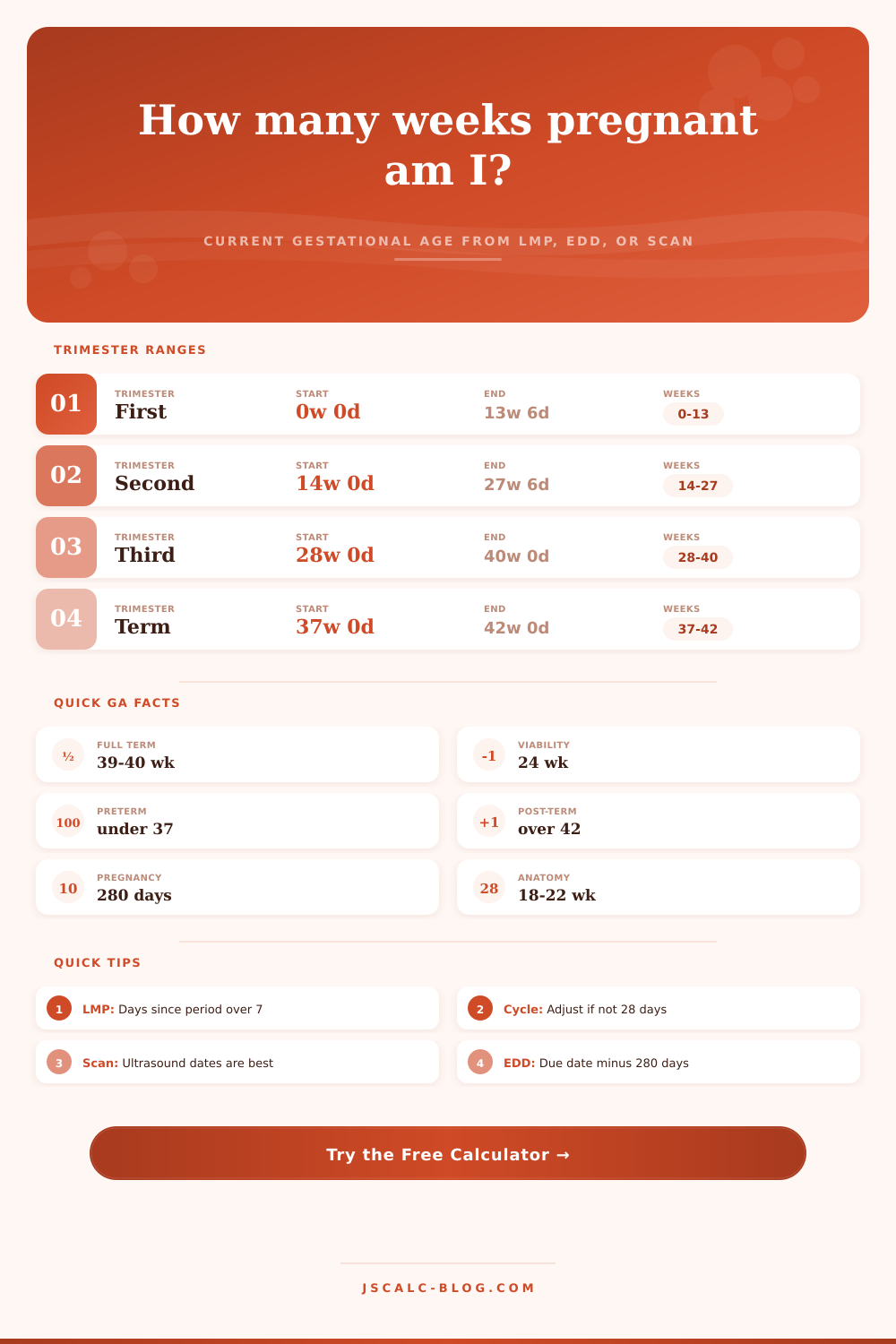
| Trimester | Start | End | Weeks | What Happens |
|---|---|---|---|---|
| First | 0w 0d | 13w 6d | 0–13 | Organs and heartbeat form |
| Second | 14w 0d | 27w 6d | 14–27 | Movement, anatomy scan |
| Third | 28w 0d | 40w 0d | 28–40 | Rapid growth to birth |
📈Weekly Milestones
| Week | Stage | Milestone | Trimester |
|---|---|---|---|
| 4–5 | Embryo | Missed period, positive test | First |
| 6–7 | Embryo | Heartbeat visible on scan | First |
| 11–13 | Fetus | Nuchal screening window | First |
| 18–22 | Fetus | Anatomy scan, sex often seen | Second |
| 24 | Fetus | Viability threshold | Second |
| 28 | Fetus | Third trimester begins | Third |
| 37–38 | Newborn | Early term reached | Third |
| 39–40 | Newborn | Full term, due date near | Third |
| 41–42 | Newborn | Late and post-term | Third |
📏GA to Fetal Size Reference
| Week | Length | Weight | Compared To |
|---|---|---|---|
| 8 | 1.6 cm | 1 g | Raspberry |
| 12 | 5.4 cm | 14 g | Lime |
| 16 | 11.6 cm | 100 g | Avocado |
| 20 | 25.6 cm | 300 g | Banana |
| 24 | 30 cm | 600 g | Ear of corn |
| 28 | 37.6 cm | 1.0 kg | Eggplant |
| 32 | 42.4 cm | 1.7 kg | Squash |
| 36 | 47.4 cm | 2.6 kg | Romaine head |
| 40 | 51.2 cm | 3.4 kg | Small pumpkin |
🗂Term Classification Grid
| Class | GA Range | Weeks | Days | Timing | Note |
|---|---|---|---|---|---|
| Previable | Under 24w 0d | 0–23 | 0–167 | Very early | Below viability |
| Extreme preterm | 24w 0d–27w 6d | 24–27 | 168–195 | Very early birth | Intensive care |
| Moderate preterm | 28w 0d–33w 6d | 28–33 | 196–237 | Early birth | Often needs support |
| Late preterm | 34w 0d–36w 6d | 34–36 | 238–258 | Just before term | Usually milder |
| Early term | 37w 0d–38w 6d | 37–38 | 259–272 | Term begins | Considered term |
| Full term | 39w 0d–40w 6d | 39–40 | 273–286 | Ideal window | Due date here |
| Late term | 41w 0d–41w 6d | 41 | 287–293 | Past due date | Monitoring rises |
| Post-term | 42w 0d and over | 42+ | 294+ | Overdue | Induction discussed |
⚙Full Formula Breakdown
📋Method Reference
| Method | You Enter | LMP-Equivalent | Best When |
|---|---|---|---|
| LMP | First day of last period | LMP ± cycle shift | Regular cycles, known date |
| Due date | Estimated due date | EDD – 280 days | Provider gave an EDD |
| Ultrasound | Scan date and GA at scan | Scan date – scan GA | Most accurate dating |
| Conception | Conception or transfer day | Conception – 14 days | Known ovulation or IVF |
💡Gestational Age Tips
This gestational age calculator gives an informational estimate only and is not medical advice. Confirm dating, trimester, and due date with your own healthcare provider.
Then there’s that day (or morning) when it all becomes real. It happens when you pick up a stick and see two pink lines. Suddenlly, what happened yesterday doesn’t matter; the calendar matters now. A date you wrote off as small detail is now a center point for other dates to follow.
It’s like flipping a switch and setting a countdown timer, except without a manual from anyone. How do we calculate our gestational age? Do we calculate it by taking away some dates in the app? No, no; that won’t cut it. We’ve got to get into it: what does a week mean, exactly, such that someone can say “week 14” and the number will actualy make sense?
How to Calculate Your Due Date
This traditional approach involve your last menstrual period‘s first day. Yes, you weren’t pregnant back then, it seems backwards! But because ovulation isn’t exactly easy to pinpoint, that’s the fixed starting point used by medical community. From there, it take about 280 days, or approximately forty weeks, to reach full-term (on average).
Plug in your starting date here and the calculator will do the rest. You won’t have to worry about getting confused with timezones or adding one too many zeros when doing the math yourself. It’ll even adjust for how long your cycle typically run. This is an important adjustment that most basic calculators don’t consider.
Your cycles are longer than the default twenty-eight day standard? Then you’re ovulating later in the cycle. This also means that conception was later in line than the default model takes into account. By adding those additional days to your equation, you ensure your due date doesn’t get pulled forward too far. This lets you make your own expectations and plan to match. Just tell it what your average cycle length is and it adjust the baseline accordingly. That way the calculated due date lines up with your actual biology instead of some generic average.
But there’s also another window into time. The one provided by ultrasound scans. Ultrasounds provide a snapshot in time, measuring size of fetal structures relative to established growth curves. Because all embryos grow relatively similarly within the first 12 weeks, early ultrasounds tend to be very accurate. Afterward, other factors like genetics and environment begin to affect size, making variations more frequent.
Depending on how far off your period-based date is from an early ultrasound, doctors will sometimes change their official record dates to match the ultrasound. You can enter that ultrasound information here to backtrack your pregnancy timeline, so it matches up with your medical chart.
What’s going on in there? How does it all fit? Understanding the trimester breakdown can help put things into perspective. Week one through 13 sees quick cell growth and organs takes shape. After week 14 we enter the second trimester (and for a lot of parents this is when things start feeling stable). This is where movement typically occur and parents gets their anatomy scan, which shows how the body is built. These parameters will give you an idea of when each test will happen. So if you don’t want to memorize the dates, know the big picture so your prenatal appointments aren’t as confusing or disconnected from each other, just part of a larger journey.
After that it’s all about milestones in the home stretch. Once you hit 37 weeks, you’re technically “in term” with a baby who could be born now, but might still have some time before reaching her due date. And full term, the sweet spot many people think about as the best time to go into labor, lands between 39-40 weeks. After 42 weeks, your pregnancy enters post-term land, when you’ll need more frequent check-ins. Those designations is important because they factor into decisions like interventions and when to induce. All that information is neatly spelled out on the page, so you know whether you’re ahead or behind each clinical milestone.
Sometimes we fall into the trap of fixating on a particular day, but as people we’re not so predictable. In fact, only around 5% of babies hits their assigned due date with absolute accuracy. Most will land somewhere in the ballpark of a couple of weeks on either side of that predicted date. Yes, it’ll have a nice round figure attached which you can tick off along the way but really what it means is you could of been both informed and ready. Not only do you have an idea where you stand but also why the dates change. That’s a basis for your health care team. That understanding matters far more then any exact date ever can.