Factoring Quadratic Calculator
Rewrite any ax²+bx+c as its factored form using the AC method. See the factor-pair search, the middle-term split, factoring by grouping, the GCF, the roots, and a full expand-back check.
📌Real Factoring Presets
📝Quadratic Coefficients
Leading coefficient. Must not be zero for a quadratic.
🔢Method Snapshot
🔎AC-Method Factor-Pair Search
| Factor m | Factor n | Product m×n | Sum m+n | Matches b? |
|---|---|---|---|---|
| Enter coefficients above to generate the factor-pair search. | ||||
The AC method searches integer pairs whose product is a×c. The pair that also sums to b splits the middle term for grouping.
🪡Grouping Steps
| Step | Action | Result |
|---|---|---|
| The step-by-step grouping walkthrough appears after you factor. | ||
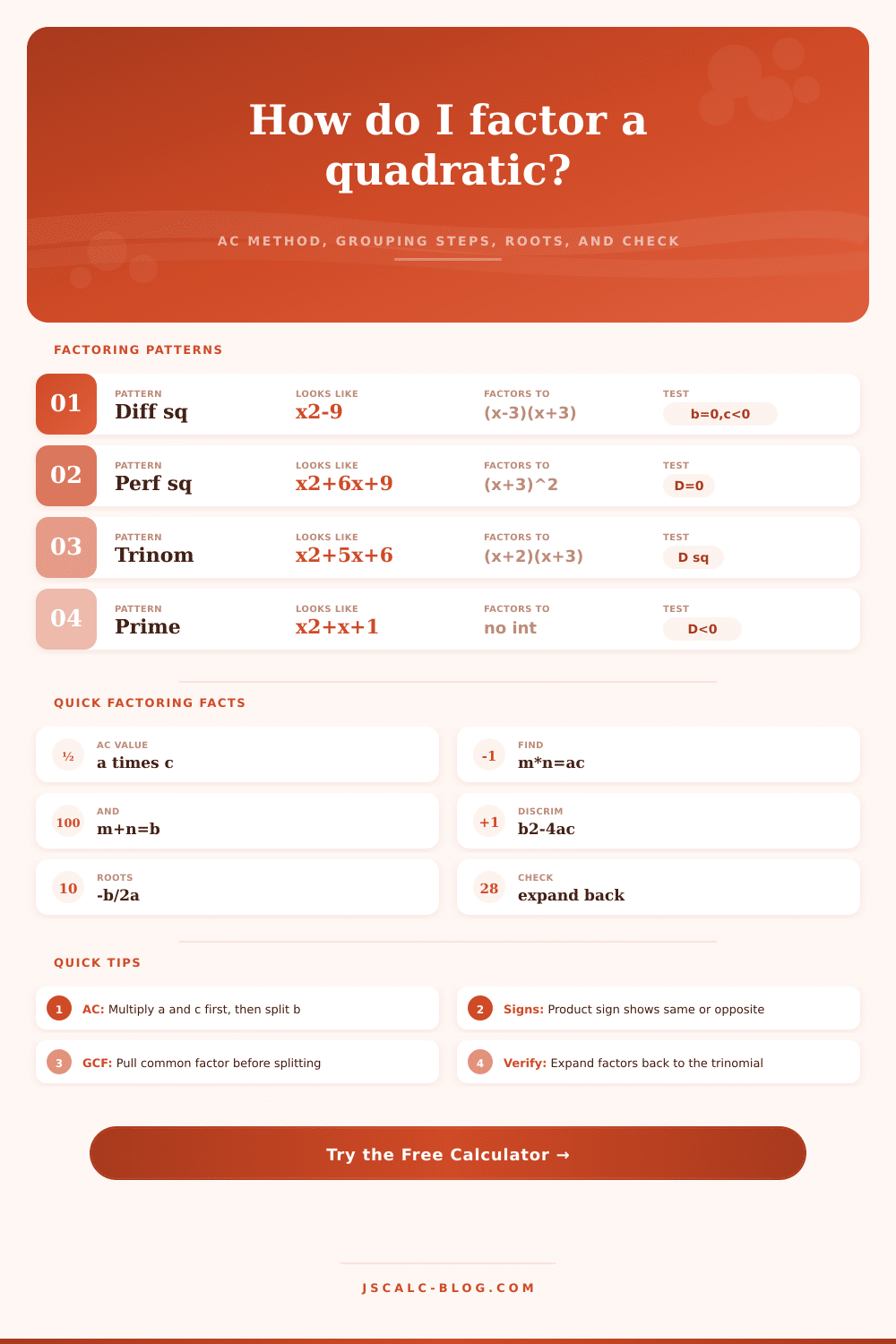
🧩Factoring Pattern Reference
| Pattern | General Form | Factored As | How To Spot It |
|---|---|---|---|
| Difference of squares | a²–b² | (a–b)(a+b) | b term is 0 and c is a negative perfect square |
| Perfect-square trinomial | a²±2ab+b² | (a±b)² | discriminant equals 0, so both roots are equal |
| Simple trinomial | x²+bx+c | (x+m)(x+n) | a is 1; find m,n with m×n=c and m+n=b |
| General trinomial | ax²+bx+c | (px+q)(rx+s) | a is not 1; use the AC method and grouping |
| Common factor first | k(ax²+bx+c) | k×factors | a, b, c share a greatest common factor k |
| Prime over integers | ax²+bx+c | no integer factors | discriminant is not a perfect square |
🗂Special Forms & Worked Comparison
| Quadratic | a | AC=a×c | Split m,n | Factored Form | Roots |
|---|---|---|---|---|---|
| x²+5x+6 | 1 | 6 | 2, 3 | (x+2)(x+3) | –2, –3 |
| x²–5x+6 | 1 | 6 | –2, –3 | (x–2)(x–3) | 2, 3 |
| x²+x–12 | 1 | –12 | 4, –3 | (x+4)(x–3) | –4, 3 |
| x²–9 | 1 | –9 | 3, –3 | (x–3)(x+3) | 3, –3 |
| x²–4x+4 | 1 | 4 | –2, –2 | (x–2)² | 2 (double) |
| 2x²+7x+3 | 2 | 6 | 1, 6 | (2x+1)(x+3) | –0.5, –3 |
| 6x²+11x+3 | 6 | 18 | 2, 9 | (2x+3)(3x+1) | –1.5, –1/3 |
| 3x²–x–2 | 3 | –6 | 2, –3 | (3x+2)(x–1) | –2/3, 1 |
⚙Full Method Breakdown
📋Roots-to-Factors Reference
| If A Root Is | The Factor Is | Example Root | Matching Factor |
|---|---|---|---|
| x = r (integer) | (x – r) | x = 3 | (x – 3) |
| x = –r | (x + r) | x = –2 | (x + 2) |
| x = q/p (fraction) | (px – q) | x = 1/2 | (2x – 1) |
| x = –q/p | (px + q) | x = –1/3 | (3x + 1) |
| Double root x = r | (x – r)² | x = 2, 2 | (x – 2)² |
| Irrational or complex | no rational factor | x = 1±√2 | prime over integers |
💡Practical Factoring Tips
Did you ever look up at a quadratic equation on the blackboard with a mess of terms and think “How in the world am I supposed to simplify this thing?” Factoring work like a puzzle; there is two numbers (or more) that obey certain rules. It’s less about doing homework correctly then it is about understanding the structure within algebraic expression.
After entering your coefficients into calculator above, it does all the arithmetic while you avoid staring at pages of trial-and-error attempts. With AC, this is where real work begins, but knowing what it means will help you understand the name. It’s a problem with two constraint. Multiply leading coefficient by constant term to get target product, then find two numbers whose product is that number and whose sum are the middle coefficient. Students often forget about addition constraint and just search for factors of the product; in other words, they has the right multiplication but wrong answer. There’s no guessing at all with the tool; it tell you exactly what pair works.
How to Factor Quadratic Equations
One little bit of advice: Always check to see if there’s a greatest common factor before splitting up those terms. That will save you trouble down the road. If all of the number in your equation have something in common, take it out now. You’ll be working with smaller integers and it will be more simpley to find their factor pairs. You can select to do this on the calculator automatically or keep everything within parentheses. In general, pulling out greatest common factor will give you a cleaner result which is also easier to follow. It keeps the numbers small enough for you to work with them without need for additional tools.
After locating the two critical numbers, you break middle term apart into its component pieces. That makes the equation look nasty. Instead of getting shorter, it’s gotten longer! But it is setting us up to factor by grouping. We are going to take first two terms and factor them out, and we’ll repeat with final two terms. Doing this correctly result in having a common two-term expression occur in both groupings. Think of that binomial as something that holds the whole expression together. The pattern become easier to follow if you look at reference tables on the page.
Not all quadratics factor nicely over the integers. They can be prime in that sense. Looking at their discriminant will let you know; this is a number that’s calculated from your coefficients. Is it a perfect square? No? Then there is no way you can divide this expression into tidy factors consisting entirely of whole numbers. Rather than forcing this into an embarassing fraction, the calculator recognizes this and informs you truthfuly, saving you some time searching for what isn’t there. Sometimes knowing where to cease your efforts are as important as knowing how to factor.
The factored form may not interest real world problems at all, but their x-intercepts (the places that the graph touches the x-axis) will. That could be when a ball hits the earth in physics or the break-even point on new product in economics. After displaying factors, the calculator provides roots directly. If you need to, expand result and see if it agree with the original equation. It is always good to check if you want to trust your answer.
It’s not so much about memorization with factoring quadratics as it is seeing patterns and fitting the puzzle together. When you recognize where all of the pieces belong, the dread dissapears. You’re no longer doing some random equation, you’ve got a box to open that came from multiplying two binomial expressions. Now, you simply take apart what has been created. Regardless of whether you’re learning the steps from scratch or merely checking your work based off the tool, you still want to know how it fits together. That knowledge transforms a drudgery into a fun brain exercise. You should of checked if you wanted to be sure.