Drill Tip Calculator
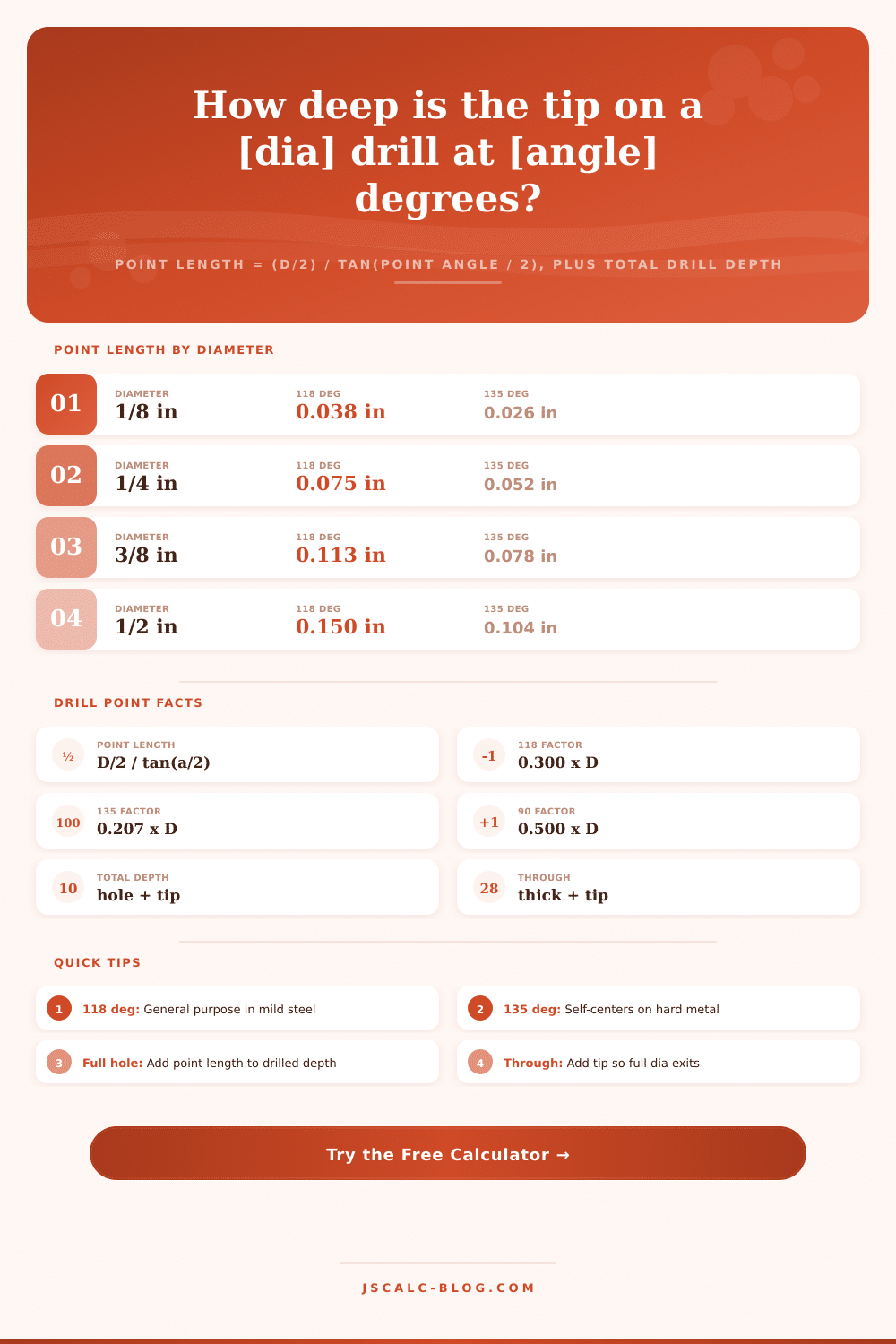
Find the drill point length, the extra tip depth beyond the full-diameter cutting edges, using point length = (D / 2) divided by tan(point angle / 2). Then get the total drill depth to reach a chosen full-diameter hole depth and the total travel needed to break through a material thickness.
🔧Quick Drill Presets
📏Drill and Hole Inputs
Applies to diameter, hole depth, thickness, and results.
Nominal cutting diameter of the twist drill.
The full included angle stamped on the drill point.
Used only when Custom is selected above, 1 to 179 deg.
Depth of hole at full diameter you need for a blind hole.
Stock thickness the drill must fully pass through.
Optional extra travel added past breakthrough for safety.
Controls rounding on every result card.
🔢Tip Factor Snapshot
📋Point Length by Diameter (Inch)
| Drill Diameter | 118 deg Tip | 135 deg Tip | 90 deg Tip |
|---|---|---|---|
| 1/16 in (0.0625) | 0.0188 in | 0.0129 in | 0.0313 in |
| 1/8 in (0.125) | 0.0376 in | 0.0259 in | 0.0625 in |
| 3/16 in (0.1875) | 0.0563 in | 0.0388 in | 0.0938 in |
| 1/4 in (0.250) | 0.0751 in | 0.0518 in | 0.1250 in |
| 3/8 in (0.375) | 0.1127 in | 0.0777 in | 0.1875 in |
| 1/2 in (0.500) | 0.1502 in | 0.1036 in | 0.2500 in |
| 5/8 in (0.625) | 0.1878 in | 0.1294 in | 0.3125 in |
| 3/4 in (0.750) | 0.2253 in | 0.1553 in | 0.3750 in |
| 1 in (1.000) | 0.3004 in | 0.2071 in | 0.5000 in |
📏Point Length by Diameter (Metric)
| Drill Diameter | 118 deg Tip | 135 deg Tip | 90 deg Tip |
|---|---|---|---|
| 3 mm | 0.90 mm | 0.62 mm | 1.50 mm |
| 5 mm | 1.50 mm | 1.04 mm | 2.50 mm |
| 6 mm | 1.80 mm | 1.24 mm | 3.00 mm |
| 8 mm | 2.40 mm | 1.66 mm | 4.00 mm |
| 10 mm | 3.00 mm | 2.07 mm | 5.00 mm |
| 12 mm | 3.61 mm | 2.49 mm | 6.00 mm |
| 16 mm | 4.81 mm | 3.31 mm | 8.00 mm |
| 20 mm | 6.01 mm | 4.14 mm | 10.00 mm |
| 25 mm | 7.51 mm | 5.18 mm | 12.50 mm |
⚙Point Angle by Material
| Material | Suggested Angle | Tip Factor | Notes |
|---|---|---|---|
| Mild steel | 118 deg | 0.300 | General purpose HSS drills |
| Stainless steel | 135 deg | 0.207 | Split point resists walking |
| Hardened alloy | 135 deg | 0.207 | Stronger web, slower feed |
| Aluminum | 118 deg | 0.300 | High speed, clears chips well |
| Brass and bronze | 118 deg | 0.300 | Zero rake or dubbed lip helps |
| Cast iron | 118 deg | 0.300 | No coolant needed, dry cut |
| Acrylic and plastic | 60 deg | 0.866 | Low angle stops grabbing |
| Wood | 90 deg | 0.500 | Brad point for clean entry |
📊Tip Factor by Point Angle
| Point Angle | Half Angle | tan(half) | Tip Factor 0.5 / tan |
|---|---|---|---|
| 60 deg | 30 deg | 0.5774 | 0.8660 |
| 82 deg | 41 deg | 0.8693 | 0.5752 |
| 90 deg | 45 deg | 1.0000 | 0.5000 |
| 100 deg | 50 deg | 1.1918 | 0.4196 |
| 118 deg | 59 deg | 1.6643 | 0.3004 |
| 135 deg | 67.5 deg | 2.4142 | 0.2071 |
| 140 deg | 70 deg | 2.7475 | 0.1820 |
| 150 deg | 75 deg | 3.7321 | 0.1340 |
📐Fraction to mm Drill Sizes
| Fraction | Decimal in | Millimeters | Nearest Metric |
|---|---|---|---|
| 1/16 in | 0.0625 | 1.588 mm | 1.6 mm |
| 1/8 in | 0.1250 | 3.175 mm | 3.2 mm |
| 3/16 in | 0.1875 | 4.763 mm | 4.8 mm |
| 1/4 in | 0.2500 | 6.350 mm | 6.4 mm |
| 5/16 in | 0.3125 | 7.938 mm | 8.0 mm |
| 3/8 in | 0.3750 | 9.525 mm | 9.5 mm |
| 1/2 in | 0.5000 | 12.700 mm | 12.7 mm |
| 3/4 in | 0.7500 | 19.050 mm | 19.0 mm |
| 1 in | 1.0000 | 25.400 mm | 25.4 mm |
🗃Diameter vs Point Length Comparison Grid
| Diameter | 60 deg | 90 deg | 118 deg | 135 deg | 150 deg |
|---|---|---|---|---|---|
| 1/8 in | 0.1083 in | 0.0625 in | 0.0376 in | 0.0259 in | 0.0168 in |
| 3/16 in | 0.1624 in | 0.0938 in | 0.0563 in | 0.0388 in | 0.0251 in |
| 1/4 in | 0.2165 in | 0.1250 in | 0.0751 in | 0.0518 in | 0.0335 in |
| 3/8 in | 0.3248 in | 0.1875 in | 0.1127 in | 0.0777 in | 0.0503 in |
| 1/2 in | 0.4330 in | 0.2500 in | 0.1502 in | 0.1036 in | 0.0670 in |
| 3/4 in | 0.6495 in | 0.3750 in | 0.2253 in | 0.1553 in | 0.1005 in |
| 1 in | 0.8660 in | 0.5000 in | 0.3004 in | 0.2071 in | 0.1340 in |
| 10 mm | 8.660 mm | 5.000 mm | 3.004 mm | 2.071 mm | 1.340 mm |
| 20 mm | 17.321 mm | 10.000 mm | 6.009 mm | 4.142 mm | 2.679 mm |
✎Formula Breakdown
💡Practical Drilling Tips
How does a hole-drill ever come up short? Because when you mark out a blind hole on paper you think it’s as deep as it is, and in fact it isn’t. Why? The bottom of the hole are not flat. A drill is not a blade, but rather a cone. And that conical point go deeper than the edges that cut full diameter. So the depth shown on your dial represent a narrowing area before reaching full diameter cut-out.
This calculator solve the math for this geometric problem. It computes exactly how much more distance you must travel to make your hole truly flat bottomed or to ensure the drill will cut all the way through your workpiece. That’s pretty basic trigonometry.
How Drills Work and How Deep They Go
The drill point form a right triangle where one leg is the point length (the vertical depth) and the other is drill radius (the horizontal distance). Divide the radius by tangent of half the included angle and you know exactly how deep that cone goes into your part. The calculator does all this for you. It converts from degrees to radians and calculates value. Then, it simply adds that point length to whatever thickness of material or desired depth of hole you specify.
That difference matter when doing accurate work: a single fraction of an inch different makes a bolt stick in its slot or a part fail to seat properly due to the remaining web of material left behind. That all changes when you account for point angle. Most drills has an 118-degree point, which is standard for drilling mild steel and aluminum, and the point length are about thirty percent of the diameter. However, if you use a 135-degree split point (commonly used on hard alloys like stainless steel or materials prone to walking), then the point will be a flatter cone shape. In this case, the point length is approximately twenty-one percent of the diameter.
This geometry shift causes a 135-degree drill to reach full diameter before an 118-degree drill. If you’re drilling blind holes to a great depth, this shallower point provide extra room for chip clearance. Similarly, if you’re through-drilling a part, you can shave off some of the total travel distance needed for the drill bit to escape the material. This protects your work surface in case your depth stop fail.
Once you understand those multipliers and are estimating them, there’s no reason to use the calculator, but the other way around, understanding how big the hole will be from a given point makes it easier to figure out what size bit to get. Here are some approximations:
• A 90 degree point drill adds exactly half the diameter
• A sharp 60 degree point for plastics adds almost ninety percent the diameter
• A 118 degree point adds about.3 times the diameter
All of those ratios hold true whether you’re doing your math in millimeters or inches. For quick references, I’ve made tables for several common sizes on this page so you can check your hand calculations if needed.
This boils down to practical use: What is depth anyway? On your job? If you’re drilling a hole with a countersink or something like this where a bolt head goes into the hole, you’ll want it fully sized all the way up to depth. So, you set the stop based off the specified depth but add the point length to get full size on the bottom.
Drilling through something, like a piece of plate, requires adding the point length plus whatever material thickness so that cutting lips come clear on the other side. It’s good practice to add some kind of clearance buffer here too. Otherwise, the chisel edge could come out before the lips chew their way clear of the opposite side and leave a rough burr (and maybe even damage the bit).
The other factor that plays a role in the angle choice is material. The 135-degree point self-centers on harder materials better than the more aggressive 60. This minimizes the chance of the drill skidding around on top of the material. On softer plastics, this means you need the more aggressive angle to keep from grabbing and cracking them. You can quickly toggle back and forth with the angle in the calculator to view the effect it has on your depth needs based on different tip shapes.
It closes the loop between what is possible through machined specs and what works when you’re actualy cutting metal, going from a fuzzy guess to an exact figure. So the lesson here is simply to give the tool due respect, i.e., account for the shape of the thing. That’s what this whole drill-point business comes down to: Remember that a drill doesn’t make a cylinder cut; it makes a cone cut followed by a cylinder cut. If you fail to take into account that cone cut, which always precedes the cylinder cut, you will get shallow holes and eventualy a broken tool.
Add the amount of the tip to whatever setting you have for your tool depth, and now your machine is working with the actual cut geometry. Next time you set your depth stop, keep in mind that when the tip stops there, the full diameter of the tool is just behind it, not at it. You know exactly where that shoulder is, so you’ll get each hole spec’d out right the first time. You should of used the calculator to be safe.