Double Discount Calculator
Stack two percentage discounts in the correct order, find the equivalent single discount, add quantity, tax, and flat handling, then compare the final total with a one-discount offer.
🎯Double Discount Presets
🧮Discount Inputs
Used for the category note and quick reference snapshot.
Most coupons use the stacked method, not simple addition.
Enter the marked price before either discount.
Round quantity to whole items for order totals.
Example: a store markdown or sale tag.
Example: an extra coupon, member code, or checkout offer.
Only used when the capped stacking method is selected.
Use 0 if tax is not part of the comparison.
Added once per order after item subtotal and tax.
Shows whether a single offer beats the double discount.
Cent rounding is the usual receipt-style estimate.
Most receipts tax the discounted sale amount.
🔢Current Deal Snapshot
📌Category Discount Notes
📊Common Double Discount Equivalents
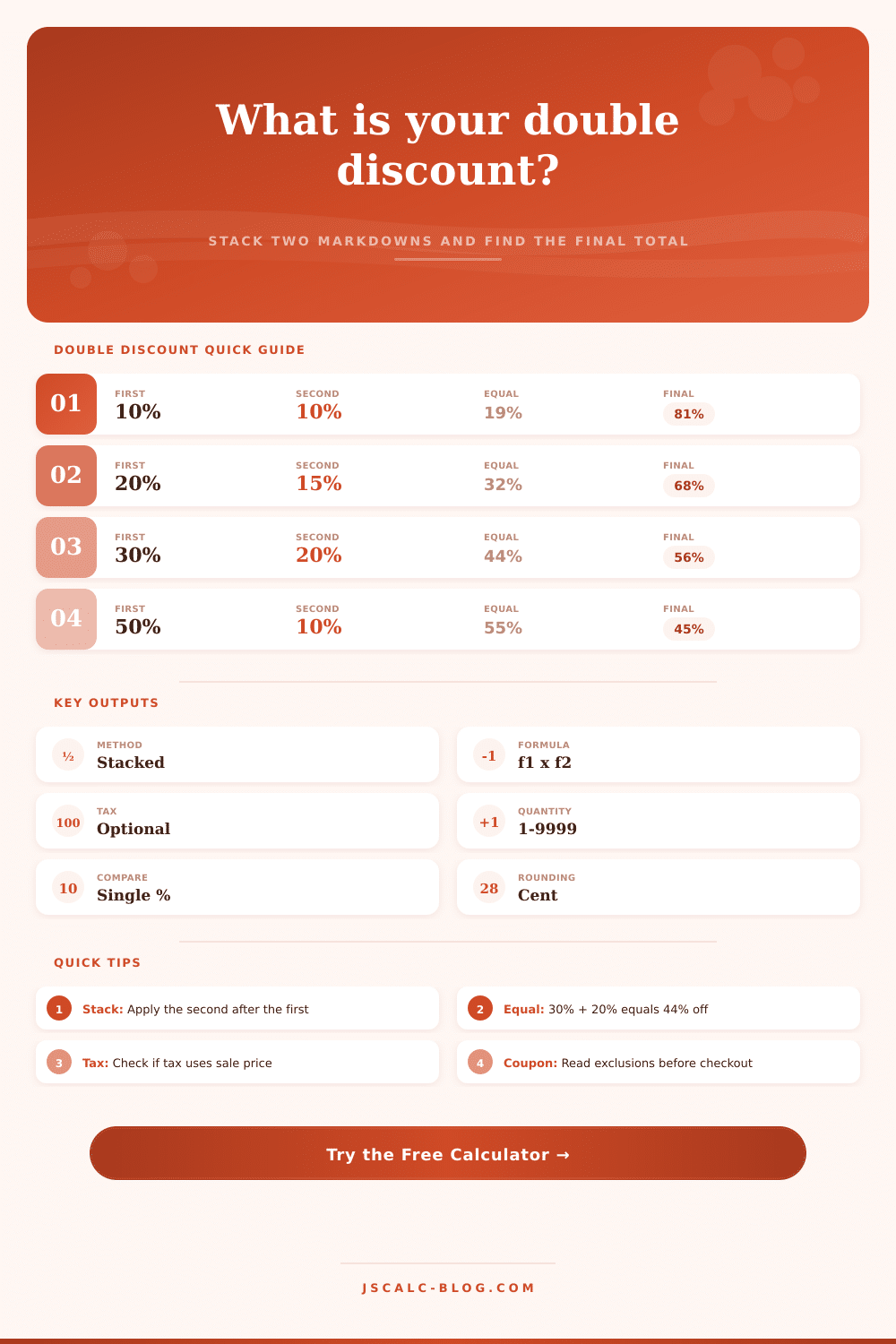
| First Discount | Second Discount | Stacked Formula | Equivalent Single Discount | Final Price Share |
|---|---|---|---|---|
| 10% | 10% | 1 - 0.90 x 0.90 | 19.00% | 81.00% of original |
| 15% | 15% | 1 - 0.85 x 0.85 | 27.75% | 72.25% of original |
| 20% | 10% | 1 - 0.80 x 0.90 | 28.00% | 72.00% of original |
| 20% | 20% | 1 - 0.80 x 0.80 | 36.00% | 64.00% of original |
| 30% | 20% | 1 - 0.70 x 0.80 | 44.00% | 56.00% of original |
| 40% | 15% | 1 - 0.60 x 0.85 | 49.00% | 51.00% of original |
| 50% | 10% | 1 - 0.50 x 0.90 | 55.00% | 45.00% of original |
| 60% | 20% | 1 - 0.40 x 0.80 | 68.00% | 32.00% of original |
🧭Preset Scenario Reference
| Scenario | Original | Qty | Discounts | Tax | Handling | Compare | Why It Matters |
|---|---|---|---|---|---|---|---|
| Clearance rack stack | $120.00 | 2 | 30% then 20% | 8.25% | $0.00 | 40% | Shows why 30% plus 20% is 44%, not 50% |
| Member coupon deal | $85.00 | 3 | 25% then 15% | 7.50% | $4.95 | 35% | Compares a stacked member code with one sale sign |
| Furniture weekend sale | $899.00 | 1 | 20% then 10% | 6.25% | $79.00 | 30% | Includes delivery-like flat handling in the total |
| Laptop promo stack | $1249.00 | 1 | 12% then 8% | 8.875% | $0.00 | 18% | Useful when electronics discounts are modest |
| Appliance rebate event | $1499.99 | 1 | 15% then 10% | 7.00% | $99.00 | 25% | Tests whether stacking beats a clean one-quarter markdown |
| Bulk office order | $42.50 | 24 | 10% then 12% | 5.50% | $18.00 | 20% | Quantity makes small per-item differences visible |
| Annual plan offer | $240.00 | 1 | 30% then 15% | 0.00% | $0.00 | 40% | Good for services that discount before renewal |
| Grocery coupon stack | $6.99 | 8 | 15% then 10% | 2.00% | $0.00 | 25% | Small prices need receipt-style rounding |
| 70% versus stack | $300.00 | 1 | 50% then 30% | 8.00% | $0.00 | 70% | Shows that 50% then 30% equals 65% off |
⚖Stacking Method Comparison
| Method | Final Price Formula | Best Use | Main Caution | Calculator Setting |
|---|---|---|---|---|
| Sequential stack | Price x (1 - d1) x (1 - d2) | Most coupons and sale codes | Discounts do not add directly | Stacked |
| Both from original | Price x (1 - d1 - d2) | Rare receipt or manual override cases | Can hit zero at high totals | Original |
| Best single discount | Price x (1 - max d) | Non-stackable promotions | Ignores the smaller discount | Best single |
| Capped stack | Min(stack, cap) | Offers with maximum advertised savings | Requires reading the cap rule | Capped |
| Comparison discount | Price x (1 - compare) | Checking two rival sale signs | Must use the same tax and fees | Compare field |
| No tax comparison | Subtotal only | Pre-tax store math | Receipt total may differ later | No tax |
📐Double Discount Formula
💡Double Discount Tips
The sign catches your eye: Thirty percent off clearance items! A little happy dance happens in your heart. And then, you spy the tiny print below: “Another 20% off with a seasonal coupon OR a store credit card.” Your mind instantly multiplies those two discounts for fifty percent off… And suddenly, you’re picturing all the money you’ll save.
Unfortunatly, the second discount isn’t applied to the original price. It’s applied to the already discounted price. This is what most people miss; this is why when you’re standing at the checkout line, you’re thinking: Why did my receipt look so different than what I had imagined?
How to Understand Stacked Discounts
Multiplying versus adding percentages may be a small difference in meaning but it affects your wallet. It means real dollars. The problem with stacking discounts, of course, is that it’s like cutting the same cake twice: Once to remove a slice, and then again to remove a slice of what’s left over.
Discounting a product by thirty percent mean you’ll end up paying $70 for an item originally priced at $100. But that next 20% discount come out of the remaining $70, not the original $100. 20% of $70 equals $14. So you subtract $14 from $70 to arrive at a final price of $56. That’s a total savings of $44, which is forty-four percent. Simple, right? Except doing that in your head while jostling someone else for the last pair of jeans are almost impossible.
Let the calculator above run the numbers for you. It do all the math so you don’t have to worry about whether the store is ripping you off or giving you a good deal.
This exposes how stores trick us with the illusion of additive savings. By tacking on percentages, they make their offer seem better. Forty-four percent off sounds nice, but doesn’t carry the same psychological wallop as saying “Fifty percent off.” Once you learn how things work, you can judge their offers without your gut fooling you.
It’s like being faced with a flat forty percent off versus a 30% sale + 15% coupon. On a gut level, the former looks like a stronger deal (cleaner numbers, lower number). But when you run it through the calculator, we saw that 30% + 15% comes out to a total discount of forty-two and a quarter percent. The stack wins. Knowing this before touching an item, saves you money.
Percentages only tell part of the story, they’re just numbers in isolation. Real world purchases contain other factors that mental math frequentely overlooks, and the tool accounts for them. One huge factor is quantity. Buying one shirt for two dollars off isn’t terrible. Buying 20 shirts for two dollars off is a whole different financial story. You can put in how many items you’re buying so it scales the amount saved and shows the effect on your bottom line.
Another complication that doesn’t work out in our heads is tax. Most places calculate tax based off the discount price, meaning that if you stack discounts then your tax bill goes down too. A few jurisdictions use original price as the base instead (though this is pretty rare). The tool lets you choose whether to use the discounted price or the original price as the tax base depending on where you live. This ensures that the end result is accurate.
There’s also the fact that every appliance and piece of furnitures comes with handling fees and delivery charges. This could offset the savings, especially for big-ticket items like appliances and furniture. Just enter in any fixed charges for delivery into the calculator and then decide whether the discount is really worth it. After all, maybe you don’t get much of a discount after adding in shipping, in which case the deal isn’t as good as it seems from the shelf.
The page explains this simply through its reference table. Different combinations act differently depending on the circumstances, but it’s a handy way to check in before opening up a spreadsheet app (or pulling out a real calculator).
There are some trips-ups with the caps and exclusions retailers apply. For example, some promotions only allow you to get a maximum discount as a percent of total amount. Or they will exclude whole categories or brands. If it’s one of those, there’s a field in the calculator to specify a cap so you can model out what the worst-case or best-case outcomes might be. That’s especially handy when the item is expensive and the margin is slim. It could of cost hundreds of dollars for just a few percentage points. Modeling the precise terms means no sticker shock at check-out time.
To conclude, So what? The point here is: you want to make an educated decision. To save money, you don’t have to become a math nerd about it. All you have to know is this: when you’re seeing sequential discounts (meaning one after another), the percentages aren’t additive. The computer does the math for you; all you do is come up with the game plan.
This tool helps you break down a large number of offers and compare them apples-to-apples. You go in there with a game plan. You come out with the best deal. And that’s what happens when you learn how those damn numbers realy add up. Next time you’re faced with a stacked discount, you’ll know what you’re getting… And you won’t get suckered-in by the headline number.