Days Sales Outstanding Calculator
Measure current DSO, average DSO, net credit sales, cash sales exclusions, daily credit sales, and the receivables gap against your target collection period.
⚡DSO presets
📝Receivables and sales inputs
DSO results
🧮Quick metrics grid
📐Formula breakdown
📊DSO comparison grid
| Collection profile | Typical DSO range | Working-capital signal | Review trigger | Best follow-up metric |
|---|---|---|---|---|
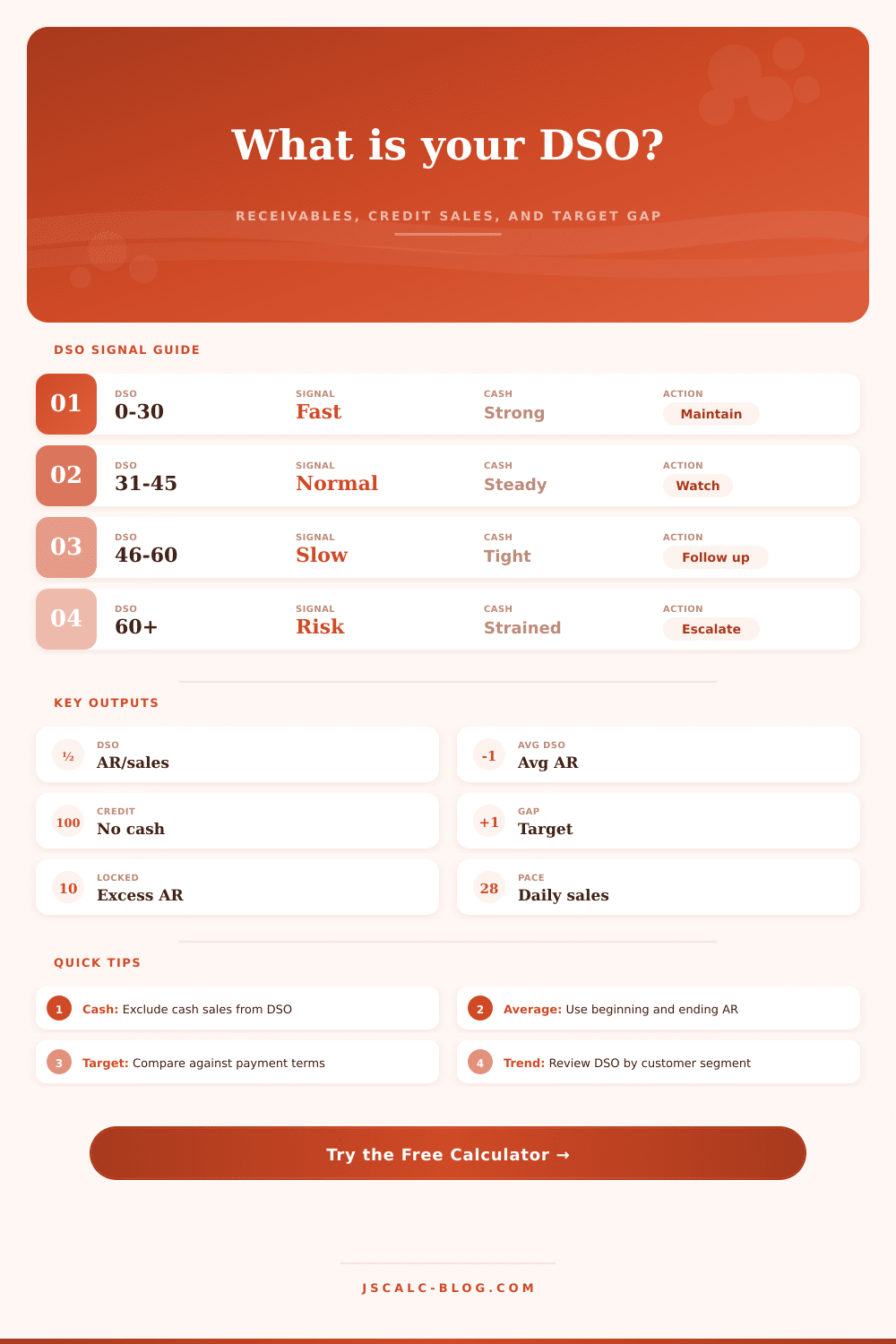
| Fast collection cycle | 0 to 30 days | Strong cash conversion | Watch for overly tight credit terms | Customer churn from payment friction |
| Standard B2B terms | 31 to 45 days | Usually manageable | DSO above written net terms | Aging bucket over 30 days |
| Slower invoice approval | 46 to 60 days | Cash tied in AR | Large customers delaying approvals | Weighted average days delinquent |
| Stressed receivables | 61 to 90 days | Collections strain | Past-due share over 25% | Bad debt reserve and dispute rate |
| Severe collection backlog | 90+ days | High liquidity pressure | Repeat delinquency or unresolved disputes | Customer-level collection plan |
📋Common period day table
| Reporting period | Days to enter | Best AR input | Credit sales note |
|---|---|---|---|
| Monthly close | 28 to 31 | Ending AR or average AR | Use month net credit sales only |
| Fiscal quarter | 90 or 91 | Average AR | Exclude cash sales in the quarter |
| Year to date | Actual elapsed days | Average AR | Use YTD net credit sales |
| Annual review | 365 or 366 | Average AR | Use annual net credit sales |
| Custom cycle | Exact cycle days | Match AR to cycle dates | Avoid mixing billed and cash revenue |
💳Credit sales adjustment table
| Input line | Include in DSO? | Calculator treatment | Why it matters |
|---|---|---|---|
| Credit invoices | Yes | Kept in gross sales | Creates receivables to collect |
| Cash sales | No | Subtracted from gross sales | Cash sales do not create AR |
| Returns and allowances | No | Subtracted from gross sales | Reduces collectible credit sales |
| Credit memos | No | Enter with returns | Removes invoices no longer collectible |
| Finance charges | Usually separate | Exclude unless billed as sales | Can inflate denominator quality |
🎯Target gap scenarios
| Actual vs target | Meaning | Cash impact | Collection priority |
|---|---|---|---|
| 10+ days below target | Collecting ahead of plan | Cash released faster | Protect customer experience |
| 0 to 5 days from target | Close to plan | Normal AR load | Monitor aging mix |
| 6 to 15 days above target | Moderate delay | Extra AR tied up | Follow large overdue invoices |
| 16 to 30 days above target | Material slowdown | Cash pressure building | Escalate disputes and approvals |
| 30+ days above target | Severe gap | Liquidity strain likely | Customer-by-customer recovery plan |
💡DSO calculation tips
Days Sales Outstanding is how long it takes you to get paid by your customers. Collecting cash is important, you might close some deals and invoice but without cash coming in your bank account doesn’t budge. Your Days Sales Outstanding sits somewhere between your profit statement and your liquidity. If you’re profitable on paper but struggling financially, that’s because your cash flow is delayed.
Enter your sales and receivables data into calculator and watch as we transform it all into an easy-to-understand picture of cash flow speed.
Why Days Sales Outstanding Matters for Your Cash Flow
Days Sales Outstanding is a simple formula with one common mistake: the inputs is misunderstood. It is your accounts receivable divided by your average daily credit sales times number of days in period. The truth lies in the data you use. For most businesses, the total sales figure include cash transactions. There is no accounts receivable balance created from a cash sale. Therefore, these should not be included as part of denominator when calculating this metric. They will make your collection efficiency appear higher then it actualy is. By default, tool eliminates returns and cash to provide a clean starting point of your credit performance.
Lastly, do you want an average balance or an ending balance? An ending balance is what it sounds like. An average balance are calculated by averaging the beginning and ending balances. An ending balance is easy but misleading. Close on the day just before a big check comes in, and your Accounts Receivable will be low, and your Days Sales Outstanding will look great. Close on the day just after a flurry of invoicing went out, and vice versa. The average smooths out those spikes. Instead of seeing a picture of one moment in time, you get a picture of the entire period. That’s important if you’re looking for trends across time.
The number does not tell you only days. It tells you how healthy you are as an operation. If your Days Sales Outstanding (DSO) matches your payment terms, it means your customers pay on time. If your DSO exceed your terms, there’s some friction in the system. Perhaps your invoices aren’t clear enough. Or maybe your credit team is overly-lenient.
On page, the reference table breaks down ranges into signals. Strong cash conversion are linked to fast collection. Stress is linked to stressed receivables, i.e., you’re financing your customer, not vice versa. Getting competitive on credit terms is a fine line away from getting out of cash-flow.
The trick is knowing your desired Days Sales Outstanding. How much longer than that are you? If you want 30 days and have been running 45, then you’re carrying 15 days worth of extra cash in unpaid invoices. How do you know precisely how many dollars is stalled by that lagging payment? That’s your working capital, money that could be invested in inventory, payroll, growth, etc. It’s more than a number on a balance sheet; it’s a way to measure what you’re missing out on.
Look at your aging report when you notice the gap expanding. Maybe there’s a dispute left unsettled, or a big customer keep pushing back approval dates. Days Sales Outstanding doesn’t mean much by itself; the trend is what matters. When your DSO is increasing, it means cash flow is at risk… Ahead of time and before you are out-of-money.
You see where your credit sales speed-up or slow-down each day, and you track the concentration of your old bill that have gone unpaid. Then you take action before the pain gets bad. Maybe you’ll increase your follow-ups on overdue customers, or adjust your credit policy toward new business. It’s all about managing the cycle.
Days Sales Outstanding also serves as a sign of your business discipline. How good are you at following up? At communicating terms? Are you good at managing credit? If it takes too long to get paid, you can’t afford to have cash sitting idle in a ledger while you chase profits on a spreadsheet. A couple of days in the collection cycle is often all that separates a healthy business from a struggling one. Keep that cash moving, keep that number low and you’ll keep the business running smoothly.