Cost Per Click Calculator
Calculate CPC from campaign spend and paid clicks, then review CTR, CPM, CPA, ROAS, break-even CPC, target clicks, and channel benchmark context in one ad performance worksheet.
🎯Campaign Presets
🧮Ad Campaign Inputs
Benchmarks use broad planning ranges; compare against your own account history first.
The math is currency-neutral; this only changes result labels.
Use spend from the same reporting window as clicks and impressions.
Enter link clicks or billed clicks consistently across campaigns.
Needed for CTR and CPM; leave above zero for complete output.
Use purchases, leads, signups, installs, or another primary action.
For lead generation, enter estimated lead value or pipeline value.
Break-even CPC uses conversion rate x value per conversion / target ROAS.
Adjusted CPC divides spend by clicks after removing this allowance.
Forecasts clicks, conversions, and value if current rates continue.
📌Current Campaign Snapshot
📊Channel Benchmark Grid
🗂Campaign Preset Reference
| Preset | Channel | Spend | Clicks | Impressions | Conversions | Value | Typical Read |
|---|---|---|---|---|---|---|---|
| Search lead campaign | Paid search | $2,400 | 1,200 | 60,000 | 96 | $9,600 | Balanced CPC with strong lead value |
| Shopping product ads | Shopping | $8,750 | 3,500 | 210,000 | 175 | $31,500 | Retail CPC checked against ROAS |
| Social launch push | Paid social | $1,650 | 2,750 | 185,000 | 82 | $6,560 | Low CPC with creative-driven CTR |
| Display remarketing | Display | $940 | 1,880 | 470,000 | 54 | $5,400 | High reach, low CPM, modest CTR |
| Video click campaign | Video | $1,280 | 1,600 | 320,000 | 32 | $2,880 | Traffic quality needs conversion check |
| Local service ads | Local | $3,600 | 720 | 28,800 | 88 | $22,000 | Higher CPC justified by lead value |
| B2B sponsored post | B2B | $6,300 | 700 | 92,000 | 42 | $63,000 | Expensive clicks need pipeline tracking |
| App install traffic | App | $4,200 | 6,000 | 400,000 | 1,050 | $12,600 | Low CPC but install value matters |
| Newsletter sponsorship | Newsletter | $2,200 | 880 | 44,000 | 66 | $7,920 | Email click cost with clean audience |
📝CPC Benchmark Table
| Channel | Planning CPC Range | CTR Range | Primary Strength | Main Caution |
|---|---|---|---|---|
| Paid search | $1 to $5 | 2% to 6% | High intent queries | Keyword competition can lift bids fast |
| Shopping or product ads | $0.60 to $3 | 0.8% to 3% | Product-qualified traffic | Feed quality affects click efficiency |
| Paid social feed | $0.50 to $3 | 0.7% to 2% | Creative testing and scale | Cheap clicks may not convert |
| Display network | $0.20 to $1.50 | 0.1% to 0.8% | Reach and remarketing | Viewability and placement quality vary |
| Video traffic ads | $0.30 to $2 | 0.4% to 1.5% | Demand generation | Clicks can be exploratory |
| Local service ads | $3 to $12 | 2% to 8% | Nearby buyer intent | Lead quality must be reviewed manually |
| B2B sponsored content | $5 to $15 | 0.4% to 1.5% | Precise job and firm targeting | Small audiences make CPC volatile |
| App install traffic | $0.30 to $2.50 | 1% to 4% | High-volume testing | Install quality can lag click volume |
| Newsletter sponsorship | $1 to $6 | 1.5% to 5% | Trusted audience context | One-send sample sizes can be lumpy |
⚙Formula Reference
🔍CPC Reading Guide
| Signal | Likely Meaning | Confirm With | Useful Follow-Up | Calculator Field |
|---|---|---|---|---|
| CPC below benchmark | Cheap traffic or efficient bids | Conversion rate and CPA | Check quality before scaling spend | CPC card |
| CPC near benchmark | Normal auction pressure | CTR and ROAS | Optimize ads and landing pages together | Benchmark note |
| CPC above benchmark | Competitive audience or weak relevance | CTR, quality score, lead value | Refine match type, targeting, or creative | Channel table |
| High CTR with high CPC | Ad is engaging but auction is expensive | CPA and value per conversion | Keep if ROAS clears the target | CTR and ROAS |
| Low CTR with low CPM | Cheap reach but weak response | Placement and audience reports | Refresh creative or narrow placements | CPM snapshot |
| Low CPC with poor ROAS | Traffic is cheap but not valuable | Post-click conversion quality | Shift budget to higher-intent segments | ROAS card |
💡Practical CPC Tips
Ten bucks per click: Walk away rich. A thousand clicks for ten dollars: Lose your shirt. In isolation, cost per click is a vanity metric. A dollar have meaning when attached to an action. You get ten dollars in exchange for someone clicking a button. That’s something tangible. It is something you can feel good about, like you’re getting your money’s worth.
But what that number actualy represents is the cost of attention. It is nothing more. And nothing less. It doesn’t tell you anything about the value of that attention. Does it matter if the CPC is cheap or expensive? In either case, I still need to know if it’s worth it. This is why cost per click are a vanity metric.
Why Cost Per Click Is Not the Most Important Thing
This page is a way to prevent you from doing just that, churning up cheap traffic that never converts. It help connect the bid you pay to the value you capture.
Low CPC is considered victory by most advertisers; which is a mistake. Low-cost clicks tends to be low-intent. Traffic from display networks and broad social feed costs pennies on the dollar, but that’s because it’s just people scrolling around. They’re not actively looking to buy. Traffic from search tend to be expensive because these are folks with a problem they need solving right now.
The tool helps you see this tradeoff clearly. It pulls in your clicks, spend and conversions so you can judge your efficiency, not just cost. Do those expensive search clicks drives revenue? You’d better know.
But here’s the thing: Inputs is more important than outputs. Before you ask “is my CPC too high?” you must first determine what exactly is being converted. Is it a sale? Or just a form fill? Is it a lead for a $5,000 contract? Or is it a lead for a $50 item? Until you know that, you can’t calculate if your CPC is too high.
Enter the calculator. It allows you to put in either your estimate of the lead value or your attributed revenue. That makes all the difference.
If your margin on the product is $8 and your CPC is $10, that’s terrible. If your customer lifetime value is $2,000 and your CPC is $10, that’s fantastic. The math doesn’t give a crap how you feel about it. Only the ratio between value and cost matter.
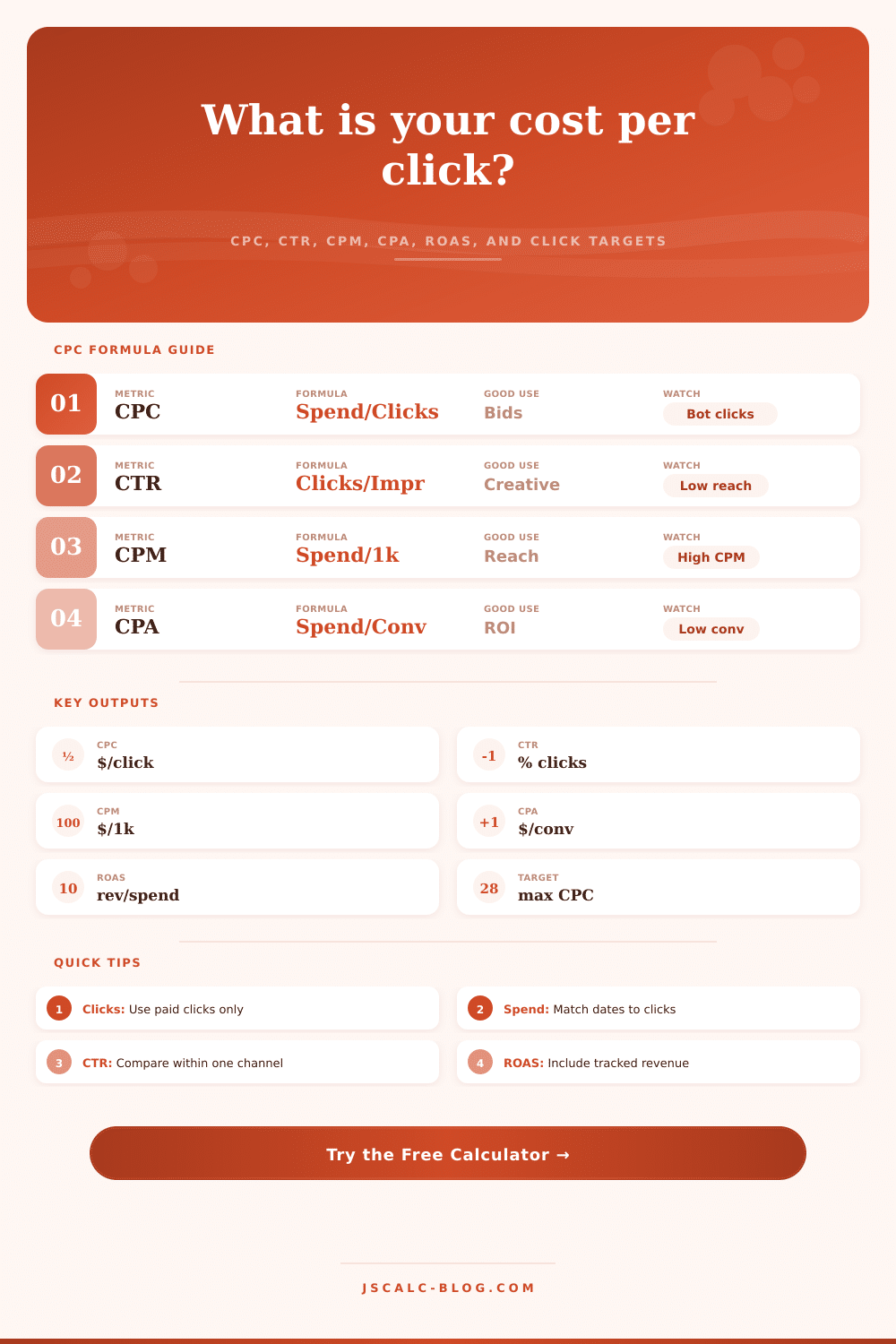
CPC hides click-through rate and cost per mille which add context. If your creative is good and it’s an expensive auction, a high CPM and CTR typically show that. Is the CPM low and the CTR terrible? Then you’re paying for looks away from the screen.
The tool includes reference tables laying out typical range by channel. Obviously, CTRs will be higher in search as users seeked you out. They’ll be lower on social since you’re interrupting someone’s feed. That’s the equivalent of comparing apples to oranges. To get a signal, you need to compare within-channel.
Silent budget killers includes bot traffic and invalid clicks. There’s no such thing as pure traffic sources. Wasted clicks has to be accounted for. A small percentage deduction is included in the calculator, acknowledging reality. A 3% rate is a conservative estimate. 12% is aggressive but realistic with broad display campaigns. Adjust for this and you get a truer picture of what your actual cost per human visitor are. You won’t optimize against phantom data.
The best output is Target CPC. This is what you can bid up to but not more then if you want to achieve your return on ad spend goal. (It’s calculated based off your value per conversion and your conversion rate.) So if your actual CPC is higher than your target, then something isn’t right. Your return target is too ambitious. Or your value is too low. Or your conversion rate is too low.
Lowering your bids won’t get you the same volume. Fix the upstream issues. Use better targeting. Improve your landing pages. Better creative.
You need to plan your budget because you don’t know what you don’t know. By having that snapshot of how you’re doing now, you can predict what a higher spend could of done for you. There’s no guarantee, however. Dynamics change when you scale. Less competitive placements gets new impressions. Conversion rates may dip. Etc. But it provides you with a baseline. It helps to set expectations before committing the funds.
But, again, it’s not about minimizing your CPC. It’s about getting the most value from a click. And when you do that, stop chasing the cheapest number and chase the best return. Because that’s how you really win with paid traffic.