Commission Split Calculator
Model a commission pool, referral fee, manager override, house share, and participant payouts by percentage or role weight.
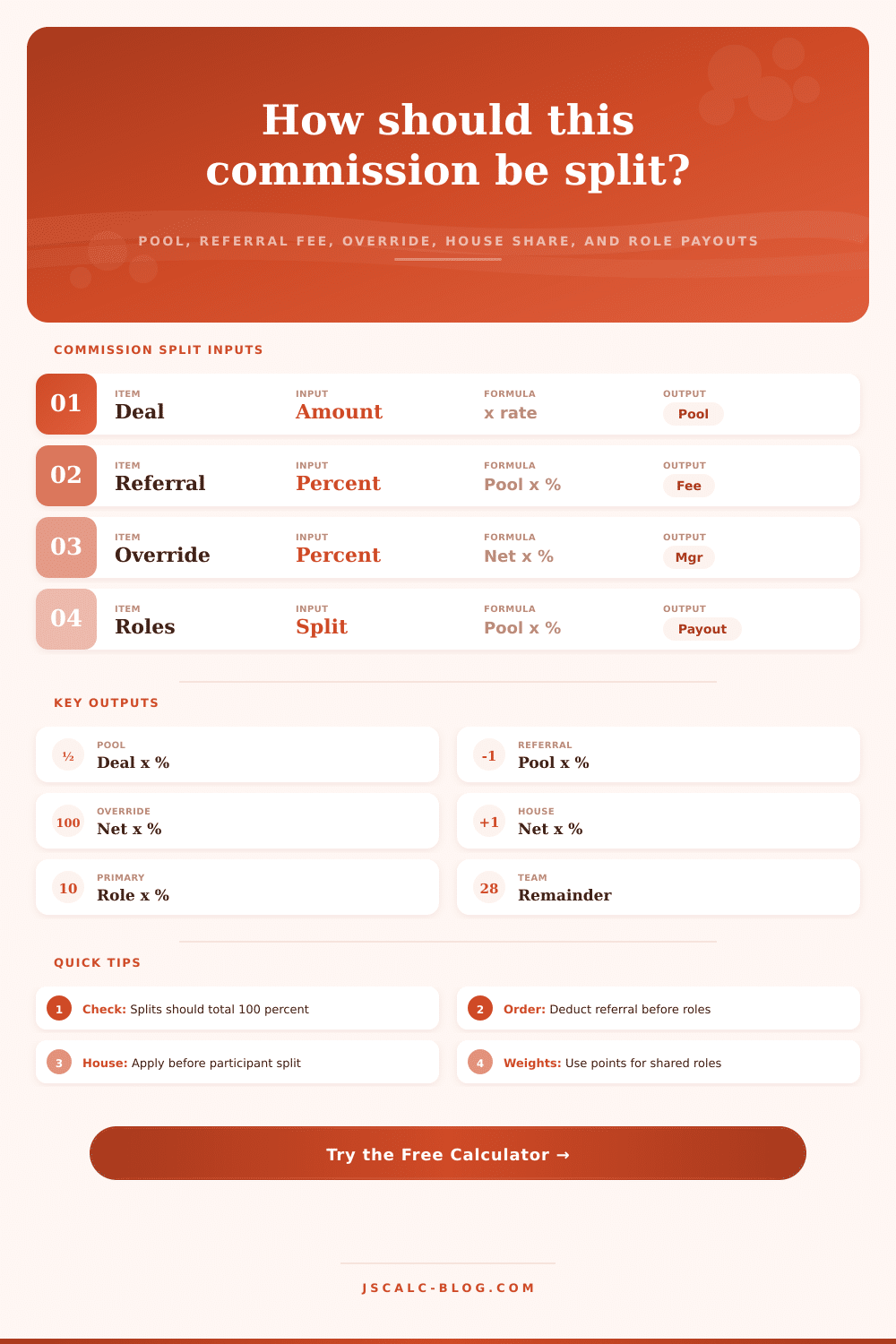
Total commission pool = deal amount x commission rate
Referral fee = total commission pool x referral fee percent
Manager override = (pool - referral fee) x manager override percent
House share = (pool - referral - override) x house split percent
Participant payout = participant role pool x split percent or participant payout = role pool x role weight / total weights
For percent mode, the participant percentages are normalized if they do not total exactly 100 percent, and the warning box shows the entered total.
| Scenario | Best fit | Referral order | House timing | Participant basis | Watch item |
|---|---|---|---|---|---|
| Solo brokerage split | One producer | Before house | Before agent payout | Primary percent | Cap rules |
| Referral closing | Referred deal | First deduction | After referral | Net role pool | Fee base |
| Team lead model | Lead plus help | Optional | After override | Role percent | Lead credit |
| Buyer and listing side | Two sides | Usually side-level | Each side net | Side percent | Side totals |
| Manager override | Supervised team | Before override | After override | Reduced pool | Double count |
| House-heavy plan | Company leads | Before house | High retained share | Smaller net pool | Net clarity |
| Weighted role plan | Flexible teams | Before weights | Before weights | Point weights | Total points |
| Enterprise account | Complex sales | Contract-driven | After override | AE, SDR, CS | Crediting date |
| Deal type | Typical rate input | Pool formula | Notes for split math |
|---|---|---|---|
| Real estate side | 2.5% to 3.0% | Sale price x side rate | Use one side only when each side splits separately. |
| Agency retainer | 5% to 15% | Revenue x commission rate | Use the commissionable portion, not pass-through spend. |
| SaaS new sale | 8% to 12% | Contract value x rate | Apply crediting policy before role weights. |
| Channel partner | 10% to 30% | Net sale x partner rate | Referral and partner fee may be the same deduction. |
| Recruiting placement | 15% to 25% | Salary x placement rate | Split after any desk fee or manager override. |
| Insurance premium | 5% to 20% | Premium x commission rate | Separate first-year and renewal rates when needed. |
| Step | Calculation base | Formula | Remaining amount |
|---|---|---|---|
| 1. Commission pool | Deal amount | Deal amount x commission rate | Gross pool |
| 2. Referral fee | Gross pool | Gross pool x referral percent | Pool after referral |
| 3. Manager override | Pool after referral | After referral x override percent | Pool after override |
| 4. House split | Pool after override | After override x house percent | Participant role pool |
| 5. Role split | Participant role pool | Role pool x split percent or weight share | Participant payouts |
| Role | Common weight | Percent equivalent | When it fits |
|---|---|---|---|
| Primary agent or account executive | 6 to 8 points | 50% to 80% | Owns close, negotiation, and client commitment. |
| Partner or buyer agent | 2 to 4 points | 15% to 35% | Material work on side, buyer, or account development. |
| Coordinator or assistant | 0.5 to 2 points | 5% to 15% | Handles transaction, paperwork, scheduling, or handoff. |
| Trainee, SDR, or support rep | 0.5 to 2 points | 5% to 20% | Sources meetings, qualifies lead, or supports delivery. |
Before any money changes hands, have a definite commission structure established. When a commission is due, there’s always the question of who gets paid first. It doesn’t matter if it’s an agency, a real estate deal, or a sales transaction. This is how arguments begins after you sign on the dotted line. Set reasonable guidelines at the start to avoid problems.
But here’s the kicker: Most people get their order of deductions all jacked up. If you deduct from incorrect base, money dissapears fast. A referral fee might sound small as a percentage, but it comes off of top before other people see a dime. Then, when you calculate manager overrides as a percentage of gross, you’re doubling your count. That confuses thing. The calculator does that math for you.
Set Clear Commission Rules First
The first thing to look at is the total commission pool. That’s the agreed rate x the deal value. That’s the max. What comes out of that? What goes into that?
First: take out any referral fees. Because the referrer brought in the client, they deserve a piece of the total. They didn’t closed the deal. Second: take out the manager override. This rewards leadership and supervision. It is higher than company share and lower than the referral fee. It rewards individual who assembled the team. The company gets their cut after that for the house share. It covers infrastructure, leads, and overhead. What’s left over is participant pool.
Here’s where strategy comes in. For smaller teams, you can simply divide it up based off percentages. Bigger groups requires weighted roles. A main agent carries more of the risk. They get a bigger weight. That’s not ego, its accountability.
Most teams don’t take house share into account. They assume that the gross equals the net. Wrong. Gross is total commission pool, and house share is a deduction from that gross. Make sure you explain to producers exactly how much the platform takes from the total commission pool. That way no one gets resentful. Show them the tool adjusting the house percentage and watch the pool change accordingly.
How does this work? Order of deduction matters. Paying a company first means that manager is losing out. Paying the referrer first means the participant is losing out. Tiny adjustments to the sequence mean massive swings in payout. And most disagreements occur because nobody wrote it down. Everyone assumes they’re on the same page, usually they aren’t.
Run the numbers through the various scenarios provided. Try a solo agent split vs a complex enterprise account. See what happens when you throw in a trainee. The models illustrate the tradeoffs. Giving the manager a bigger cut could incentivizes them, but it leaves less money for closer. Splitting the house up more might give everyone fewer dollars, but it brings in better leads. No one combination is ideal. The best combination is one that makes sense to each member of the team and that they agree upon.
Get it in writing before you close the deal. Don’t negotiate points after you sign the closing statement. Before you close, determine who gets what. Decide how important each item is. Set the order of deductions.
Once you’ve built the framework, the distribution should of be automatic when the cash hits your bank account. It’s so smooth that it feels like any other transaction. If it’s fair, then people gets rewarded based on how much they work. Nail down the order, and the rest will fall into place. You got a good deal. Ensure the payout is better.