Coffee to Water Ratio Calculator
Dial in grams of coffee and water for drip, pour-over, French press, cold brew, or espresso. Solve from the number of cups, from a coffee dose, or from a water target using the classic 1:X brewing ratio.
☕Real Brew Presets
📝Brew Inputs
Picking a method suggests a starting ratio you can still adjust.
Choose what you already know; the rest is solved for you.
Lower number = stronger. Espresso is about 1:2, cold brew 1:8.
Used when solving from cups.
Used when solving from water. 1 ml water is about 1 gram.
Used when solving from a coffee dose.
🔢Ratio Snapshot
📊Brew Method Ratio Reference
| Method | Typical Ratio | Grind Size | Coffee per 500 g Water | Notes |
|---|---|---|---|---|
| Drip / automatic | 1:15 to 1:17 | Medium | 29 to 33 g | Everyday balanced cup |
| Pour-over | 1:15 to 1:16 | Medium-fine | 31 to 33 g | Bright, clean, aromatic |
| French press | 1:12 to 1:15 | Coarse | 33 to 42 g | Full body, immersion |
| AeroPress | 1:13 to 1:16 | Medium-fine | 31 to 38 g | Flexible, forgiving |
| Cold brew concentrate | 1:7 to 1:9 | Extra coarse | 56 to 71 g | Dilute before serving |
| Espresso | 1:1.5 to 1:2.5 | Fine | 200 to 333 g | Short, intense shot |
⚖Grams to Tablespoons & Scoops
| Coffee (grams) | Level Tablespoons | Standard Scoops | Rounded Cups Brewed | Best For |
|---|---|---|---|---|
| 10 g | ~1.9 tbsp | ~1.0 scoop | ~1 cup | Single serving |
| 15 g | ~2.8 tbsp | ~1.5 scoops | ~1.5 cups | Large mug |
| 20 g | ~3.8 tbsp | ~2.0 scoops | ~2 cups | Two small cups |
| 30 g | ~5.7 tbsp | ~3.0 scoops | ~3 cups | Small pot |
| 45 g | ~8.5 tbsp | ~4.5 scoops | ~4 cups | Standard carafe |
| 60 g | ~11.3 tbsp | ~6.0 scoops | ~6 cups | Full carafe |
Based on about 5.3 g of medium-ground coffee per level tablespoon and a 10 g standard coffee scoop; grind and roast change the weight slightly.
🥤Cup Size to Milliliters Reference
| Cup Name | Fluid Ounces | Milliliters | Water Grams | Coffee at 1:16 |
|---|---|---|---|---|
| Small European | 5 fl oz | 150 ml | 150 g | ~9 g |
| Standard coffee cup | 6 fl oz | 177 ml | 177 g | ~11 g |
| US mug | 8 fl oz | 240 ml | 240 g | ~15 g |
| Large mug | 10 fl oz | 296 ml | 296 g | ~18 g |
| Travel mug | 12 fl oz | 355 ml | 355 g | ~22 g |
| Full carafe | 60 fl oz | 1774 ml | 1774 g | ~111 g |
Coffee-maker "cups" are usually 5 to 6 fl oz, not a full 8 fl oz mug, which is why a 12-cup carafe holds around 60 fl oz.
🗂Strength Ratio Comparison Grid
| Strength | Ratio | Coffee / 250 ml | Coffee / 500 ml | Coffee / 1000 ml | Character |
|---|---|---|---|---|---|
| Very strong | 1:12 | ~21 g | ~42 g | ~83 g | Intense, syrupy |
| Strong | 1:14 | ~18 g | ~36 g | ~71 g | Bold, robust |
| Balanced | 1:16 | ~16 g | ~31 g | ~63 g | Everyday cup |
| Golden ratio | 1:17 | ~15 g | ~29 g | ~59 g | SCA sweet spot |
| Mild | 1:18 | ~14 g | ~28 g | ~56 g | Light, easy |
| Very mild | 1:20 | ~13 g | ~25 g | ~50 g | Tea-like, subtle |
⚙Full Formula Breakdown
💡Practical Brewing Tips
Your coffee tastes less like beans you buy and more about your coffee-to-water ratio. If you brew with science (chemistry), then you’re in business. Brewing are chemistry, not art, and precision is key.
Measuring by weight is superior than measuring by volume; for example, a heaping tablespoon of coarse grounds weigh significantly less than a packed tablespoon of fine powder. Is it coarse or fine? This will result in inconsistent strength. Measuring using grams ensures that you’ll have a clear idea of how much coffee you’re getting out. The calculator do this for you so you don’t have to guess.
How to Measure Coffee Correctly
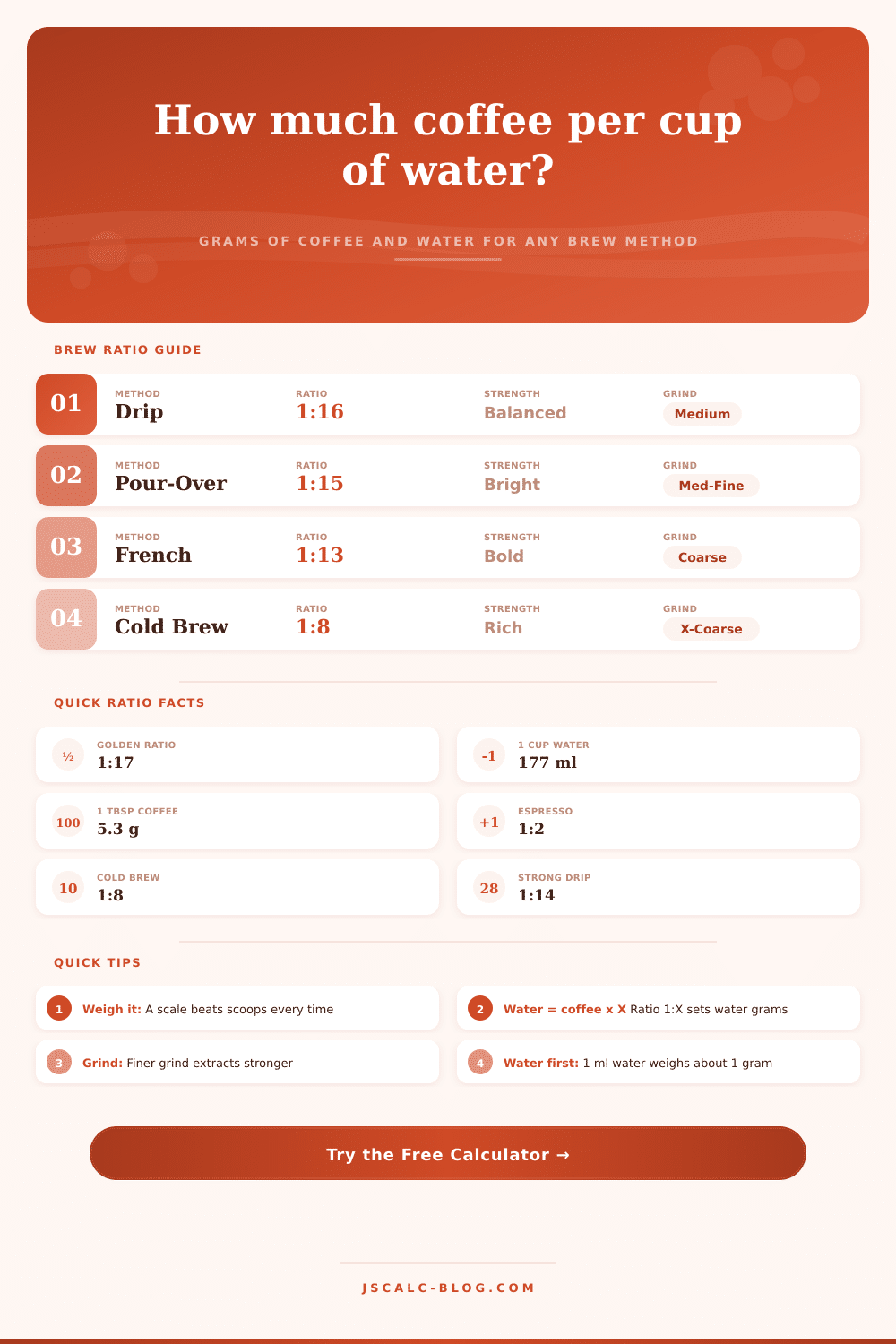
As far as ratios go, most barista say to start around one part coffee to sixteen parts water. That gives you a nicely balanced cup that yields enough sweetness without leaving behind bitter flavors. If you’re brewing something strong (French press), you can uses a ratio of one to thirteen since immersion extracts things very well.
For cold brew, you’ll need to have a really high concentration, say one part coffee to eight parts water, but then you will be diluting that out at some point. You need higher concentration upfront because you are brewing time instead of temperature.
The grind matters, but not before fixing the ratio. Too fine? That won’t fix coffee that tastes watery because you didn’t use enough beans to start with. Changing the grind change how quickly coffee comes out of those grounds. Fixing the ratio establishes the base strength; then the grind determines how rapidly that strength come out of your grinds.
Too little water and a coarse grind make a weak cup of coffee. Too much water and a fine grind makes a sour and thin cup of coffee. Start with the right weight as your starting point, tweak the grinder from there.
If you’re not sure where to start, these numbers is helpful: the more coffee vs. More water makes it stronger, and less water make it lighter. There’s also this reference table to help translate those ratios to real-life quantities and figure out how many gram of coffee to use depending on your water volume. It will give you a concrete number to have in mind when measuring your coffee (like “about fifteen grams of coffee for a regular-sized mug”). Then it’s just a matter of applying this quantity to your own workflow so you get consistent results.
Now we’re onto execution; the right number gets thrown away if it’s done wrong. For instance, tap water taste better filtered because filtering removes the chlorine that masks the subtle flavors in light-roast coffee. And temperature is key, don’t make your water boil. Making it too hot will scorch the grounds and result in something so harsh that no amount of sugar will help. What you want is about ninety-five degrees Celsius, that’s hot enough to pull out great flavors but not hot enough to burn them.
Stronger doesn’t equal better; more coffee doesn’t necessarily equal better. Quality isn’t strength. So go for clarity over intensity. Even if the darker, burnt roast have more kick, a light roast that’s been extracted properly might be tastier. You don’t want to taste the caffeine, you want to taste the roast and its origin. Getting clear on your ratio will help with that.
Use the recommended ratio for your brewer, brew, and try it. Does it taste good? Adjust the ratio until you get it right. Too strong? Add more water next time. Use less next time. Too little? Use slightly more coffee next time. Change the grind only when the strength is right but the flavor balance are off.
By following this system, we remove emotion from troubleshooting and make brewing an experiment to be done step by step. A good ratio is better than expensive equipment, but a bad ratio is not. Cheap equipment can works if it’s measured properly. It’s more important to know how you’re going to use your tools instead of what tools you have.
If there is one thing that will improve your cup of coffee, it’s getting the weight correct. Don’t fret over the rest until you get that right. You should of started with a accurate measurement. Most people find it difficultly to get this right naturaly without a modern scale for their luxurios setup.