Blood Alcohol Percentage Calculator
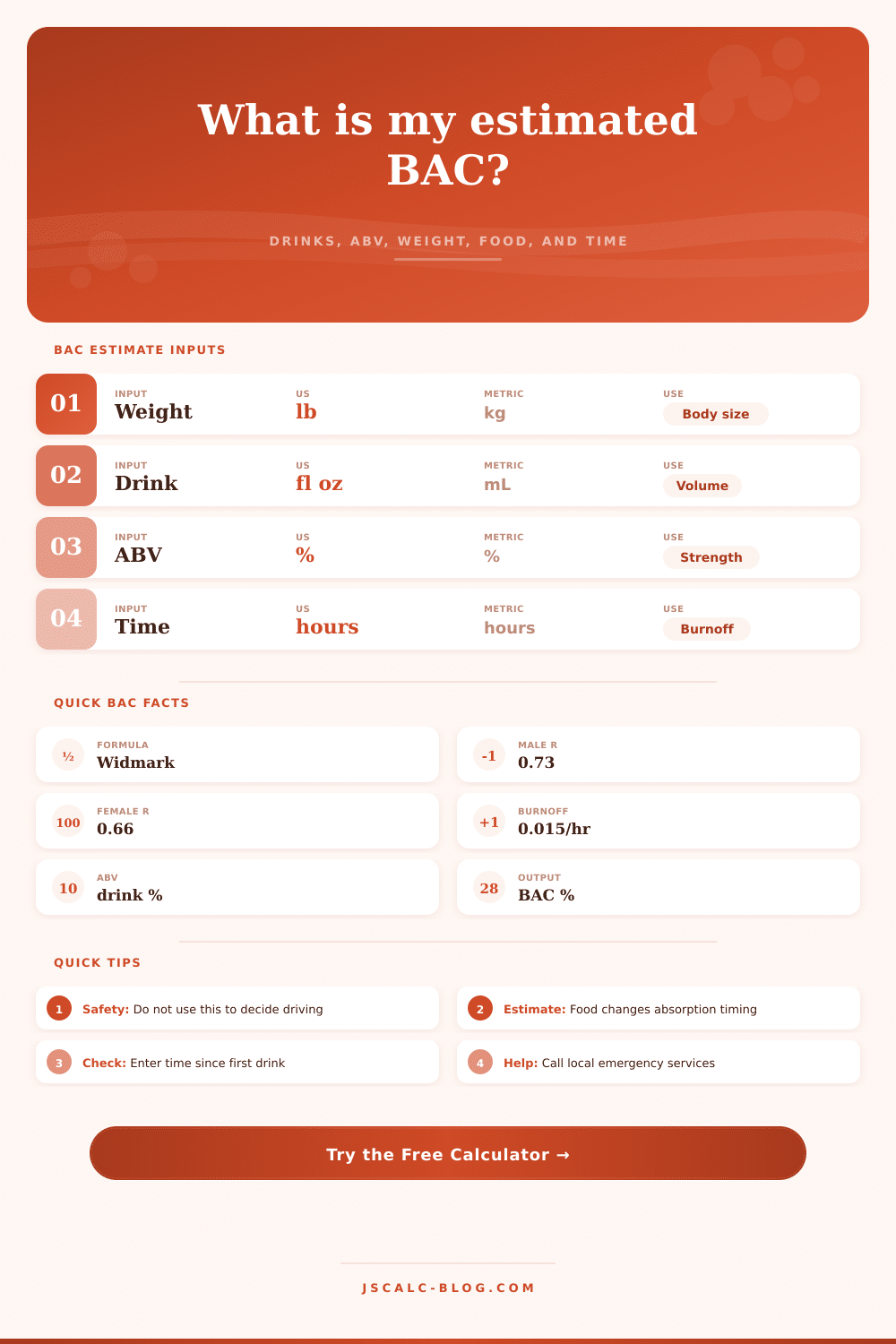
Estimate BAC percent on JSCalc-Blog.com using drink volume, ABV, body weight, body water ratio, food timing, and hours since the first drink.
🍷Real Drink Scenario Presets
⚙Inputs
Metric mode converts kg to lb for the Widmark formula.
Food can delay absorption; this is a rough estimate, not a safety guarantee.
📊Formula Snapshot
📘Drink Strength Comparison
| Drink Type | Serving | Typical ABV | Ethanol oz | Ethanol mL | Calculator Entry |
|---|---|---|---|---|---|
| Regular beer | 12 fl oz | 5% | 0.60 | 17.7 | 12 oz, 5% |
| Light beer | 12 fl oz | 4.2% | 0.50 | 14.9 | 12 oz, 4.2% |
| Craft IPA | 16 fl oz | 7% | 1.12 | 33.1 | 16 oz, 7% |
| Table wine | 5 fl oz | 12% | 0.60 | 17.7 | 5 oz, 12% |
| Sparkling wine | 4 fl oz | 11% | 0.44 | 13.0 | 4 oz, 11% |
| 80-proof spirits | 1.5 fl oz | 40% | 0.60 | 17.7 | 1.5 oz, 40% |
| Strong cocktail | 3 fl oz spirits mix | 25% | 0.75 | 22.2 | 3 oz, 25% |
| Hard seltzer | 12 fl oz | 5% | 0.60 | 17.7 | 12 oz, 5% |
🧮Widmark Method Table
| Step | Calculator Value | Formula Piece | Notes |
|---|---|---|---|
| Alcohol ounces | Volume x servings x ABV | A | ABV is entered as a percent, then divided by 100. |
| Distribution | Weight lb x body water ratio | weight_lb x r | Preset r values are broad population estimates. |
| Initial estimate | A x 5.14 / distribution | (A x 5.14) / (weight_lb x r) | This estimates blood alcohol concentration as a percent. |
| Time subtraction | Burn rate x hours | 0.015 x hours | The default burnoff follows the requested Widmark rate. |
| Food estimate | Initial estimate x food factor | Food factor 0.85 to 1.00 | Food may delay absorption and make timing less predictable. |
📏Unit Conversion Reference
| Measurement | US Unit | Metric Unit | Conversion |
|---|---|---|---|
| Body weight | 1 lb | 0.453592 kg | kg x 2.20462 = lb |
| Drink volume | 1 fl oz | 29.5735 mL | mL / 29.5735 = fl oz |
| Ethanol amount | 1 fl oz | 29.5735 mL | fl oz x 29.5735 = mL |
| Alcohol strength | ABV percent | ABV percent | Use the same number in both systems |
| Elapsed time | Hours | Hours | Use time since the first drink |
⚠Estimate Limits and Safety
| Factor | Can Change BAC Timing | Calculator Handles It How | Safety Note |
|---|---|---|---|
| Food | Yes | Applies a rough reduction factor | Food does not make an impaired person safe to drive. |
| Drink pacing | Yes | Uses total time since first drink | Recent drinks may still be absorbing. |
| Body composition | Yes | Uses r presets | Individual variation can be large. |
| Medication or health | Yes | Not modeled | Use extra caution and seek professional guidance when relevant. |
| Legal limits | Yes | Not legal advice | Do not use an estimate to decide if driving is legal. |
💡Calculator Tips
You’ve had two beers over an hour. You’re wondering whether or not you should attempt driving home. It’s an important question but it never has a straightforward answer. Human biology isn’t quite so cut-and-dry. While blood alcohol content estimators provides some sort of mathematical window into how our bodies work, they’re more akin to guessing games.
What if there was a way to connect time, body weight, alcohol by volume, and drink volume into one neat little percentage? There is. And it’s called this calculator. At its core, the calculator rely on the Widmark formula. After all these decades, the formula is still considered the standard; it gives us a reliable base from which we can calculate how ethanol will spreads throughout our body water.
How to Use This Calculator
This is about body weight. This is the single biggest piece of information you’ll feed into the calculator. You’re asked to choose an estimated body weight for either males or females, which corresponds roughly to typical male or female physiology. You then provide a number, which is the percentage of your body that’s water. Alcohol doesn’t dissolves in muscle or fat. Alcohol dissolves in water. In other words, if you have more fat than water, alcohol will be more concentrated on your water. Once you choose one of these presets, the calculator figures out all that stuff about distribution for you. You multiply total ethanol intake by a conversion factor and divide it by your water volume. That result give the first spike before your liver kicks in.
Those early numbers also take into account food in a surprising way. A lot of people think eating will prevent alcohol from entering their system, but that’s only half true. What food mainly does is slow the process of absorption. If you eat a big meal prior to drinking, your stomach empties slower which means the ethanol hit your bloodstream more gradually. This causes a delay in effect, which the calculator accounts for roughly. It doesn’t remove the alcohol, it just alters its timing. That’s why you’ll see people having wildly different experiences even if they drank the same amount based on what they ate earlier in the day.
There’s also one more thing working against you in the short-term but on your side in the long-run: time. How many showers you take, how much coffee you drink, and so on don’t matter to much. Alcohol is processed by your liver at a reasonably constant pace. There are lots of estimates out there; you can adjust this rate in the tool if you know your metabolism runs slower or faster then average. If you’re aware of your metabolism, perhaps because you know someone who processes alcohol faster/slower than normal, then you can tweak that in the tool. Then it’ll use that number to subtract a constant amount per hour from your total. That value represents how far you’ve come compared to where you started. It’s a good reminder that time is the only true cure for drunkenness.
Legal limits exist for public safety rather than personal comfort: what feels fine to one person might be dangerous for another. Everyone reacts differently; everyone have different levels of tolerance. This number is strictly for educational purposes. It will teach you about how your body works, but that doesn’t mean it can substitute for sound judgement or a breathalyzer. Don’t take this figure as a way to test your limits or make spur-of-the-moment driving decisions. In the real world, there isn’t nearly as wide of a margin for error as the math implies.
Knowing all this shifts your perception around social drinking. Suddenly, knowing that a large glass of wine isn’t automatically equivalent to a small beer if the ABV differs significantly changes your perspective. Not eating lunch can make your nightcaps go down quicker and stronger. All this knowledge is derived from being familiar with the inputs instead of simply looking at the final output. While the calculator up top does the number crunching for you, it’s still completely your responsibility to interpret the results. Overall, it is a tool to help you be aware.
Breaking booze down into time, weight, and volume takes the mystique out of what it’s doing inside your body. It reveals that there are some simple physical laws at work on your body as it processes a chemical substance. And learning these laws doesn’t protect you from them. It just helps you make smarter decisions before raising a glass. When you know how it works, you can plan accordingly. And planning is the safest thing you can bring with you into any drinking-related social situation.