APR Calculator
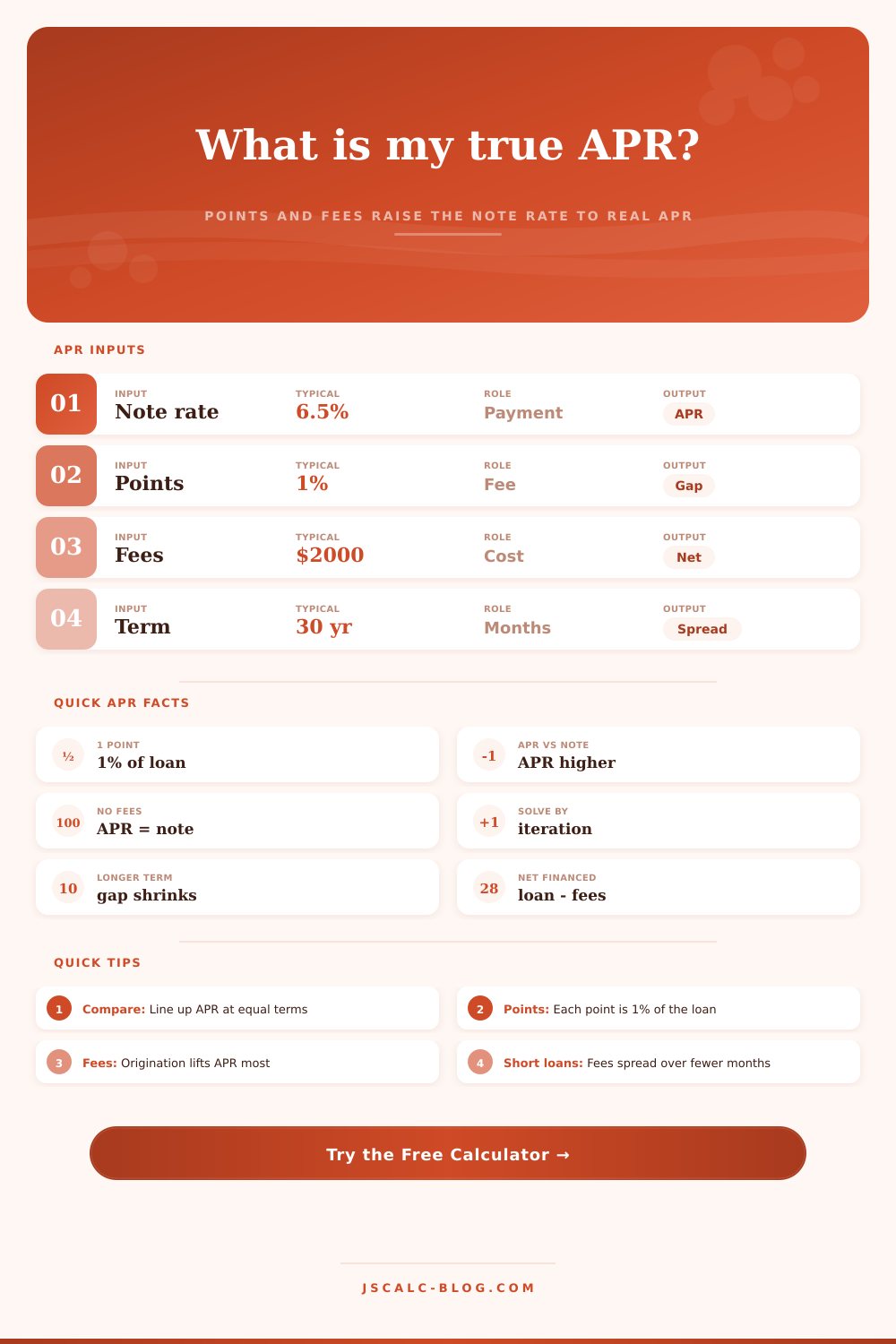
Find the true annual percentage rate on a loan once discount points, origination charges, and financed closing costs are folded in. The APR is solved by iteration and runs higher than the plain note rate whenever fees apply.
🎯Real APR Presets
📝Loan and Fee Inputs
Full principal the borrower repays over the term.
1 point = 1% of the loan amount, paid up front.
Prepaid finance charges such as underwriting or processing.
Rolling fees raises the principal that carries interest.
🔢Method Snapshot
📊APR vs Note Rate by Fee Level
| Fee Level | Points + Fees | Net Financed | Note Rate | True APR | APR Gap |
|---|---|---|---|---|---|
| Enter values above to build the fee-level comparison. | |||||
Each row keeps your loan, note rate, and term fixed while raising total finance charges. As fees climb, the net amount financed drops and the true APR pulls further above the note rate.
📌Points to Rate Reference
| Points | Percent of Loan | Cost on This Loan | Typical Rate Cut | APR Effect |
|---|---|---|---|---|
| Enter values above to price each point. | ||||
Discount points are prepaid interest. One point equals 1% of the loan and usually trims the note rate, yet the up-front cost is still a finance charge that lifts APR until the lower rate earns it back.
🗂Term Sensitivity of the APR Gap
| Term | Periods | Payment | Note Rate | True APR | APR Gap |
|---|---|---|---|---|---|
| Enter values above to see how term changes the gap. | |||||
The same fees spread over more payments, so a long mortgage shows a small APR gap while a short loan shows a wide one. This is why APR alone can mislead when two offers have different terms.
📋Loan Estimate Fee Components
| Fee | Where It Lands | Counts in APR? | Typical Range |
|---|---|---|---|
| Discount points | Prepaid interest | Yes | 0 to 3% of loan |
| Origination fee | Lender charge | Yes | 0.5% to 1.5% |
| Underwriting / processing | Lender charge | Yes | $400 to $1,500 |
| Mortgage broker fee | Broker charge | Yes | 0.5% to 2% |
| Appraisal | Third party | Often no | $400 to $700 |
| Title insurance | Third party | Often no | $700 to $2,000 |
| Recording / transfer | Government | No | $50 to $500 |
Lender-controlled prepaid finance charges are what push APR above the note rate. Third-party and government costs are usually excluded, so put only the finance charges in the fee inputs above for a clean comparison.
📈Scenario Comparison Grid
| Scenario | Loan | Note Rate | Points + Fees | Term | Est. APR |
|---|---|---|---|---|---|
| Mortgage with 2 points | $300,000 | 6.25% | $8,100 | 30 yr | ~6.49% |
| Auto loan, no fees | $30,000 | 7.40% | $0 | 5 yr | 7.40% |
| 1% origination | $250,000 | 6.50% | $4,500 | 30 yr | ~6.68% |
| Personal loan fee | $15,000 | 11.00% | $750 | 3 yr | ~13.1% |
| Refi closing costs | $280,000 | 5.90% | $6,300 | 30 yr | ~6.10% |
| High fee loan | $200,000 | 6.00% | $12,000 | 15 yr | ~6.98% |
| Jumbo with points | $400,000 | 6.75% | $10,500 | 30 yr | ~6.98% |
| Low rate, high fee | $220,000 | 5.25% | $11,000 | 30 yr | ~5.62% |
⚙Full Method Breakdown
💡Practical APR Tips
Last week you signed your name to those loan papers, and the lender gave you an estimated rate of 6.5 percent (the note rate). You thought that sounded about right, for a 30-year mortgage. And then you saw that the APR was a bit higher: 7.1 percent.
No, this isn’t a mistake or a punishment… It’s the best gauge of what you’ll pay. The note rate measure only interest cost. The annual percentage rate measures all points, fees and other charges involved in taking out mortgage. You can use the calculator above to do all that, but knowing how it works is better than just clicking a button.
The True Cost of Your Loan: APR vs Interest Rate
APR removes the gloss of marketing to show you what borrowing actualy costs; which is why lenders want you to focus on note rates (which are easy to compare if you ignore everything else). But borrowers need to be focused on APR, since it includes the costs involved in getting money; you pay points to reduce your rate, so you’re pre-paying interest. That initial out-of-pocket cost reduces net dollars you get back on the loan.
If your lender charges discount points, also known as discount fees, it’s a choice between paying now or paying later. Later: You’ll pay one percent of the loan for every point paid upfront; and every point decrease the interest rate by.25 percent. For example, paying two discount points at closing on a $250,000 loan might decrease the note rate by 0.25 percent… The calculator does that math automatically when you input your actualy discount fees.
Is it worth it? It depends on your schedule. If you’re planning to live in house for twenty years, chances are good that lower monthly payments will more than compensate for hit to cash flow. If you’re selling within five years, however, those points become cash down the drain, with nothing to show for them.
Points vs. Origination fee: Points are different than origination fees (which also impact the APR), since they reduce the loan’s principal balance and hence the amount of money “you receive” on closing day. That means they’re considered prepaid finance charges that reduce the principal when calculating the APR. But it still reduces your principal, which results in an interest rate that produce the same monthly payment.
The way calculation works is iterative, there isn’t really any straightforward linear formula. It simply tries lots of different rates until it finds one for which the present value of your future payments equals exactly the amount of cash you recieve after subtracting all fees. These fees are also dependent on length of the loan: $1000 spread out over 30 years won’t have much of an effect on your monthly payment, but $1000 in a three year personal loan will significantly raise the true cost of borrowing, which is why you’ll see very large differences in APR between short-term vs. Long-term debts even if the nominal interest rates is similar.
Long-term debts, and why lenders will offer the same nominal rate for vastly different terms. This difference is reflected in our tool at various time horizons, where a wide gap reflects high up-front fees which take years to pay off, while a thin gap means it’s really just getting charged for interest rate itself. The problem is that you can’t justifiably compare an APR across different types of loans (e.g., comparing the APR on a 30-year loan to the APR on a 15-year loan).
The time value of money work differently in each case. Always compare loans based off their similarity in terms, that’s how you can get a valid apples-to-apples comparison. After controlling for term, the APR will serve as a valid measure of total cost since it forces lenders to show their fees rather than burying them in closing disclosures.
A lot of borrowers zero in on the monthly payment without seeing it in the context of their bigger financial picture; hence, missing out on a zero-point loan with a higher note rate because competitors is charging a huge amount of up-front fees, resulting in an even lower APR. The point: know what you’re measuring and determine whether you want to pay cash now (or pay interest later) based on your individual liquidity. One size doesn’t fit all; it’s all about your unique financial situation and holding period.
You should of checked the fine print earlier. What happens is that the note rate is the headline, it grabs your attention but tells only half the story, while the APR is the fine print that reveals the economic reality of the deal. It converts abstract numbers into actual dollars and cents. This prevents you from jumping on seemingly good deals that have hidden costs making them look artificially low. Once you learn to decipher the spread, you begin to negotiate not only for a lower interest rate but also for a better overall cost of borrowing.