Wire Resistance Calculator
Compute the electrical resistance of a conductor run from R = rho x L / A, apply a temperature correction for hot or cold operating conditions, and read the voltage drop and power lost in the wire at your working current for copper, aluminum, silver or gold.
🎯Real Wiring Scenario Presets
🔌Conductor Inputs
Sets resistivity rho at 20 C and temperature coefficient alpha.
Choose a standard gauge or type an exact area in mm2.
American Wire Gauge; 4/0 through 2/0 use negative index.
Used when sizing by area instead of a gauge.
The physical distance the wire spans in the unit below.
Applies to the length field above.
Resistance is corrected from the 20 C reference to this value.
Used for voltage drop and power loss in the wire.
Round-trip doubles length for realistic voltage drop.
Only used to express drop as a percent of supply.
🔢Formula Snapshot
⚙Formula Breakdown
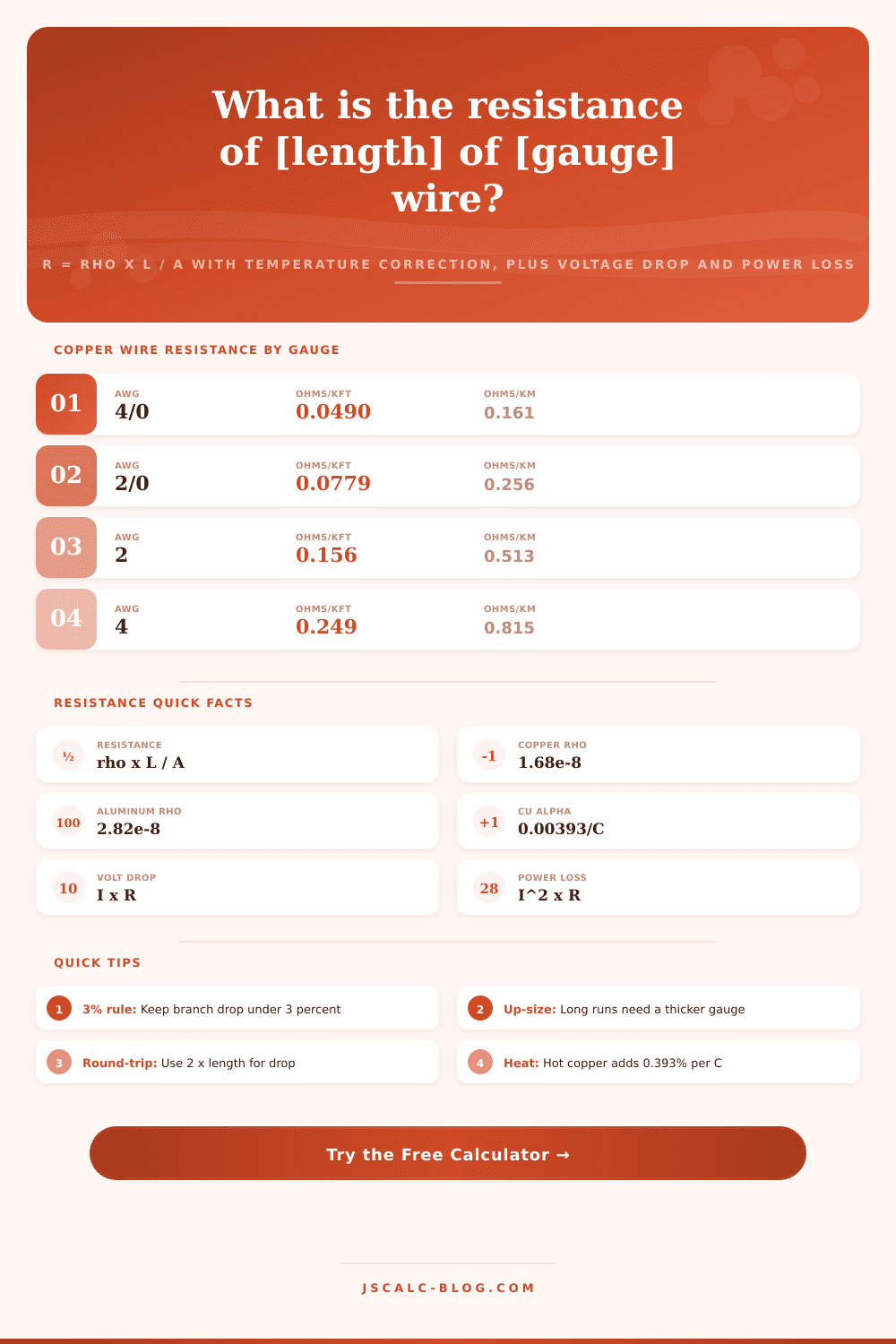
📋Copper Wire Resistance by Gauge (20 C)
| AWG | Diameter (mm) | Area (mm2) | Ohms per 1000 ft | Ohms per km |
|---|---|---|---|---|
| 4/0 | 11.68 | 107.2 | 0.0490 | 0.161 |
| 2/0 | 9.266 | 67.43 | 0.0779 | 0.256 |
| 1/0 | 8.251 | 53.48 | 0.0983 | 0.322 |
| 2 | 6.544 | 33.63 | 0.156 | 0.513 |
| 6 | 4.115 | 13.30 | 0.395 | 1.296 |
| 8 | 3.264 | 8.366 | 0.628 | 2.061 |
| 10 | 2.588 | 5.261 | 0.999 | 3.277 |
| 12 | 2.053 | 3.309 | 1.588 | 5.211 |
| 14 | 1.628 | 2.081 | 2.525 | 8.286 |
| 18 | 1.024 | 0.823 | 6.385 | 20.95 |
🧭Conductor Material Properties
| Material | Resistivity rho (ohm-m, 20 C) | Alpha (per C) | Conductivity vs Cu |
|---|---|---|---|
| Silver | 1.59e-8 | 0.00380 | 106% |
| Copper | 1.68e-8 | 0.00393 | 100% |
| Gold | 2.44e-8 | 0.00340 | 69% |
| Aluminum | 2.82e-8 | 0.00403 | 60% |
| Copper hot 75 C | 2.04e-8 | 0.00393 | 82% |
| Aluminum hot 75 C | 3.44e-8 | 0.00403 | 49% |
📏Length and Unit Conversions
| Quantity | Equals | In Base Unit | Note |
|---|---|---|---|
| 1 ft | 0.3048 m | 0.3048 m | Length in meters |
| 1000 ft | 304.8 m | 304.8 m | Spec-sheet basis |
| 1 km | 3280.8 ft | 1000 m | Metric run length |
| 1 mm2 | 1e-6 m2 | 0.000001 m2 | Area to SI base |
| 1 kcmil | 0.5067 mm2 | 5.067e-7 m2 | Circular-mil area |
| 1 mohm | 0.001 ohm | 0.001 ohm | Milliohm scale |
🗃Resistance and Drop Comparison Grid (Copper, 20 C)
| AWG | Area (mm2) | Ohms/1000 ft | Ohms/km | R for 100 ft | Vd at 20 A round-trip |
|---|---|---|---|---|---|
| 4/0 | 107.2 | 0.0490 | 0.161 | 0.00490 ohm | 0.196 V |
| 2 | 33.63 | 0.156 | 0.513 | 0.0156 ohm | 0.626 V |
| 6 | 13.30 | 0.395 | 1.296 | 0.0395 ohm | 1.58 V |
| 8 | 8.366 | 0.628 | 2.061 | 0.0628 ohm | 2.51 V |
| 10 | 5.261 | 0.999 | 3.277 | 0.0999 ohm | 4.00 V |
| 12 | 3.309 | 1.588 | 5.211 | 0.1588 ohm | 6.35 V |
| 14 | 2.081 | 2.525 | 8.286 | 0.2525 ohm | 10.1 V |
| 18 | 0.823 | 6.385 | 20.95 | 0.6385 ohm | 25.5 V |
💡Practical Wiring Tips
When every hobbyist or electrician reaches this point they meet theory and reality. Yes, you have read Ohm’s law. Yes, you realize that wire has resistance. But knowing math isn’t the same as knowing how much it will cost you in terms of safety margin or lost voltage. This asks not just what the resistance is, but also what that resistance costs you.
All conductors fight back against the current running through them. That’s a clean relationship. Resistance = Resistivity * Length / Area. This calculator work out that equation for wires made of gold, silver, copper, or aluminum. It adjusts for actual operating temperatures. And finally converts those answers to two things that make a difference at the jobsite. It shows how much power was burned off as heat and how much voltage drop along the way.
How to Use the Wire Calculator
Resistance scales with three physical facts about your conductor: resistivity is an intrinsic property of the metal, while length and area are dimensions of the wire itself. Aluminum have higher resistivity than copper. That means the same sized bit of aluminum will conduct less. The third is length, which is directly proportional to resistance. Double the length and you double the number of ohms. Area works the opposite way, the more space there is, the easier it is for current to flow. Worst case, a long skinny wire made out of a bad conductor; best case, a short fat one made out of copper or silver.
The calculator does the unit book-keeping work for you. It’ll convert square millimeters into base units and feet into meters and do the multiplying and dividing for you. It saves you from having to fumble around with exponents on construction site. The tool automates this conversion for you: Most wire out there is specified in American Wire Gauge, not by raw area. Unfortunately, the gauge system is counterintuitive because a “thinner” wire have a higher number. Thanks to math, a jump of six gauge numbers reduces the area by about half, while a drop of three increases it more than double. You can also switch over to metric, if that’s your preference; then you’ll enter an exact cross-section value in square millimeters, which is how cable is marked in most of the world.
The right area makes all the difference because resistance is in that denominator. When metals become hot, they conduct less and the change isn’t small enough to be safely ignored. A temperature correction is applied that covers the difference between standard reference temperature of 20 degrees celsius and what you intend to operate your circuit under. In the case of copper, this causes an increase in resistance of approximately.4 percent per degree celsius. That means that the same piece of copper at the rated temperature of the insulation (seventy five degrees) has some twenty two percent more resistance then the same length when cool on your workbench. If you choose to ignore this correction, voltage drop looks better on paper than it will in a sun-baked rooftop or in a warm conduit. In short, don’t make light of operating temperature input. This is where careful design resides.
Ohm’s law completes the loop: Voltage drop = Current x Resistance. The latter only shows itself when there’s current to resist. Current goes out to the load and must return, so the tool accounts for a round trip. That’s double the one-way length. The honest sizing for a supply-and-return pair. It says the drop is some percentage of your source voltage; how codes and rules of thumb are written. Branch-circuit drop should be kept below three percent, a common target. Test different scenarios in the presets, and you’ll see exactly where a given gauge will cross that line at some point as the run increases.
The resistance that steals voltage also burns power as heat. Because of the same resistance that steals voltage, it burns up power, too. And not gently. The amount of power lost in the wire increase as the current is squared. Double the load, and you quadruple the heat in the same size wire. That’s why undersized conductors gets hot. It’s also why long high-current feeders are sized much larger than their raw ampacity rating alone would suggest. The calculator shows you this dissipation directly. This allows you to get a feel for how many watts is being converted into warmth within the insulation instead of doing any useful work at the load.
A little bit here goes a long way. One of those areas is wire size. That’s why we base each result on the underlying equation and add an honest temperature correction. We then carry that answer forward to calculate power loss and voltage drop, giving you the whole picture in a few seconds. Choose one of our presets that matches your project. Enter your actual length, current. Dial-in the temperature the wire will experience, and read the cards. Learn about how conductors behave. Check a branch circuit. Plan out a long feeder. The numbers remains honest and the physics don’t change.