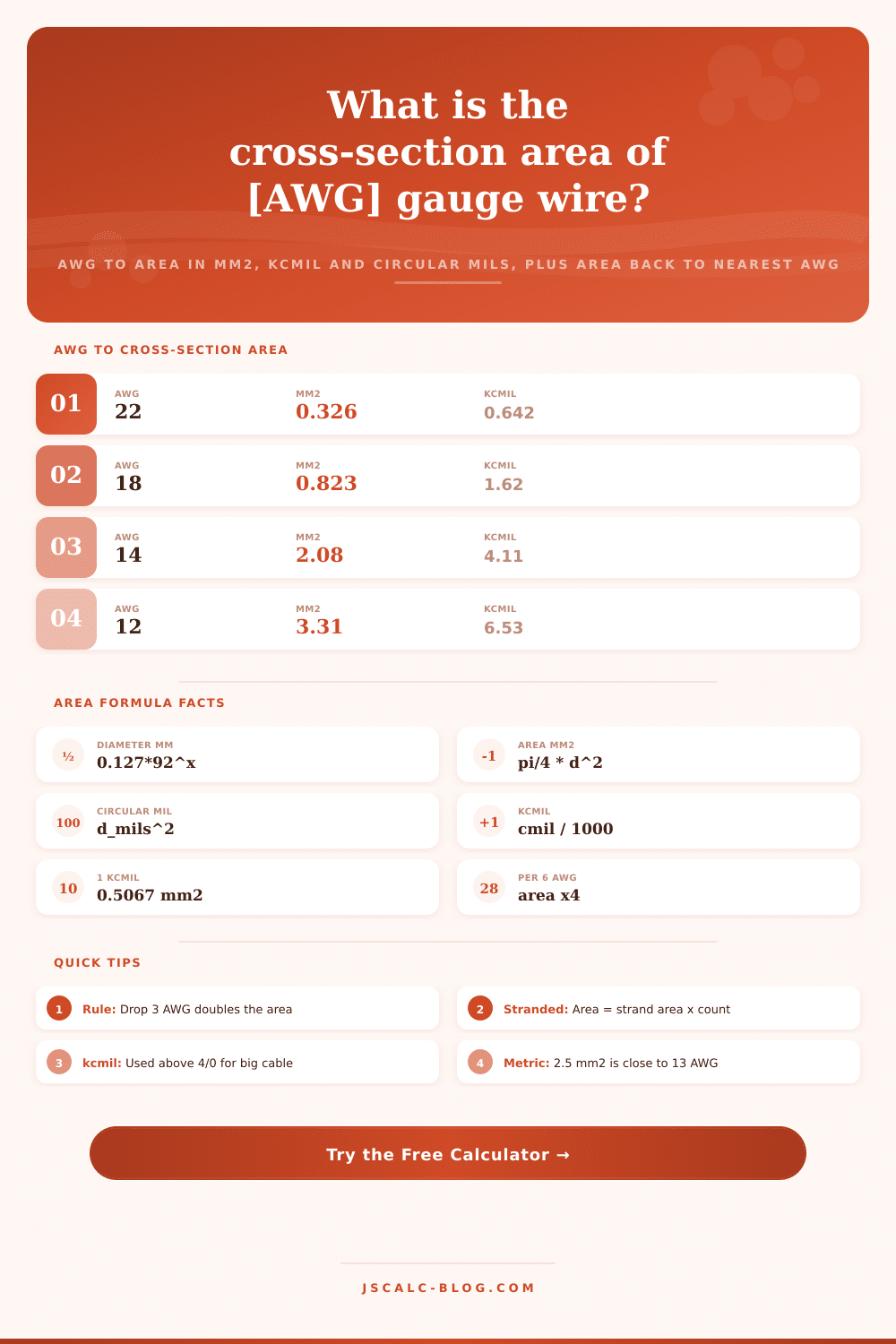
AWG to Cross-Section Area Converter
Convert an American Wire Gauge number into conductor cross-sectional area in square millimeters, thousand circular mils and circular mils, or reverse a known area back to the nearest standard AWG size. Supports solid and stranded conductors from 40 AWG up to 4/0.
⚡Choose a Direction
🔌Real Wire Size Presets
📝Conductor Inputs
Standard gauges from 40 up to 4/0. Higher gauge means thinner wire.
Enter the conductor area to find the closest AWG size.
Unit for the area value you entered above.
Stranded totals the metal area across every strand.
Used only for stranded builds to size a single strand.
Number of strands, for example 7, 19 or 37 in a rope lay.
Sets the headline area card. Others always show too.
Rounding applied to every result card.
🔢Formula Snapshot
📋Common AWG Area Reference
| AWG | Area mm2 | Area kcmil | Typical Use |
|---|---|---|---|
| 24 | 0.205 | 0.404 | Ethernet, low signal |
| 22 | 0.326 | 0.642 | Sensor and control |
| 18 | 0.823 | 1.62 | Speaker, thermostat |
| 14 | 2.08 | 4.11 | 15 A lighting branch |
| 12 | 3.31 | 6.53 | 20 A receptacles |
| 10 | 5.26 | 10.4 | 30 A dryer, water heater |
| 8 | 8.37 | 16.5 | 40 A range circuit |
| 6 | 13.3 | 26.3 | 55 A sub feeder |
📊Large Conductor Area Chart
| AWG / Size | Area mm2 | Area kcmil | Circular Mils |
|---|---|---|---|
| 4 | 21.2 | 41.7 | 41,740 |
| 3 | 26.7 | 52.6 | 52,620 |
| 2 | 33.6 | 66.4 | 66,360 |
| 1 | 42.4 | 83.7 | 83,690 |
| 1/0 | 53.5 | 106 | 105,600 |
| 2/0 | 67.4 | 133 | 133,100 |
| 3/0 | 85.0 | 168 | 167,800 |
| 4/0 | 107 | 212 | 211,600 |
📏Area Unit Conversions
| Unit | Equals | In mm2 | Note |
|---|---|---|---|
| 1 mm2 | 1973.5 cmil | 1 mm2 | Square millimeter |
| 1 cmil | 0.0005067 mm2 | 0.0005067 | Circle 1 mil across |
| 1 kcmil | 1000 cmil | 0.5067 mm2 | Thousand circular mils |
| 1 MCM | 1 kcmil | 0.5067 mm2 | Old name for kcmil |
| 1 mil | 0.0254 mm | -- | One thousandth inch |
| 1 mm2 | 0.001974 kcmil | 1 mm2 | Reverse of above |
🗃AWG Comparison Grid
| AWG | Diameter mm | Area mm2 | kcmil | Circular Mils | Nearest Metric mm2 |
|---|---|---|---|---|---|
| 20 | 0.812 | 0.518 | 1.02 | 1,020 | 0.5 mm2 |
| 18 | 1.024 | 0.823 | 1.62 | 1,620 | 0.75 mm2 |
| 16 | 1.291 | 1.31 | 2.58 | 2,580 | 1.5 mm2 |
| 14 | 1.628 | 2.08 | 4.11 | 4,110 | 2.5 mm2 |
| 12 | 2.053 | 3.31 | 6.53 | 6,530 | 4 mm2 |
| 10 | 2.588 | 5.26 | 10.4 | 10,380 | 6 mm2 |
| 8 | 3.264 | 8.37 | 16.5 | 16,510 | 10 mm2 |
| 6 | 4.115 | 13.3 | 26.3 | 26,250 | 16 mm2 |
| 4 | 5.189 | 21.2 | 41.7 | 41,740 | 25 mm2 |
| 2 | 6.544 | 33.6 | 66.4 | 66,360 | 35 mm2 |
⚙Formula Breakdown
💡Practical Wire Sizing Tips
The wire jacket will give you some idea of your electrical system, but only if you’re willing to read beyond printed gauge number. Because the American Wire Gauge system run in reverse, with a higher number corresponding to smaller diameter, it’s counter-intuitive. It seems backwards, until you realize that scale is based off the ability to draw metal through a die, not ease of mental arithmetic. This reversal is one reason why most folks who want to calculate how much copper there realy is (as opposed to knowing the label) break out the calculator.
The true metric are cross-sectional area, as this controls both resistance and the capacity of the wire to dissipate heat far better than the label on the wire jacket ever could. These wires follow precise geometry that’s hard to understand at first glance. The step between gauges (so, for instance, jumping from 16 AWG to 14 AWG) is always a constant-ratio change in diameter and therefore an even larger change in area. A jump of three steps down the scale are about a doubling in area, and a jump of six steps doubles it again. That’s a handy little rule of thumb that makes it easy to get a sense for how much voltage drop a slightly thicker wire might reduce, instead of whipping out your manual, or something. It also make it clear why something as seemingly small as going from 14 AWG to 12 AWG feels like such a huge improvement with those big appliances.
Why You Need to Calculate Wire Area Instead of Just Reading the Gauge Number
Most of us think about it in terms of thousand circular mils or square millimeters, but converting between them can be tricky if you are doing it by hand. And while you can do the conversion manually, it’s not always easy to translate one to the other. Use this calculator. Just enter your measurements and let it crunch numbers for you.
If you’re working with stranded conductors; something that trips up a lot of DIYers… It will also factor that in. Strands of wire is bundled together to make for flexibility, but total conductive area is simply the sum of all the strands. You can use size and number of each strand to find out how much metal there actualy is. This keeps you from choosing a flexible cord that is too small just because it looks like less material than solid core.
While any electrical engineer worth their salt can do calculations using metric, square-millimeter wire is much easier if you’ve grown accustomed to measuring in inches or feet. Most likely due to code familiarity and sheer inertia, we’re still mostly stuck with circular mils here in North America. Don’t worry about Pi; a circular mil is just the area of a circle whose width is one-thousandth of an inch, so it’s not hard to go from diameter to the area. If you look at a 2.5 mm2 metric wire, you’ll see what I’m talking about: that thing doesn’t cleanly match nor cleanly exceed either standard, and usually ends up somewhere awkward between 12 and 14 AWG.
This difference make it necessary to always round up (to the next higher size) when making substitutions between systems. Again, it’s done for a reason; it keeps you safely above the minimum ampacity requirement. Reversing the process from area back to gauge is just as common, particularly if you’re dealing with an old schematic or specs from overseas gear. In that case, you can input the area in any unit and it will return the closest standard AWG size. That connecting of hypothetical design and what’s actualy available on the shelf is where this tool shines.
You plug in the math behind what you need and then it tells you precisely which off-the-shelf wire matches those requirements. It takes all the guessing out of whether your circuits are oversized for safety margin and picking replacements. So how do we understand these wire-gauge conversions? It’s not so much table memorization as it is recognition of the physics of the conductor: The larger the area (in metal), the more current a wire can deliver safely.
This holds true whether you’re powering your workshop or running a speaker line across a room in your home theater. Right-sizing the cable ensures the lights stays on and keeps the equipment safe. Next time you reach for some wire and read the gauge on the spool, imagine the real-world circle of copper behind it instead. It’s an easy switch in thinking that puts the otherwise-abstract numbers into practical engineering terms.
You should of seen it sooner.