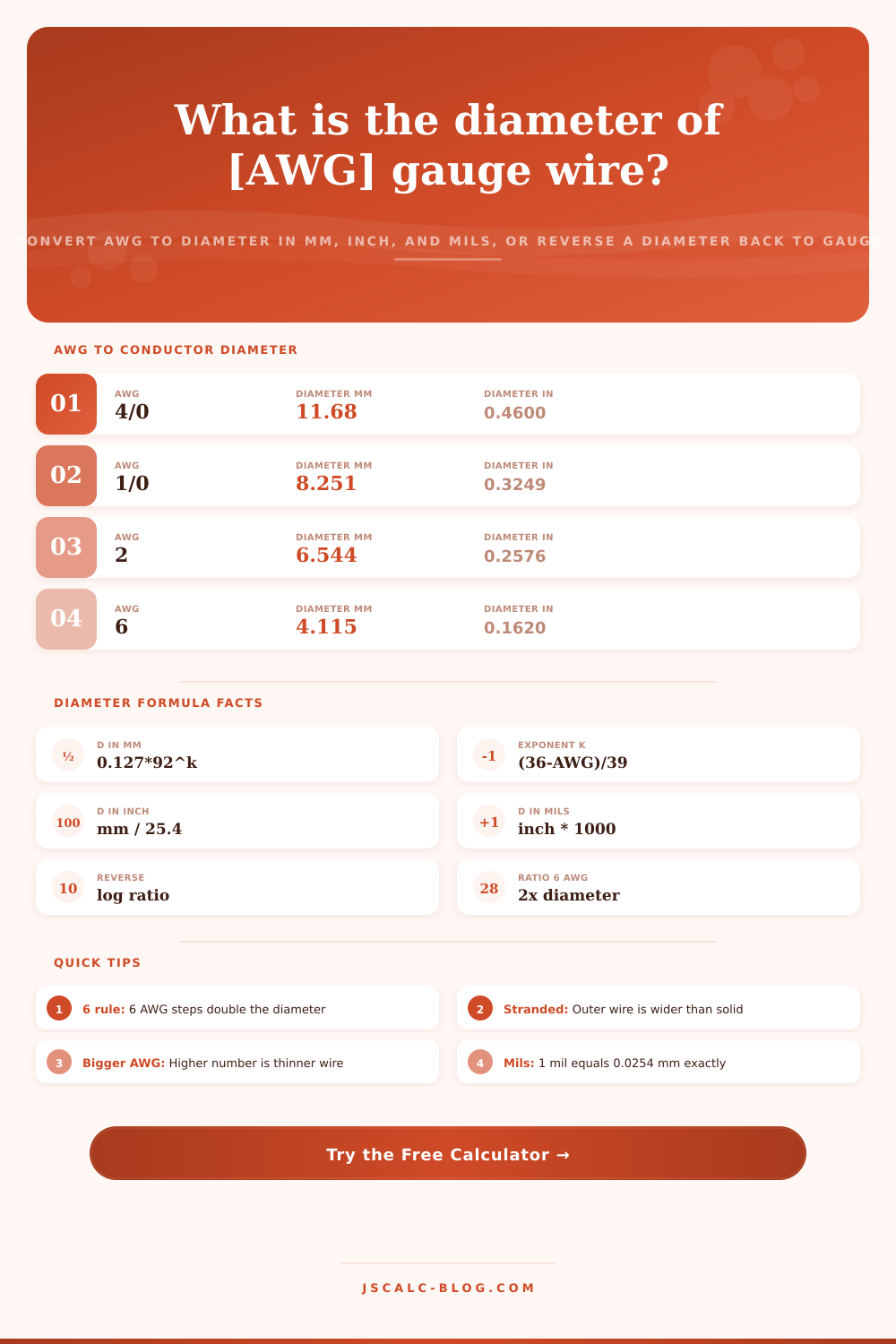
AWG to Diameter Converter
Convert any American Wire Gauge to its solid conductor diameter in millimeters, inches, and mils using d = 0.127 × 92^((36 − AWG) / 39), or reverse a measured diameter back to the nearest standard AWG. Handles fine 40 AWG hookup wire up to heavy 4/0 feeders, solid or stranded.
⚡Conversion Direction
🔧Real Wire Presets
📏Wire Inputs
Use 0, -1, -2, -3 for 1/0, 2/0, 3/0, 4/0. Higher number = thinner wire.
Measure a single solid conductor, not the insulation jacket.
Unit of the measured diameter entered above.
Stranded overall diameter runs slightly larger than an equal-area solid.
Common counts are 7, 19, or 41. Sets the single-strand diameter.
Chooses which unit leads the status summary line.
Controls rounding on every result card.
🔢Formula Snapshot
📋AWG to Diameter Quick Reference
| AWG | Diameter mm | Diameter inch | Diameter mils |
|---|---|---|---|
| 2 | 6.544 | 0.2576 | 257.6 |
| 4 | 5.189 | 0.2043 | 204.3 |
| 6 | 4.115 | 0.1620 | 162.0 |
| 8 | 3.264 | 0.1285 | 128.5 |
| 10 | 2.588 | 0.1019 | 101.9 |
| 12 | 2.053 | 0.0808 | 80.81 |
| 16 | 1.291 | 0.0508 | 50.82 |
| 20 | 0.8118 | 0.0320 | 31.96 |
📊Fine Gauge Diameters
| AWG | Diameter mm | Diameter inch | Diameter mils | Typical Use |
|---|---|---|---|---|
| 22 | 0.6438 | 0.0253 | 25.35 | Breadboard jumpers |
| 24 | 0.5106 | 0.0201 | 20.10 | Cat5 Ethernet pair |
| 26 | 0.4049 | 0.0159 | 15.94 | Ribbon cable |
| 28 | 0.3211 | 0.0126 | 12.64 | USB signal wire |
| 30 | 0.2546 | 0.0100 | 10.02 | Wire-wrap posts |
| 32 | 0.2019 | 0.0080 | 7.950 | Fine coil winding |
| 36 | 0.1270 | 0.0050 | 5.000 | Magnet transformer |
| 40 | 0.0799 | 0.0031 | 3.145 | Micro sensor lead |
🗃AWG Comparison Grid
| AWG | Diameter mm | Diameter inch | Diameter mils | Metric Equivalent | Common Role |
|---|---|---|---|---|---|
| 4/0 | 11.68 | 0.4600 | 460.0 | ~11.7 mm | Service entrance |
| 2/0 | 9.266 | 0.3648 | 364.8 | ~9.3 mm | Large feeder |
| 1/0 | 8.251 | 0.3249 | 324.9 | ~8.3 mm | Panel feed |
| 2 | 6.544 | 0.2576 | 257.6 | ~6.5 mm | Sub-panel run |
| 6 | 4.115 | 0.1620 | 162.0 | ~4.1 mm | Battery cable |
| 10 | 2.588 | 0.1019 | 101.9 | ~2.6 mm | Solar PV, dryer |
| 12 | 2.053 | 0.0808 | 80.81 | ~2.05 mm | 20 A receptacle |
| 14 | 1.628 | 0.0641 | 64.08 | ~1.63 mm | 15 A lighting |
| 18 | 1.024 | 0.0403 | 40.30 | ~1.0 mm | Speaker lead |
| 24 | 0.5106 | 0.0201 | 20.10 | ~0.51 mm | Ethernet, phone |
📏Diameter Unit Conversions
| Unit | Equals | In Millimeters | Note |
|---|---|---|---|
| 1 inch | 1000 mils | 25.4 mm | Base imperial length |
| 1 mil | 0.001 inch | 0.0254 mm | Thousandth of an inch |
| 1 mm | 0.03937 inch | 1 mm | Metric millimeter |
| 1 mm | 39.37 mils | 1 mm | Millimeter in mils |
| 6 AWG steps | 2x diameter | ratio 92^(6/39) | Doubling rule |
| 3 AWG steps | ~1.41x diameter | square root of 2 | Half the doubling span |
⚙Formula Breakdown
💡Wire Gauge Tips
What is the difference between a thinner and thicker wire? Does a bigger number on the wire gauge mean a thicker or thinner wire? Well that is one of those quirks in electrical engineering that gets us all. In fact we go backward with the American Wire Gauge (AWG), where 4/0 is as thick as your thumb and 40 AWG are as thin as a hair. That makes the number almost meaningless until you put a wire in your hand and relate that abstract number to what is happening physcially in your hands.
This little tool converts the wire gauge into inches, mils and even millimeters. Those are the units that you use when determining how much a wire can absorbs under a voltage drop or whether it will pass through a terminal.
How to Use the Wire Gauge Tool
That’s why it seems backwards: the size comes from the world of blacksmithing not pure geometry. In fact historically, the number refered to the number of draws the wire has been pulled through a die to reduce its width to the desired size. Higher = finer. Fewer = thicker. Today, we still have the same numerical system, only now it is tied down to a very specific mathematical curve. Each six-gauge size are exactly twice the diameter of the next. That’s an exponential ratio: 6 AWG is twice as thick than 12 AWG, which is twice as thick as 18 AWG. Plugging in your actual measurement or gauge size into the calculator takes care of all that math for you. You won’t have to flip back and forth between charts or try to remember logarithms while sitting at the workbench.
But first, what are you measuring? What’s the input? If it’s bare copper wire, you’re looking at the diameter of the solid conductor. But if it’s a stranded cable measured with calipers, you’ll see something else. Stranded wires is made up of lots of small strands bunched into a bigger package with little voids (air) around each one. That means that when you measure the total diameter of the bunch, it will be larger than an equally thick gauge of a solid conductor. So the tool allows you to indicate whether your conductor is stranded or not and also the number of strands within the bundle. It then computes what the diameter of a single strand would be if it carried as much current as the entire bundle. This is important when mating a crimp connector. If you use the wrong size, you may end up with loose connection or even overheating.
But sometimes you can also go backwards. Maybe there’s a wire in your house that someone measured but didn’t label before they left. Or you need to see if its size meet the new code requirements for an older structure. Whatever, you get out your calipers and measure the diameter in inches or millimeters. Type that in and the converter does its math. It works backward to show you the next highest or lowest standard AWG, along with the specific fractional gauge down to the hundredth. In my example, 2.05 mm points directly to 12 AWG, typical for most home wiring. 2.6 mm, it tells me, is actualy a bit bigger, and therefore probably 10 AWG, which will carry higher amperage and would of been found on something like a dryer circuit or a larger wiring run. The status line sums up that result in simple words without requiring you to decipher a table of fractions by hand.
Those options also represent the way people actualy work. If you’re a US-based electrician you tend to think in terms of mils (one thousandths of an inch) and inches. Folks who use international standards is more comfortablely using millimeters. Mis-converted units are one of the biggest reasons for spec error. To prevent this, the tool shows them all at once so you don’t slip up on a single digit when going from 26 AWG to 24 AWG. This change doesn’t sound like much on paper but it makes a big difference in cross-sectional area, heat dissipation, and resistance in delicate electronic gear.
Those standard settings on the page includes typical things like heavy battery cables and even Cat5 ethernet cable so you have a quick reference point without having to type anything out. It’s all about measuring the actual metal. Because insulation jackets can add almost a millimeter to the overall diameter, it’s easy to misidentify the gauge if you’re not careful. Take some time to strip back a bit of the wire and measure the bare conductor in a few spots along its length, averaging any slight variations. With the true diameter measured the tool will tell you without question what gauge you’ve got. It explains a confusing numbering system and tells you exactly what you have for your next project.