Volume Converter
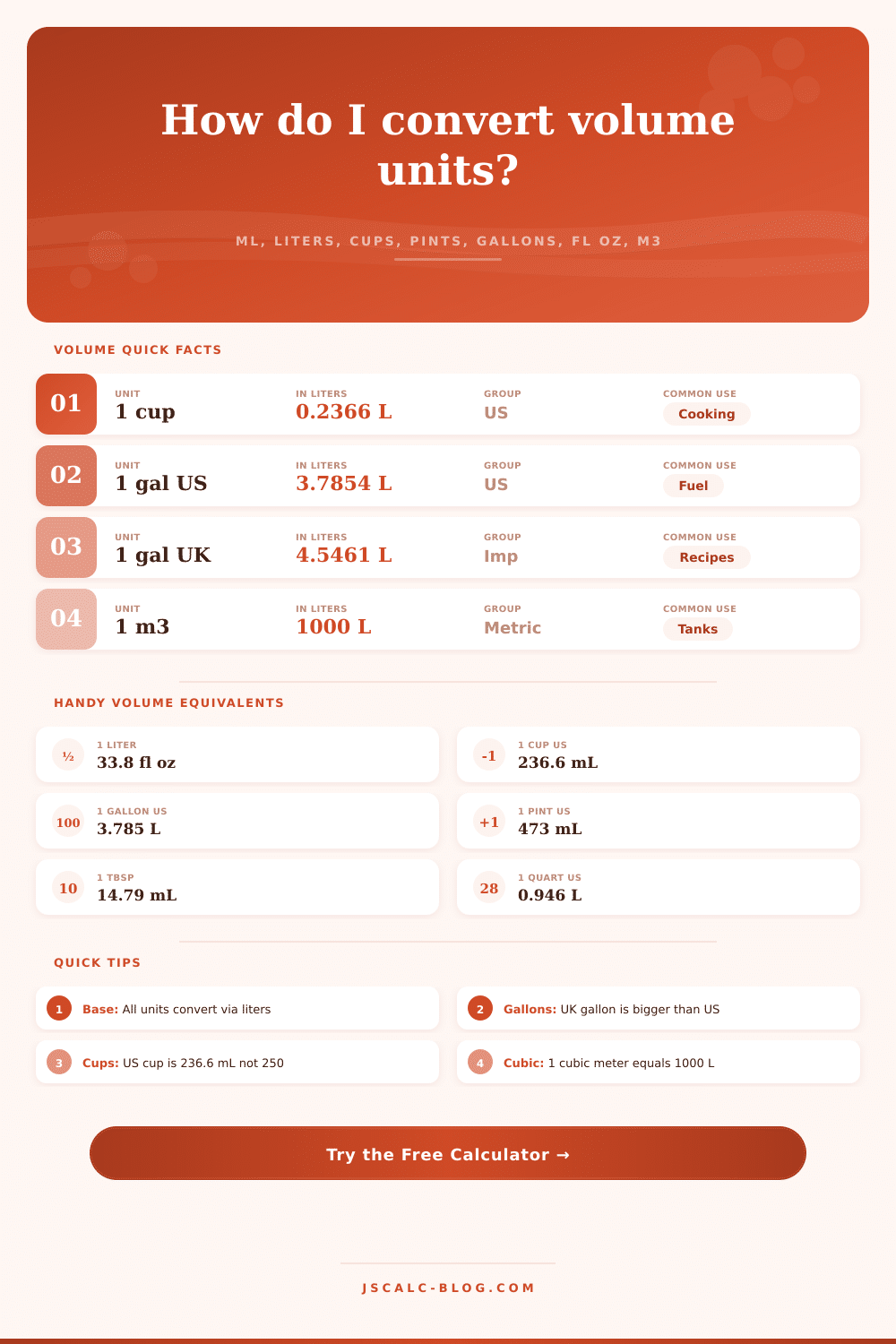
Convert milliliters, liters, cubic meters, cubic feet, fluid ounces, cups, pints, quarts, and gallons in both US and UK systems. Every unit canonicalizes through liters for accurate two-way conversions.
🎯Real Volume Presets
📝Conversion Inputs
Enter any positive number, including decimals.
Only affects the cooking reference notes below.
🔢Conversion Snapshot
📊Common Equivalents Of Your Input
| Target Unit | Converted Value | Unit Group | 1 Unit In Liters |
|---|---|---|---|
| Enter a value above to see all equivalents. | |||
🧮Volume Conversion Factors (Base = Liters)
| Unit | Symbol | Liters Per Unit | Units Per Liter |
|---|---|---|---|
| Milliliter | mL | 0.001 | 1,000 |
| Liter | L | 1 | 1 |
| Cubic meter | m³ | 1,000 | 0.001 |
| Cubic centimeter | cm³ | 0.001 | 1,000 |
| Teaspoon (US) | tsp | 0.00492892 | 202.884 |
| Tablespoon (US) | tbsp | 0.0147868 | 67.628 |
| Fluid ounce (US) | fl oz | 0.0295735 | 33.814 |
| Cup (US) | cup | 0.236588 | 4.2268 |
| Pint (US) | pt | 0.473176 | 2.1134 |
| Quart (US) | qt | 0.946353 | 1.0567 |
| Gallon (US) | gal | 3.785412 | 0.26417 |
| Gallon (UK) | gal UK | 4.54609 | 0.21997 |
| Cubic foot | ft³ | 28.3168 | 0.035315 |
| Cubic inch | in³ | 0.0163871 | 61.024 |
🍳Cooking Measures Reference
| Measure | Teaspoons | Tablespoons | Fluid Oz | Milliliters |
|---|---|---|---|---|
| 1 teaspoon | 1 | 1/3 | 0.167 | 4.93 |
| 1 tablespoon | 3 | 1 | 0.5 | 14.79 |
| 1 fluid ounce | 6 | 2 | 1 | 29.57 |
| 1/4 cup | 12 | 4 | 2 | 59.15 |
| 1/2 cup | 24 | 8 | 4 | 118.29 |
| 1 cup | 48 | 16 | 8 | 236.59 |
| 1 pint | 96 | 32 | 16 | 473.18 |
| 1 quart | 192 | 64 | 32 | 946.35 |
🌎US vs UK / Imperial Reference
| Unit | US Value | UK / Imperial Value | Difference |
|---|---|---|---|
| 1 gallon | 3,785 mL | 4,546 mL | UK 20.1% larger |
| 1 quart | 946.4 mL | 1,136.5 mL | UK 20.1% larger |
| 1 pint | 473.2 mL | 568.3 mL | UK 20.1% larger |
| 1 cup | 236.6 mL | 284.1 mL | UK cup larger |
| 1 fluid ounce | 29.57 mL | 28.41 mL | US 4.1% larger |
| 1 tablespoon | 14.79 mL | 17.76 mL | UK tbsp larger |
🗂Common Container Comparison Grid
| Container | Milliliters | Liters | Fluid Oz US | Cups US | Gallons US |
|---|---|---|---|---|---|
| Shot glass | 44 mL | 0.044 L | 1.5 | 0.19 | 0.012 |
| Coffee mug | 355 mL | 0.355 L | 12 | 1.5 | 0.094 |
| Soda can | 355 mL | 0.355 L | 12 | 1.5 | 0.094 |
| Water bottle | 500 mL | 0.5 L | 16.9 | 2.11 | 0.132 |
| Wine bottle | 750 mL | 0.75 L | 25.4 | 3.17 | 0.198 |
| Milk carton | 1,000 mL | 1 L | 33.8 | 4.23 | 0.264 |
| Milk gallon jug | 3,785 mL | 3.785 L | 128 | 16 | 1 |
| Bucket | 18,927 mL | 18.93 L | 640 | 80 | 5 |
| Bathtub | 302,833 mL | 302.8 L | 10,240 | 1,280 | 80 |
| Cubic meter tank | 1,000,000 mL | 1,000 L | 33,814 | 4,227 | 264.2 |
⚙Full Formula Breakdown
💡Practical Volume Tips
Imagine this: There’s a recipe calling for two cups of flour, and you’re standing in a kitchen holding an imperial measuring cup next to a metric package of flour. How much liquid should I add? The markings on the glass dont line up with the number on the box. Volume conversion cause daily friction. In less dramatic ways, it occurs at work when a cubic meter of storage tank space need to be translated into gallons for a fuel contract.
The mathematics are similar, but a cubic meter is a different way of saying how much space is available. How we express size differs based off where we live. Knowing this is about more than doing math; it is also about understanding what the system is made of, which is its base unit.
How Volume Conversion Works
So how does it all work? All calculation run through the calculator via liters (see the top tool above). So no matter what volume you start with, whether it’s huge like a cubic foot or tiny like a teaspoon, it figure out how many liters you have and then calculates that quantity onward to whatever unit you want.
No more getting confused as to whether a gallon has 128 ounces, or a cup hold 48 tablespoons or some such nonsense. Just choose the units you’ve got, and the units you’re going to get. Then we run the numbers for you. We make sure the decimal points falls in the right place so you don’t end up with a plumbing or recipe catastrophe.
But first: Why do we have multiple systems? And why does every single book require its own? The metric system is elegant; it’s literally built to be that way. One milliliter is also a cubic centimeter, and one thousand liters is also a cubic meter, which make a lot of sense. It is linear and logical.
On the other hand, the US customary system (which comes from British imperial measurement) is what we call a compromise system, with a history behind each unit of measure. For example, a gallon isn’t a nice, round number in metric units; a pint isn’t half a liter, etc. When precision is at stake, those little inconsistencies adds up… And baking is chemistry!
You don’t want to just throw a generic 250 milliliter “metric” cup into a recipe instead of the specified number of US cups without accounting for that fraction-of-a-cup difference. Will the bread rise as intended? Yes or no. Not really a gray area.
Another mistake people make is confusing US gallons with UK gallons (they sound the same but aren’t the same size). The UK gallon is about 20% bigger. So say you’re filling up your truck’s gas tank in London and doing your math according to American measures: You’d think you were less efficient then you really are. Or the opposite happens if you go the other way.
On that page, the table as a ref shows you exactly how much extra liquid is lurking in that imperial vessel. It is small, but it is important if you’re planning a long drive or trying to figure out how big a water heater to get.
The other wrinkle involve cubic units, which are used to measure three-dimensional spaces rather than just liquid capacity. The volume contained within a cubic foot of space is incredibly different than the volume contained within a one-liter container, so there’s a lot of multiplying involved when you go from cubic feet to liters.
It’s no wonder that aquarists gets confused by international manufacturers who list their tank sizes in both liters and gallons. It’s not enough to know that your tank is “just” a large bucket. You need to understand what size the bucket is, how much water does it hold? How do you size heaters for it? What flow rate should your filters provide to match that volume?
If you convert incorrectly, you may find yourself overheating your fish or under-filtering your water. At the end of the day, though, space is simply volume, and volumes can be filled with anything: air, gasoline, milk, etc. As long as your tool converts the volume between any units we use or want to use, all those volumes will add up.
This will make sense of what’s in there and how much of it is left. You don’t have to remember how much of everything fits in each cup, gallon, liter, etc. Just know how many unit of a given volume you’ve got. Trust the metric system to handle converting from one to the other for you. Fill the cup to the top and the numbers match up.