UPS Runtime Calculator
Estimate how long a battery backup will keep your gear alive during a power cut. Enter the load in watts (or VA with a power factor), the battery voltage, amp-hours and number of blocks, then set inverter efficiency and usable depth of discharge to get runtime in minutes and hours, plus total and usable battery energy.
🔌Real Backup Presets
📝Load and Battery Inputs
Choose watts directly, or VA and var the tool apply power factor.
Total draw of everything plugged into the UPS output.
Watts = VA x power factor. Typical PC PSU is 0.6 to 0.7.
Nominal volts of one battery block, often 12 V.
Amp-hour rating printed on each battery.
How many identical batteries in the pack or bank.
DC to AC conversion loss. Use 85 to 92 percent.
Fraction you safely drain. Lead-acid 50, lithium 80 to 90.
🔢Formula Snapshot
⚡Formula Breakdown
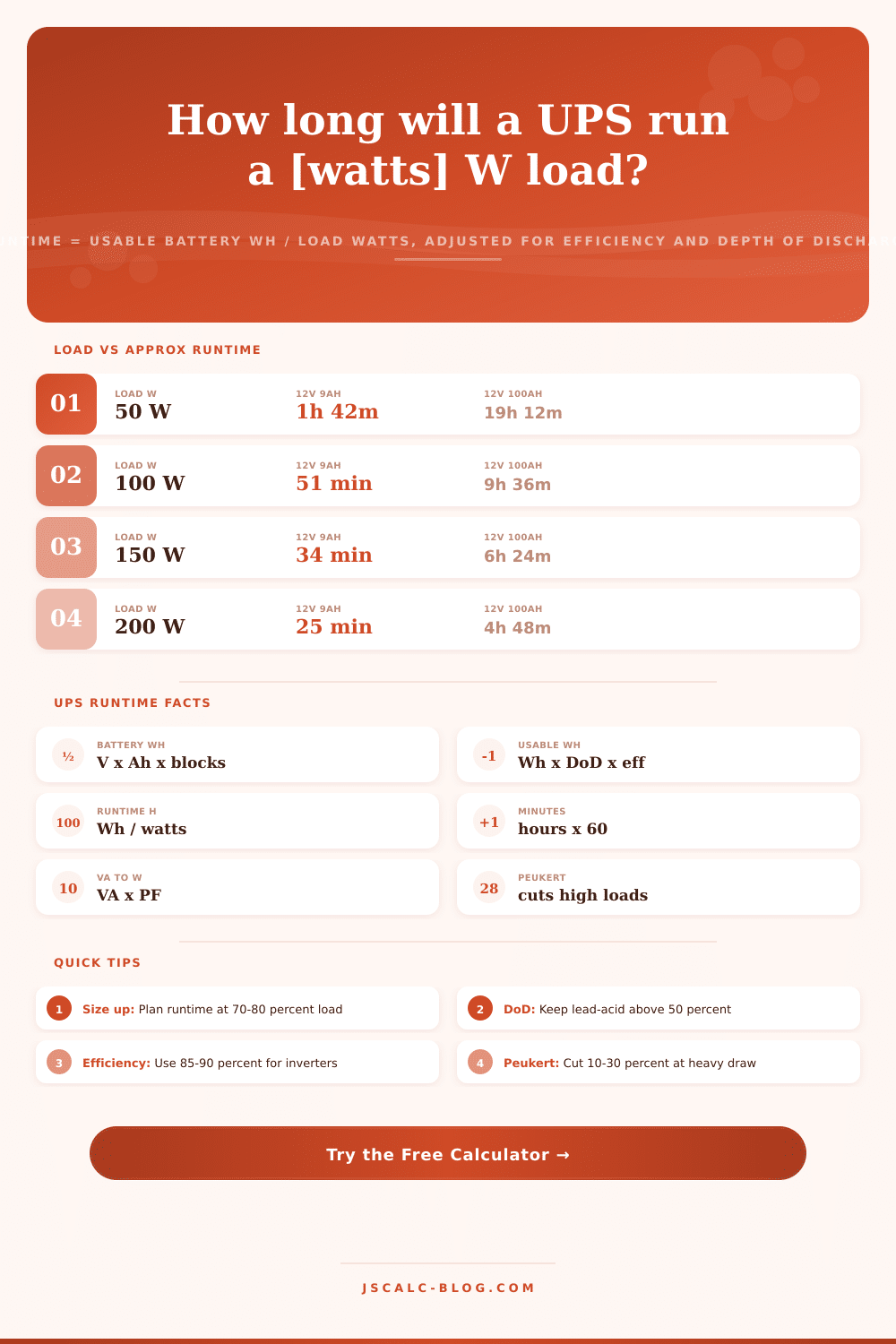
📊Load vs Runtime Comparison Grid
| Load (W) | 12V 7Ah | 12V 9Ah | 12V 18Ah | 2x 12V 9Ah | 12V 100Ah |
|---|---|---|---|---|---|
| 50 | 1h 20m | 1h 42m | 3h 25m | 3h 25m | 19h 12m |
| 100 | 40 min | 51 min | 1h 42m | 1h 42m | 9h 36m |
| 150 | 27 min | 34 min | 1h 08m | 1h 08m | 6h 24m |
| 200 | 20 min | 25 min | 51 min | 51 min | 4h 48m |
| 300 | 13 min | 17 min | 34 min | 34 min | 3h 12m |
| 500 | 8 min | 10 min | 20 min | 20 min | 1h 55m |
| 750 | 5 min | 6 min | 13 min | 13 min | 1h 16m |
| 1000 | 4 min | 5 min | 10 min | 10 min | 57 min |
| 1500 | 2 min | 3 min | 6 min | 6 min | 38 min |
Runtimes assume 12 V blocks, 80 percent depth of discharge and 90 percent inverter efficiency. The 2x 9Ah column is two blocks in parallel at the same 12 V. Real backup runs shorter at heavy loads due to the Peukert effect.
🔋Common UPS Battery Sizes
| Battery | Voltage | Capacity | Total Energy | Typical Use |
|---|---|---|---|---|
| Small SLA | 12 V | 7 Ah | 84 Wh | Desktop UPS, router |
| Standard SLA | 12 V | 9 Ah | 108 Wh | 650 to 1500 VA UPS |
| Extended SLA | 12 V | 18 Ah | 216 Wh | Long-runtime tower |
| Dual pack | 24 V | 9 Ah | 216 Wh | Line-interactive UPS |
| Deep cycle | 12 V | 100 Ah | 1200 Wh | External battery bank |
| LiFePO4 module | 12.8 V | 100 Ah | 1280 Wh | Lithium backup |
🔌Depth of Discharge Guide
| Battery Type | Safe DoD | Usable Fraction | Cycle Life Note |
|---|---|---|---|
| Flooded lead-acid | 50 percent | Half the Wh | Deeper drains shorten life |
| Sealed AGM | 50 to 60 percent | 0.50 to 0.60 | Good for standby UPS duty |
| Gel | 50 percent | Half the Wh | Tolerant of slow discharge |
| LiFePO4 lithium | 80 to 90 percent | 0.80 to 0.90 | Handles deep cycling well |
| Emergency once | up to 100 percent | Full Wh | Rare full drain only |
| Conservative | 30 percent | 0.30 | Maximizes battery lifespan |
💡Backup Sizing Tips
The primary question around backup power is “how long will it last?” That’s where a UPS runtime calculator comes in. If it gets me through a brief outage, that’s great; if I can use it to shut down cleanly for a longer one, even better. How does it know? It knows your real-world load, the capacity of your battery pack, and standard loss factors, then estimates how much time you have until lights out. You’ll get both the minutes and the hours-and-minutes version.
You’ll see the amount of usable energy in batteries as well as the total energy in them. That’ll help you get your head around why it looks like it does. Two numbers determine backup time: how much power your equipment uses (load) and how much energy your batteries can hold. Load is expressed as watts; energy is expressed as watt-hours. Divide load in watts into usable watt-hours and you have runtime in hours.
How to Calculate UPS Backup Time
The issue with both numbers are they are not straightforward. Batteries rated for 9 amp-hours at 12 volts don’t deliver their full 108 watt-hours. Devices rated for 500 watts may consumes fewer watts under normal usage. The calculator doesn’t bury the math but makes it clear.
First, convert to energy, which is typically rated in amp-hours at some voltage. To find total battery energy, multiply the amp-hour rating times battery voltage times number-of-blocks. A 12 volt, 9 amp-hour block contains 108 watt-hours. Two such blocks connected in parallel contain 216 watt-hours. A big external 12 volt, 100 amp-hour deep-cycle bank contains 1200 watt-hours. The number-of-blocks field allow you to model anything from a single internal battery to a large external bank. No need for you to do the multiplication by hand.
Two things reduce amount of power your gear gets. First is depth of discharge. You don’t want to pull all the power out of any kind of battery, especially not a sealed lead-acid battery (that’s bad). Lithium LiFePO4 can be drained to 80 or 90 percent, while lead-acid is usually considered to be about half (50 percent) before damage occurs. This is where many folks goes wrong.
Second, there is efficiency lost as DC electricity coming from your batteries converts into AC going into your devices. Inverters are good at 85 to 92 percent efficient. Watt-hours usable = total watt-hours x efficiency fraction x depth of discharge fraction
Also note: Many appliances/UPS units are rated in volt-amps (apparent power) instead of watts (real power that drains the battery). The relationship between the two is expressed as power factor. To calculate watts you multiply volt-amps x power factor. For example, a computer power supply may have a power factor of.6 or.7. If it’s drawing 800 VA, then it may be drawing approximately 480, 560 real watts. Enter this load into the tool in VA mode, include a power factor, and it will convert to watts for you before calculating how long that should of last.
It helps keep the emphasis where it belongs: How much backup time? Four cards appears on the display. First, the runtime card displays the estimated time as either minutes or hours (once the backup stretches past two hours). It also appears in hours and minutes. So “0.52” reads out as “0:31”. That’s how you’d quote it to someone. Second, the usable energy card display the amount of watt-hours that remain after considering both efficiency and depth of discharge. Third, the total energy card displays the full pack capacity for reference. And below those, there’s a breakdown panel showing each number substituted. This makes tool a check of your own math.
Keep in mind that any run-time estimate assumes the Peukert effect: lead-acid batteries don’t produce full capacity during rapid discharge. Heavy loads cause a battery to give up fewer amp-hours than a light load, which is why a long-lasting battery used lightly will tolerate a surge or cold temperature better then a well-charged one. Think of the estimated number as an upper bound; plan on actual runtime being between 10 and 30 percent lower with a high load. Leave yourself some room by sizing your UPS to operate your load at or slightly below 70 to 80 percent of its rating, while including all those effects.
Whether you’re running a small server rack, a desktop, or just a home router, the math is the same. Pick from one of the presets. Then tweak the battery voltages, amp-hours, blocks, efficiency, and depth of discharge for your equipment. The runtime is right there on the card. It’s a tool to replace guesswork with a number to base your planning on. This number includes a reasonable safety margin for Peukert effect and real-world input values. It’ll give you the minutes you need most if the power goes out.