Solar Battery Bank Size Calculator
Size an off-grid solar battery bank from your daily energy use, days of autonomy, depth of discharge and system voltage. The tool returns the usable Wh you must store, the nominal bank Wh once losses are included, the bank capacity in amp-hours at 12, 24 or 48 volts, and how many batteries you need in series and parallel.
🔋Real Off-Grid Presets
📝Battery Bank Inputs
Total loads powered from the bank in one day.
Applies to the daily consumption field.
Cloudy or no-sun days the bank must cover.
DC bus voltage that ties the bank together.
Sets a typical DoD; pick Custom to override.
How deep you drain the bank each cycle.
Round-trip and inverter losses on discharge.
Amp-hour rating of one battery you plan to buy.
Used to work out the series string length.
🔢Formula Snapshot
⚡Daily Load to Bank Size Examples
| Daily Load | Days | System V | Nominal Wh | Bank Ah |
|---|---|---|---|---|
| 0.6 kWh | 1 | 12 V | 741 Wh | 62 Ah |
| 1 kWh | 1 | 12 V | 1235 Wh | 103 Ah |
| 2 kWh | 2 | 24 V | 4938 Wh | 206 Ah |
| 3 kWh | 2 | 24 V | 7407 Wh | 309 Ah |
| 5 kWh | 2 | 48 V | 12346 Wh | 257 Ah |
| 8 kWh | 2 | 48 V | 19753 Wh | 412 Ah |
| 10 kWh | 2 | 48 V | 24691 Wh | 514 Ah |
| 5 kWh | 3 | 48 V | 18519 Wh | 386 Ah |
Assumes 90% depth of discharge and 90% system efficiency for lithium.
🔋Depth of Discharge by Chemistry
| Chemistry | Typical DoD | Cycle Life | Round-Trip | Notes |
|---|---|---|---|---|
| LiFePO4 lithium | 80-90% | 3000-6000 | 95-98% | Best usable, light |
| Li-ion NMC | 80% | 1500-3000 | 92-96% | Dense, needs BMS |
| AGM sealed lead | 50% | 500-1000 | 80-85% | Sealed, no vent |
| Gel lead-acid | 50% | 500-1200 | 80-85% | Deep cycle, slow |
| Flooded lead-acid | 50% | 800-1500 | 80-85% | Cheap, needs vent |
| Nickel-iron | 80% | 10000+ | 65-80% | Rugged, low eff |
🌞Autonomy Days by Climate
| Climate | Peak Sun Hours | Home Bank | Cabin Bank | Critical Loads |
|---|---|---|---|---|
| Sunny desert | 6.0-7.0 | 2 days | 1-2 days | 3 days |
| Sunny plains | 5.0-6.0 | 2 days | 2 days | 3 days |
| Temperate mixed | 4.0-5.0 | 2-3 days | 2 days | 3-4 days |
| Coastal marine | 3.5-4.5 | 3 days | 2-3 days | 4 days |
| Cloudy northern | 2.5-3.5 | 3-4 days | 3 days | 4-5 days |
| Winter high-latitude | 1.5-2.5 | 4-5 days | 3-4 days | 5-7 days |
🗃System Voltage vs Typical Use Comparison Grid
| System V | Typical Use | Bank Range | Wire Size | Current at 2kW | Best For |
|---|---|---|---|---|---|
| 12 V | RV, van, boat | Up to 1.5 kWh | Thick, costly | 167 A | Small loads |
| 24 V | Tiny home, shed | 1-5 kWh | Moderate | 83 A | Mid systems |
| 48 V | Off-grid home | 3-30 kWh | Thin, cheap | 42 A | Whole home |
| 48 V | Homestead | 10-40 kWh | Thin, cheap | 42 A | Heavy loads |
| 12 V | Backup lights | Under 1 kWh | Thick, costly | 167 A | Portable kits |
| 24 V | Cabin weekend | 2-6 kWh | Moderate | 83 A | Part-time use |
⚙Formula Breakdown
💡Off-Grid Sizing Tips
The single most important part of constructing an off grid solar system is sizing the battery bank. This is because during the day, solar panels generate electricity; but at night and during overcast days, they don’t. That’s where the battery bank comes into play: it holds the power generated by the panels and dispenses it for nighttime and cloudy-day usage. But if you go to big with your battery bank, then you’re wasting money on excess capacity which goes unused. Go too small with it and your power supply run dry each evening.
There are several ways to size a battery bank including using the solar battery bank size calculator found on JSCalc-Blog.com. This tool is backwards engineered based off how much power you actualy consume. It starts with your daily energy needs, your system voltage, your battery type, and how many days of cloudy weather you want your system to operate through. It then tells you exactly how many batteries (and therefore how many watts) you need. It also provides the nominal bank size, the amp-hour capacity, and the usable watt-hours.
How to Size Your Off-Grid Battery Bank
To start any sizing calculation, find the first number: how many kilowatt-hours (or watt-hours) does all of your equipment consume in an average day? Multiply watts times hours of operation for every device, or if you have an energy monitor, add up numbers on that. A small cabin that only has a few lights, a fan, and maybe a phone charger might sip 600 watt-hours in a typical day; a fully outfitted off-grid home with laptops, refrigeration, lighting, and a well pump typically draw between 8-10 kilowatt-hours per day. Either unit works on the calculator, the daily consumption is what everything else depends upon.
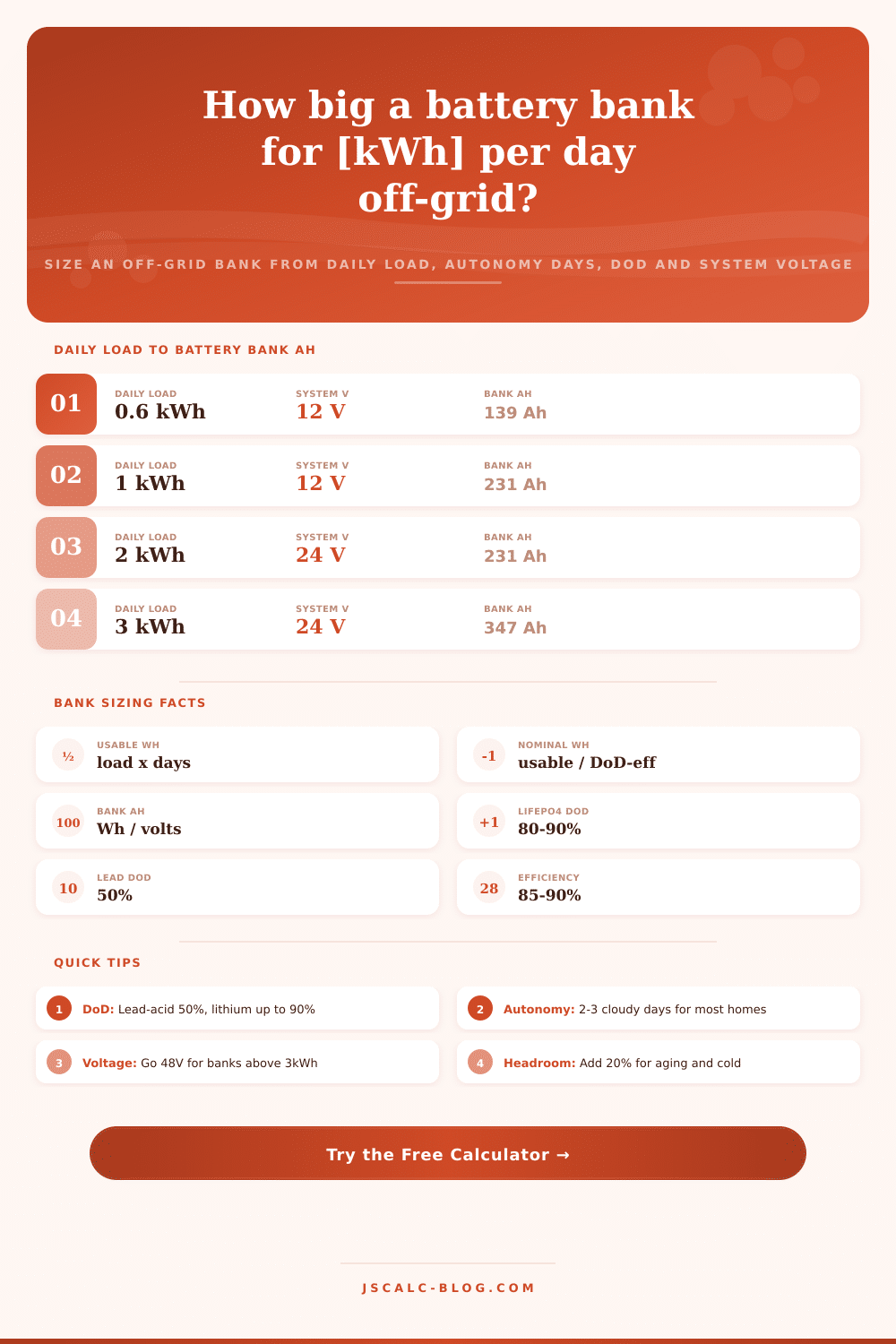
The number of days of autonomy is how many days your house will operate on stored battery power (solar inputs disabled) if it is heavily overcast. To calculate needed usable energy, just multiply your daily usage by the number of days you want to run off batteries. So if you have a house sized for 2 days of autonomy that uses 2 kilowatt-hours per day, it require 4 kilowatt-hours of usable storage. A 2-day reserve is typical for most sunny-climate set-ups and grid-tied backup systems. Homes in remote locations with cloudy northern climates often plan on 3 to 5 days of backup. Recommended autonomy ranges are shown in tables which allow you to match your bank to your climate conditions rather than guess.
Don’t let them drain completely each time. The fraction of capacity you use is called depth of discharge (DoD), which depends heavily on chemistry. For example, flooded lead-acid, gel, and AGM last longest if kept below roughly 50% DoD. That means your 200 amp-hour lead bank holds only 100 amp-hours of actual energy. By contrast, LiFePO4 lithium iron phosphate can handles 80-90% DoD. That’s why a 100 amp-hour lithium battery stores nearly as much usable energy as a 200 amp-hour lead-acid bank. The calculator then calculates the true nominal capacity needed for installation by dividing your required usable energy by the DoD.
There’s no perfect system: Batteries don’t charge and discharge perfectly; they lose some energy in the process. Wiring also loses energy (especially if poorly planned). Inverters lose energy converting DC to AC. Whole-system efficiency can be as low as around 85% using older lead-acids and maybe 90% or better with new inverters and lithium systems. The nominal bank formula accounts for efficiency as well as DoD fraction; divide usable energy by both fractions. If you want 4000 watts of usable, but your bank has 90% efficiency and only 90% DoD, you’ll actualy need roughly 4938 watt-hours of installed capacity. Not accounting for efficiency is one way that home-designed systems often fail in real life.
Since battery banks are nearly always defined in amp-hours at their nominal voltage, you then convert nominal watt-hours to amp-hours by dividing by your system voltage. At 12 volts, 4938 watt-hours becomes 411 amp-hours, while 24 volts gets 206 amp-hours and 48 volts gives 103 amp-hours of the same energy. For the same amount of energy, more voltage means less amp-hours. That translates to smaller fuses, lower-current-carrying cables, and therefore thinner, less-expensive cables. Most designers use 48 volts on a bus when the battery bank hold approximately 3 kilowatt-hours, while 12 volts is reserved for boats, vans, and RVs.
All of that turns into a shopping list for the final result. Batteries wire in parallel to build capacity and in series to build voltage. Each string (which will be your system voltage) includes batteries with the same voltage, while parallel connections involve batteries of the same voltage to build capacity. Thus a 48-volt bus built from 12-volt batteries requires four batteries per string. And how many are needed? That’s the bank amp-hours divided by the amp-hour rating of one battery…rounded UP since we shouldn’t of come up short. Take the number of parallel times the number of series and there’s your total number of modules.
The calculator gives you all three numbers so you can compare building a bank out of big 200 amp-hour lithium units against one built from smaller 100 amp-hour blocks. You could use 200 amp-hour lithiums in smaller blocks. They have presets that cover the systems folks most commonly make. A tiny home at 24 volt, 3 kilowatt-hours. A weekend cabin at 48 volt, 2 kilowatt-hours. An RV uses 12 volts and 600 watt-hours. Another preset is for a full off-grid home requiring 10 kilowatt-hours with 2 days of autonomy.
When you select any of those presets, it populates the form and recalculates instantly, providing a realistic starting place for you to adjust from there. For example: Compare a lithium homestead preset against a lead-acid AGM one. You’ll see how much the chemistry and depth of discharge drive the final battery count and cost.
Real batteries age, too (especially lead-acid). And winter will reduce the bank’s capacity due to colder weather… In some locations as much as 20 percent around freezing! So plan for roughly 20-percent more than the estimated capacity of the bank to account for aging, temperature, and those inevitable extra loads you’ll add over time.
Note that this tool also does not calculate the size of the solar array itself. You’ll still need an appropriate number of panels and a well-matched charge controller in order to fill the bank during sunny days. Combined with an estimate of your panel wattage, this solar battery bank size calculator provides a solid foundation for keeping the lights on through the night and the coldest parts of winter.