Battery Self-Discharge Calculator
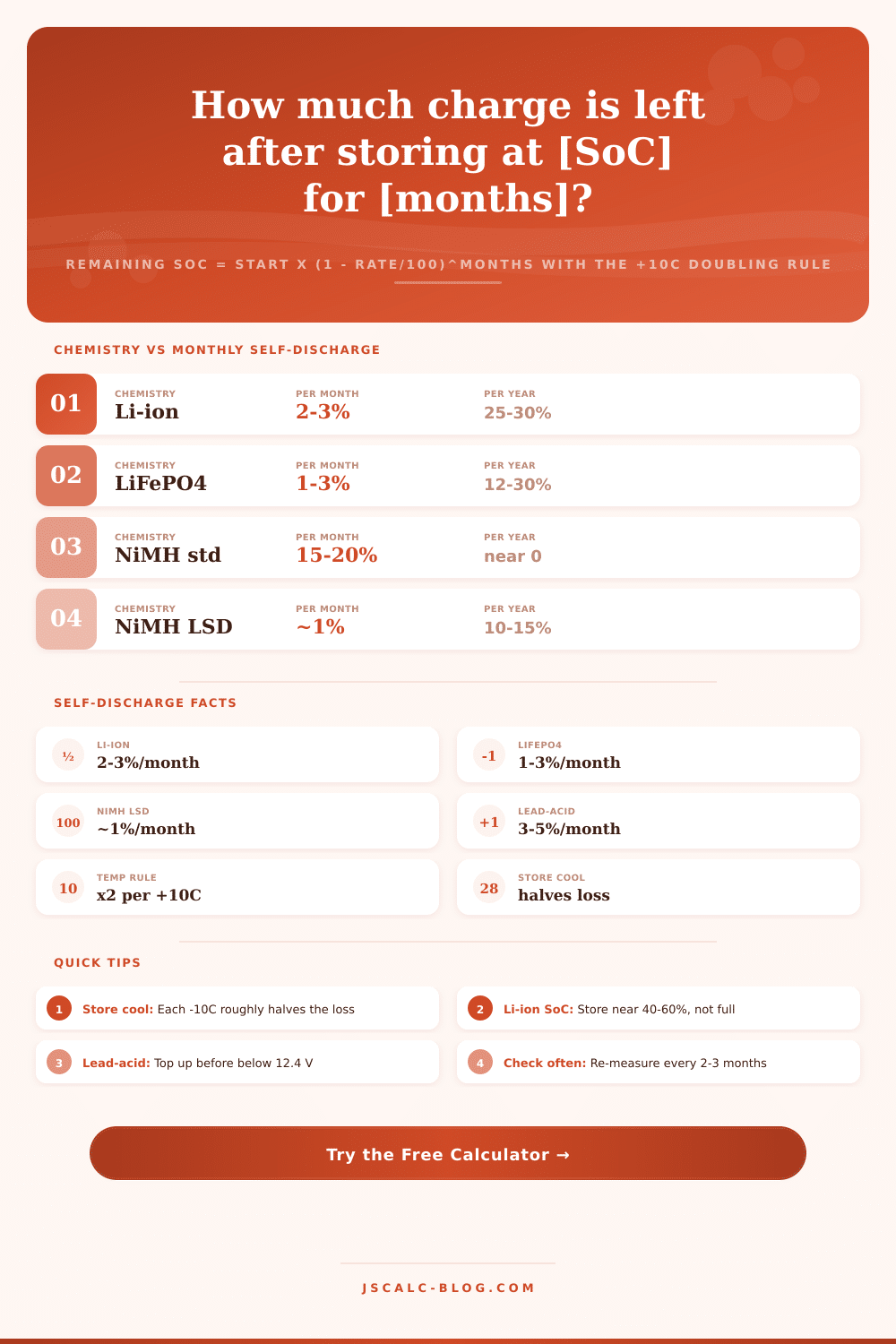
Estimate how much charge a battery loses just sitting in storage. Enter starting state of charge, chemistry, storage time and temperature, and capacity to see remaining SoC from exponential decay, the lost amp-hours, the effective monthly rate after the plus 10 C doubling rule, and how long until the pack falls to a low threshold.
🎯Real Storage Scenario Presets
🔊Storage Inputs
Charge level when you put the battery into storage.
Sets the base monthly self-discharge rate at 25 C.
Auto-filled from chemistry; edit to match a datasheet.
How long the battery sits before you use it.
Applies to the duration value above.
Average storage temperature; warmer speeds loss.
Reference is 25 C; rate doubles per plus 10 C.
Rated amp-hours, used to show lost capacity.
Level you want to stay above; used for time-to-reach.
🔢Formula Snapshot
🔋Chemistry vs Typical Self-Discharge
| Chemistry | Per Month at 25 C | Per Year Estimate | Storage SoC Advice | Typical Use |
|---|---|---|---|---|
| Li-ion (NMC/LCO) | 2 to 3% | 25 to 30% | 40 to 60% | Phones, laptops |
| LiFePO4 | 1 to 3% | 12 to 30% | 50 to 60% | Solar, RV, marine |
| Li-Po (RC pouch) | 2 to 3% | 25 to 30% | 3.8 V per cell | Drones, RC |
| Standard NiMH | 15 to 20% | near 0% | Charge before use | Older AA/AAA |
| Low self-discharge NiMH | about 1% | 10 to 15% | Ready to use | Eneloop AA/AAA |
| Lead-acid (flooded/AGM) | 3 to 5% | 35 to 50% | Keep above 12.4 V | Cars, UPS, boats |
| NiCd | 10 to 15% | near 0% | Charge before use | Legacy tools |
| Alkaline primary | about 0.025% | about 0.3% | Store as bought | Remotes, clocks |
🌡Temperature Doubling Effect
| Storage Temp | Delta From 25 C | Rate Multiplier | Effect on Loss |
|---|---|---|---|
| 5 C (fridge) | -20 C | 0.25x | Quarter the loss |
| 15 C (cool room) | -10 C | 0.50x | Half the loss |
| 25 C (reference) | 0 C | 1.00x | Baseline rate |
| 35 C (warm room) | +10 C | 2.00x | Double the loss |
| 45 C (hot garage) | +20 C | 4.00x | Four times loss |
| 55 C (car in sun) | +30 C | 8.00x | Eight times loss |
📊Li-ion SoC Left After Storage
| Start SoC | Rate/Month | After 3 Mo | After 6 Mo | After 12 Mo |
|---|---|---|---|---|
| 100% | 2% | 94.1% | 88.6% | 78.5% |
| 100% | 3% | 91.3% | 83.3% | 69.4% |
| 100% | 5% | 85.7% | 73.5% | 54.0% |
| 50% | 2% | 47.1% | 44.3% | 39.2% |
| 50% | 5% | 42.9% | 36.8% | 27.0% |
| 100% | 15% | 61.4% | 37.7% | 14.2% |
| 100% | 20% | 51.2% | 26.2% | 6.9% |
📏Duration Unit Conversions
| Input | In Months | In Days | Note |
|---|---|---|---|
| 1 day | 0.0329 mo | 1 day | Month is 30.44 days |
| 30 days | 0.986 mo | 30 days | Roughly one month |
| 1 month | 1 mo | 30.44 days | Average month |
| 6 months | 6 mo | 182.6 days | Half a year |
| 1 year | 12 mo | 365.25 days | Full year |
| 2 years | 24 mo | 730.5 days | Long-term store |
⚙Formula Breakdown
💡Smart Storage Tips
Sometimes a battery won’t start your device and you might feel frustrated, but remember: it wasn’t “bad luck,” it was because the battery self-discharged. That is, any battery lose its charge over time. It turns its stored energy into heat. And the calculator takes this into account. You can enter how long a battery has been sitting around and it will tell you how much charge remains, so you don’t end up surprised when you go to use a device that’s dead.
When there is no load, the chemistry of cells keeps reacting. These side reactions in electrolyte move electrons from one electrode to another. It’s called calendar aging, and this leads to self-discharge. Each month that you don’t use it, the amount is compounded because it isn’t based off the full initial charge (instead), it’s applied to what’s left. That’s why the model uses an exponential decay, not a straight line. As it nears empty, the curve taper off, but the reaction never completely ceases.
How to Store Your Batteries Correctly
That’s a huge difference, so what causes it? The biggest variable you have any direct control over is temperature. Self-discharge increase by about a factor of two per ten degrees Celsius rise in temperature (because of how reactions work). And the tool takes that into account, varying the base rate according to the conditions. A lithium-ion pack sitting in a hot, forty-five degree Celsius garage loses charge four times more fast than one in a cool basement. So lots of batteries dies prematurely after being left in someone’s car all summer long.
You can’t eliminate this by picking low-drain battery brands. Cooling down the environment will cut loss in half with each decrease of ten degrees. When you choose your chemistry, the calculator will take into account each battery’s baseline rate (different chemistries has different ones). At room temp, moddern lithium-ion and LiFePO4 drop by roughly two to three percent per month. Lead-acid drops three to five percent per month, which is why we see so many parked cars needing a jump start. Standard NiMH cells can drops fifteen to twenty percent per month. Lower self-discharge varieties such as Eneloops drop more like one percent. Alkalines are primaries that lose only fractions of a percent per year and can therefore last for years after being purchased.
To get started, there is four metrics on the results panel that will help guide your storage strategy. The remaining state of charge is expressed as a percent for the period you entered. Capacity lost converts it to an amp-hour value so you can see what absolute amount of energy has been lost. Effective monthly rate shows how fast the pack is decaying at current temperatures (which may be slower or faster than data sheet rates). The time-to-threshold calculation tells you how many months until your pack fall below a safe level. It also shows when to top-up before you risk doing permanent damage by going too deep.
Lithium cells can be stored in the forty to sixty percent range (partially charged) with no harm and better longevity compared to fully charged or flat batteries. Store packs away from extremes: don’t let batteries go below the lower end of their “safe” range, such as fifty percent; also, don’t put them in too hot a spot where they might prematurly age on the calendar. For the best life, keep your lithium cells in a cool, dry location around fifteen degrees Celsius. If stored in warmer conditions, periodically test batteries each month or so.
The best way to do this would of being store them at a partial charge of forty to sixty percent rather than full. This will ensure that if called upon, they’ll have enough battery to power up.