Battery Efficiency Loss Calculator
Measure how much energy a battery wastes over one charge and discharge cycle. Enter the watt-hours you put in and pull back out to get round-trip efficiency, or switch to current mode to estimate I2R resistive heating. Every result shows energy lost in Wh, heat generated, and the usable energy left after losses.
⚡Choose a Mode
🔌Real Battery Efficiency Presets
🔊Cycle Inputs
Watt-hours delivered into the battery while charging.
Watt-hours recovered from the battery on discharge.
Charge returned per charge stored, typically 98-99.9%.
Discharge voltage divided by charge voltage average.
Average current flowing during the charge or discharge.
Pack DC internal resistance in milliohms.
Nominal pack voltage, used to size energy throughput.
Duration the current flows, in hours, for heat energy.
Controls rounding on every result card.
🔢Formula Snapshot
📈Efficiency to Energy Lost per 1000 Wh
| Round-Trip Efficiency | Energy In | Energy Out | Energy Lost |
|---|---|---|---|
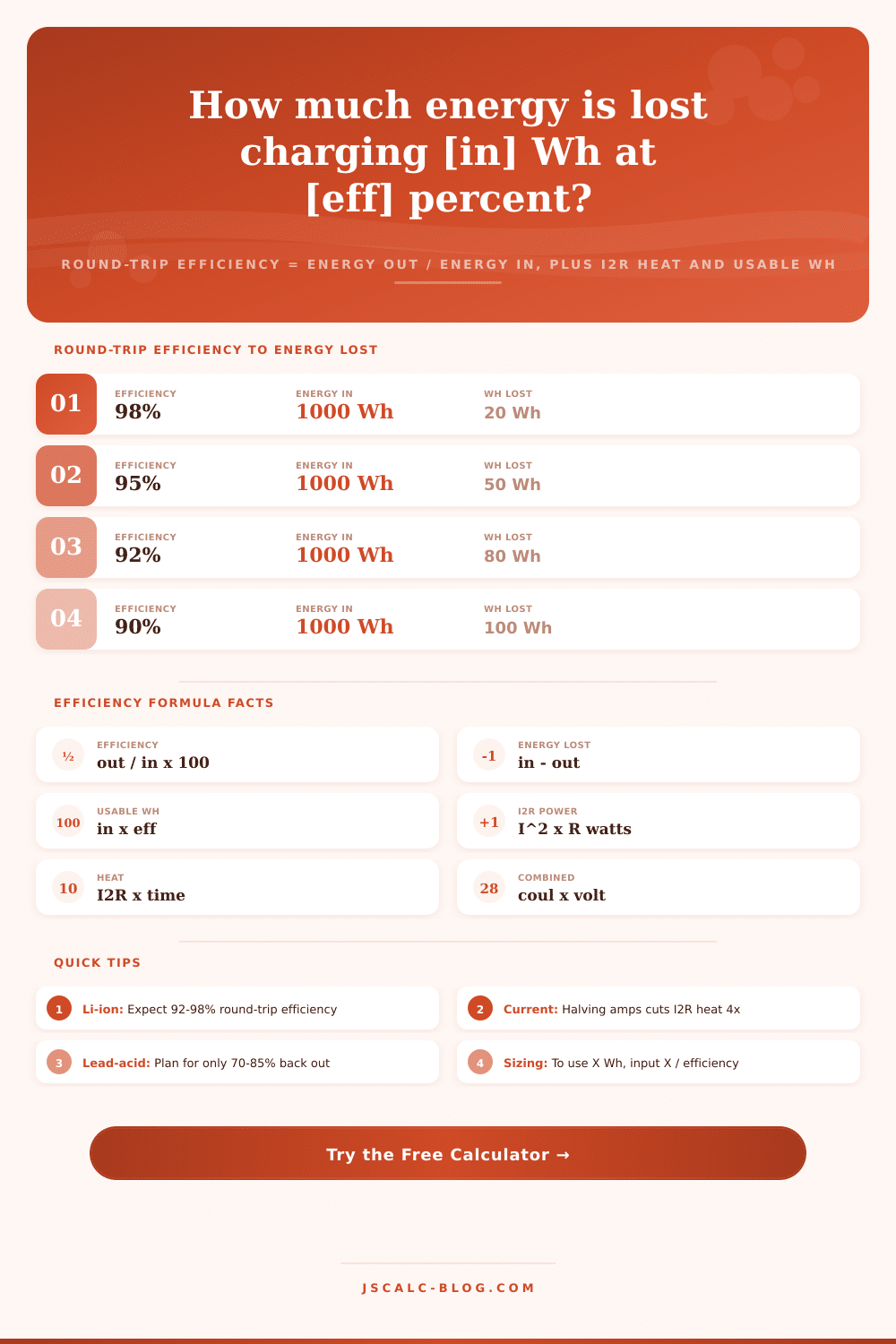
| 98% | 1000 Wh | 980 Wh | 20 Wh |
| 95% | 1000 Wh | 950 Wh | 50 Wh |
| 92% | 1000 Wh | 920 Wh | 80 Wh |
| 90% | 1000 Wh | 900 Wh | 100 Wh |
| 85% | 1000 Wh | 850 Wh | 150 Wh |
| 80% | 1000 Wh | 800 Wh | 200 Wh |
| 75% | 1000 Wh | 750 Wh | 250 Wh |
| 70% | 1000 Wh | 700 Wh | 300 Wh |
🔋Battery Chemistry Round-Trip Comparison
| Chemistry | Round-Trip Eff | Coulombic Eff | Self-Discharge / Mo | Typical Cycles |
|---|---|---|---|---|
| Li-ion NMC | 92-98% | 99+% | 2-3% | 1000-2000 |
| LiFePO4 | 92-96% | 99+% | 2-3% | 2000-5000 |
| Lead-Acid AGM | 80-85% | 90-95% | 3-5% | 300-600 |
| Lead-Acid Flooded | 70-80% | 85-90% | 5-15% | 500-1200 |
| NiMH | 65-80% | 90-95% | 15-30% | 500-1000 |
| NiCd | 70-75% | 80-90% | 10-20% | 1000-2000 |
| Flow (Vanadium) | 65-75% | 95-98% | Very low | 10000+ |
| Sodium-Ion | 85-92% | 98+% | 3-5% | 1000-4000 |
🔥I2R Heat Loss by Current and Resistance
| Current | Resistance | Power Loss | Heat in 1 h | Note |
|---|---|---|---|---|
| 10 A | 25 mOhm | 2.5 W | 2.5 Wh | Light load |
| 25 A | 25 mOhm | 15.6 W | 15.6 Wh | Moderate |
| 50 A | 25 mOhm | 62.5 W | 62.5 Wh | Fast charge |
| 100 A | 25 mOhm | 250 W | 250 Wh | High-current |
| 50 A | 10 mOhm | 25 W | 25 Wh | Low R pack |
| 50 A | 50 mOhm | 125 W | 125 Wh | Aged pack |
| 200 A | 5 mOhm | 200 W | 200 Wh | EV traction |
📊Usable Energy After Losses
| Nominal Pack | Efficiency | Usable Out | Wh Lost | Input to Deliver 5 kWh |
|---|---|---|---|---|
| 5 kWh | 95% | 4.75 kWh | 250 Wh | 5.26 kWh |
| 5 kWh | 90% | 4.50 kWh | 500 Wh | 5.56 kWh |
| 5 kWh | 85% | 4.25 kWh | 750 Wh | 5.88 kWh |
| 5 kWh | 80% | 4.00 kWh | 1000 Wh | 6.25 kWh |
| 5 kWh | 75% | 3.75 kWh | 1250 Wh | 6.67 kWh |
| 5 kWh | 70% | 3.50 kWh | 1500 Wh | 7.14 kWh |
⚙Formula Breakdown
💡Battery Efficiency Tips
All batteries are inefficient. Charging up any kind of storage system result in inefficiencies. These include losses due to voltage, heat, and chemical resistance. These unseen losses translate to watts lost, which is why the calculator provide an explicit figure on how much watt-hours get lost per charge.
Some batteries are better than others, but having a sense of your actual loss will help you know what size to make an electric vehicle pack or solar bank based off facts rather then the best case scenario promised by marketing departments.
How Batteries Waste Energy
For all types of storage systems, the single most helpful number to consider is round-trip efficiency. That’s the ratio of energy returned when discharging against the amount of energy used when recharging. So if you can store a thousand watt-hours and return nine hundred fifty then you’ve got an efficiency rate of ninety-five percent. You didn’t lose those other fifty watt-hours, they turned into heat. And this is important: it accounts for the entire cycle (charge and discharge) rather than just part of it.
Yes, you might have a battery that stores charge perfectly well but then delivers less voltage upon retrieval. Still, you’ve lost energy in the process. But that waste shows up in the form of thermal energy within cells and interconnects. That’s where tracking the heat comes into play, because it isn’t just a matter of efficiency; it’s a question of longevity and safety: Why do your packs gets hot when they’re being charged quickly? High temperatures speed up aging.
The tool calculates this waste by subtracting output from input, giving you a tangible measure of how many watt-hours you’re paying for but never using. There is even a current mode. In this mode, you can use first principles to calculate how much power is lost to resistive heating. You do this by knowing the internal resistance and charge current to compute the instant power loss.
There’s only one law about resistive heating, and it’s easy: Power lost = (Current Squared) x (Resistance). The kicker is the current squared part. When you double your current, you quadruple your losses. With a twenty-five milliohms and a fifty-amp charge, you’re losing sixty-two point five watts of heat. Two hours later, you’ve lost one-hundred-twenty-five watt-hours, wasted energy from an aggressive charge.
Use this handy dandy calculator to do the math for you: It illustrates clearly how aggressive charge rate immediately sacrifices thermal stress and usable energy. Round trip efficiency is typically divided by engineers into voltage and coulombic efficiencies. Coulombic efficiency represent how many charge carriers are returned. It’s pretty high on a Lithium cell. It is typically over ninety-nine percent.
Voltage efficiency represent the difference between a higher voltage when you charge them and a lower one when they are discharged. That is typically the greatest source of lost energy. Their product is the overall efficiency. With ninety-nine point five percent coulombic and ninety-six percent voltage efficiency, the round-trip efficiency is roughly ninety-five point five percent. Knowing where your losses lie can help find if it’s a matter of chemical potential or internal resistance.
And various chemistries falls into quite distinct bands. For example, lithium-ion reigns supreme these days at like 92-98 percent capacity. That’s why we use that today for most of our batteries. Lead acid comes back at 70-85 percent and loses a significant percentage of each charge. Nickel metal hydride has high self-dischage, hovering around 65-80 percent. Part of picking a chemistry depend on how much energy you want to give away as heat daily.
The chart on the page puts all that in perspective so you can compare apples to apples between the technologies. The energy stored is product of input and efficiency, so you work backwards from the load when you plan a system. You can never get back more than input times efficiency. Oversizing your input lets you charge enough to deliver your target. If the bank is eighty five percent efficient you need to charge around one point one eight kilowatt-hours for each kilowatt-hour you want to deliver.
Off-grid systems that come up short on cloudier evenings are forgetting this overhead. The calculator shows the usable energy directly, and tells you how much extra input you’ll need to reach your target without running out of power.
A little bit wasted adds up to a lot over the lifetime of a battery. If it runs down to 90% charge during the day rather than 95%, then your storage system wastes an additional five percent of capacity each day. This means you lose hundreds of kilowatt-hours of electricity annually that you’ve paid for but not used. Understanding how much you waste allows you to properly size your cooling, inverter and panels. It also gives you realistic expectations about how long you’ll be backed-up or how far you can drive on a single charge.
Being able to quantify efficiency loss as watt-hours is what makes the difference between a system that hits its marks and one that quietly fails them. You should of checked this earlier.